Popular Posts

Saturday, February 25, 2012

Cars I Love 1: Mercedes-Benz 300SL Roadster

Hi folks -- last night at a party someone asked me what would be the one car I would have above any other?" The expectation was that I would reply with something like "Duesenberg." But the German in me came through, or perhaps the influence of my cousin Freddy, who when I was quite young and he was much older -- 17 years older to be precise -- stated the M-B 300 SL. I am pretty sure that Freddy was thinking of the Gullwing model, but since i ma a top-down kind of guy, I have always preferred the roadster. So if my wife Kaye ever dies, it is sell the house, liquidate some assets, and buy one of these come hell or high water!

New York Mercedes distributor Max Hoffman, Daimler-Benz's official importer in the USA, suggested to DBAG management in Stuttgart that a street version of the 300SL would be a commercial success, especially in America.

The racing W194 300SL was built around a tubular chassis to offset its relatively underpowered carbureted engine. Designed by DBAG's chief developing engineer, Rudolf Uhlenhaut the metal skeleton saved weight while still providing a high level of strength. Its unique architecture gave birth to the model's distinctive gull wing doors, as part of the chassis passed through what would be the lower half of a standard door. Even with the upward opening doors, the 300SL had an unusually high sill, making entry and exit from the car's cockpit problematic. A steering wheel with a tilt-away column was added to improve driver access.

The 300SL's body was mainly steel, except for the aluminum hood, doors and trunk lid. It could also be ordered with an all-aluminium outer skin at tremendous added cost, saving 80 kg (176 lb).

More than 80% of the vehicle's total production of approximately 1400 units were sold in the US, making the Gull wing the first Mercedes-Benz which sold in bulk outside its home market and confirming the validity of Hoffman's suggestion. The 300SL is credited for changing the company's image in America from a manufacturer of solid, but staid, automobiles to that of a producer of sporty cars.

1955 Mercedes-Benz 300SL Gullwing Coupé from the Ralph Lauren collection
1957 Mercedes-Benz 300SL Roadster
1956 300 SL
1956 "Gull wing" open

The 300SL's engine, canted at a fifty-degree angle to the left to allow for a lower hoodline, was the same 3.0 liter straight 6 as the regular four-door 300. Fitted with a Bosch mechanical Gasoline direct injection system it had almost double the power of the original 86 kW (115 hp) carbureted version.

While not the first fuel-injected car - Mercedes engineers who had developed the principle for the DB 601 fighter aircraft engine had used fuel injection in the tiny 2-stroke Gutbrod they had designed after the War - it was the first to inject fuel directly into the cylinders. This innovation allowed a top speed of up to 260 km/h (161 mph) depending on gear ratio and drag, making the 300SL the fastest production car of its time.

The engine's maintenance requirements were high. Unlike the current electrically powered fuel injection systems, the mechanical fuel pump would continue to inject gasoline into the engine during the interval between shutting off the ignition and the engine's coming to a stop; this gasoline was of course not burned, and washed the oil from the cylinder walls and ended up diluting the engine's lubricating oil, particularly if the engine was not driven hard enough nor long enough to reach a temperature high enough to evaporate it out of the oil.

Exacerbating the problem were the large oil cooler as well as the large volume of oil (10 liters), both oriented more to racing than to street driving, which virtually guaranteed that the oil would not reach a high enough temperature. In practice, many street drivers would block off airflow through the oil cooler, and the recommended oil change interval was 1,000 miles (1,600 km). Operation of the clutch was initially very heavy, later roadsters having an improved clutch arm helper spring which reduced the pedal force. From March 1963 to the end of production, a light alloy crankcase was used on a total of 209 vehicles.[2]

Aerodynamics played an important role in the car's speed, Mercedes-Benz engineers even placing horizontal "eyebrows" over the wheel openings to reduce drag. Unlike many cars of the 1950s, the steering was relatively precise and the four-wheel independent suspension allowed for a reasonably comfortable ride and markedly better overall handling. However, the rear swing axle, jointed only at the differential, not at the wheels themselves, could be treacherous at high speeds or on imperfect roads due to extreme changes in camber. The enormous fuel tank capacity caused a considerable difference in handling depending on the quantity of fuel on board.



Tuesday, February 14, 2012

At the Drive-In: An Incredible Story Reflecting Rural Americana during the 1950s and 1960s


The following in bold is taken from chapter 8 of my book The Automobile and American Life and provides a context for a far more focused story that follows.


A Night at the Drive-In
For every film classic like “Rebel Without a Cause,” there were ten shot on low budget, largely now forgotten by all except film buffs and those who watch Turner Classic Movies while killing time at the nursing home. Yet, a number of these films have become cult favorites and several, like Thunder Road, or The Blob, starring an up-and-coming Steve McQueen, gained new significance in more recent times. Many of these marginal films became the staple for the drive-in of the 1950s and 1960s, a time when youths were anxious to remove themselves from parental control and search for self-identity. Drive-ins have become an endangered institution, the consequence of changing mores, suburbanization, and a migration to the exurbs. In 1958, there were more than 4,000 drive-ins in America, but by the early 1990s, the number had fallen to about 870. They were a place to meet friends, find entertainment, passion, if one was lucky, and cheap, but often bad food. But on a hot summer’s night, what better a place to spend some time and money. And what if it rained?
The longest running drive-in can be found in Orefield, Pennsylvania, north of Allentown. Shankweiler’s Drive-In was the second drive-in established in America.
[1] It opened during the summer of 1933, after its founder stopped at Richard M. Hollingshead’s theater in Camden, New Jersey on his way back from the Jersey Shore. Hollingshead had opened his operation on June 6, 1933 to 600 people who paid 25 cents per person to see the film Wife Beware. Back in Orefield, Shankweiler hung up a giant sheet between two poles, set up a giant speaker, and was in business.
Soon others would follow, but Hollingshead, who had patented his drive-in idea, would be mired in court for years over infringement suits. Technical innovations, including RCA speakers that would be hung on car windows and in-car heaters for use during the winter months, were incorporated after World War II. American life was never the same with the viewing of such films as The Hideous Sun Demon, I Married a Monster from Outer Space, Cat Women on the Moon, and The Texas Chain Saw Massacre.
[1] Stephen Bayley, Sex, Drink and Fast Cars (New York: Pantheon, 1986): 52-7.


The following is a Contribution from Ed Garten -- Thank you, Ed!


John, might be blog material if you add some cultural insight to it, but I think you've seen this photo of my Grandfather Garten's drive-in theatre -- the only drive-in in the country and for miles around. Carlos built the theatre around 1952 and it operated until around 1964 when it started to sort of go downhill and when the "beach party" B movies were shown as well as some of the "slasher-type" horror flicks. This photo appears to be circa 1954 given the cars and trucks pictured.

A important element of this theatre, located in a rural area of Summers County, West Virginia, was the way in which it served as a social gathering spot. In this photo note that there is a country-western band playing on top of the concession stand. Typically on an early summer evening, grandfather would invite in local or regional bands who would play until dusk and just before the movies started to play. Note that the cars in front of the band are turned facing the band and not turned toward the screen -- they were listening to the music and then, later, would turn their cars around to watch the movies. Note also the young girls dressed in typically 50s dresses likely congregating to catch up on local high school gossip. Also note that there are several old pick-up trucks with young guys standing in the beds -- often times a local farmer would come to the movies with his family and then also bring a few local farm boys with him.

Below, my cousin, R. D. Williams and grandfather Garten's other grandson, provides some memories of the drive-in. As I recall, although still a child, folks would often mill around prior to darkness and the beginning of the movies and talk "cars" -- comparing their cars with others' cars. Car talk, girl talk, local gossip -- the stuff that made a small Appalachian community what it was. We sometimes forget how the "drive-in theatre" was such a bonding experience for those who lived and grew up in remote and often provincial environments.

Here's cousin R. D.'s memories of the Garten Drive-in Theatre:

Your dad, Johnny ran the original concession stand behind the big screen out front before the concession stand was built. He would take home the left over popcorn each night to feed to the hogs. He made the best hamburgers ( I always had them with just mustard and onions), and mom ran the ticket booth. We always had to check the trunks of cars and watch for "sneak ins" ( walk ins from the road). I went around from car to car selling popcorn and other stuff. Your Uncle Maghee's house was close enough that he actually had a speaker run to his living room with a big picture window in the front, so you could watch the movies from his house. There were swings and see saws in front of the screen for the kids, and every fourth of July they would have a belly bucking contest and a greasy pole to climb with a $20 bill attached to the top, along with sack races and other games. They also had a lot of short shorts along with cartoons and previews before the movie, including negro spirituals, with black angels singing and walking on clouds. On warm summer nights, people would actually lay on the hood of their car and lean against the windshield to watch the movie. I saw the African Queen with Humphrey Bogart and Katherine Hepburn 11 times. Sergant York with Gary Cooper and Audie Murphy 8 times. It was a magical place and a special time....The only Drive -in ever in the county. C.B. Garten was a true entrepreneur ahead of his time. Looks like this was circa 1954 or 53. I remember watching some movies from horseback since the barn and camp were adjacent to the drive-in. Ah, those halcion days!!


Thursday, February 9, 2012

UD student auto-biography -- Katelyn Diehl: Speed, a Red Truck, and a 1965 Shelby Cobra


Katelyn Diehl
January 25, 2012
HST 344 – Dr. Heitmann
“Auto”-Biography
Speed is a word that very easily defines my life. My parents told me that I was walking by time I was 8 months old, and talking full sentences by 10 months. My father had me in a “souped-up” Fisher-Price Power Wheels Jeep by the time I was a year old. He had replaced the batter with a 12-Volt car battery so that I had more juice, and he put screws in the tires since they were plastic and had no traction. My “life-size” plastic doll, Megan, and I would ride around the front yard for hours. I loved that jeep! I even allowed my cousin, Don (who is four months older than me); take it for spin around the yard. A few seconds after he slammed my precious jeep into a tree – I looked at him and asked “what’s the matter with you?” I only know this part of the story because my Aunt retells it all the time because that’s how they knew Don needed classes at such a young age – glad I could help out!
As I continued to grow, I became too tall for the jeep and could no longer fit inside. By the age of four my dad had built me a better set of wheels. I had my very own go-cart. It was black and had foam rails that were wrapped with black electrical tape. I would ride over the drive way and the cart would stop suddenly because I was so short that my behind came off the seat and therefore my foot off the gas. My father then installed a 5-point harness that strapped me in tight. I would ride around the back yard until my arms hurt from the non-power steering.
At age sever came the quad-runner, age nine the mini-bike, and age ten came the Yamaha Warrior ATV. When I was eight years old I really started helping dad out in the garage. He decided he wanted to build a four-seat sand rail. He even let me pick the color of the powder coat for the frame. My favorite color was purple at the time, and sure enough, dad came home from Michigan with a very purple frame. He knew it would stick out since not many buggies were a “girlie” color. I helped him as much as I could by putting nuts on bolts and holding tools for him as he worked. I was also small enough to climb under the buggy while it was sitting on the ground so I always volunteered to hold stuff from under the frame. After it was complete my family spent many nights riding around town. Every summer we vacationed at the Silver Lake Sand Dunes up in Michigan and camped at the state park. I was always egging dad on from the back seat telling him to go faster over the dunes, although my mother and younger brother were always nervous. I enjoyed listening to my dad talk to questioning people walking by the campsite about the work and effort he put into the buggy. I will always miss those buggy rides.
As my automotive historical timeline continues, around the age of twelve my dad was thinking about selling “The Red Truck”. It’s a ’79 Step side Chevy that he bought new and installed a winch on the front and used it to haul many things. When I was young, Dad would take me for rides through town and I would yell “faster daddy, faster!” So, I begged him not to sell the truck, and he didn’t. Instead, he decided that he wanted to re-build it. In 2003 the project began, and I was in the barn with him helping him with the engine compartment. He had major back surgery a few months prior, and was not supposed to be lifting things. So, I was his “right-hand man”. Together we put in a 496 big block blower, bench seats, a wood-panel bed, all chrome parts underneath, and new head lights. We took the motor to a shop in Richmond to put it on a “dyno” (dynamometer). Its peak was 786 horsepower – “YEEEEEE-HAAAAWWWWW!” This project is what started me into the engineering track for college. We only take the truck to shows when it’s completely sunny and no chance of rain. My parent’s care for their vehicles has instilled a better appreciation in my actions.
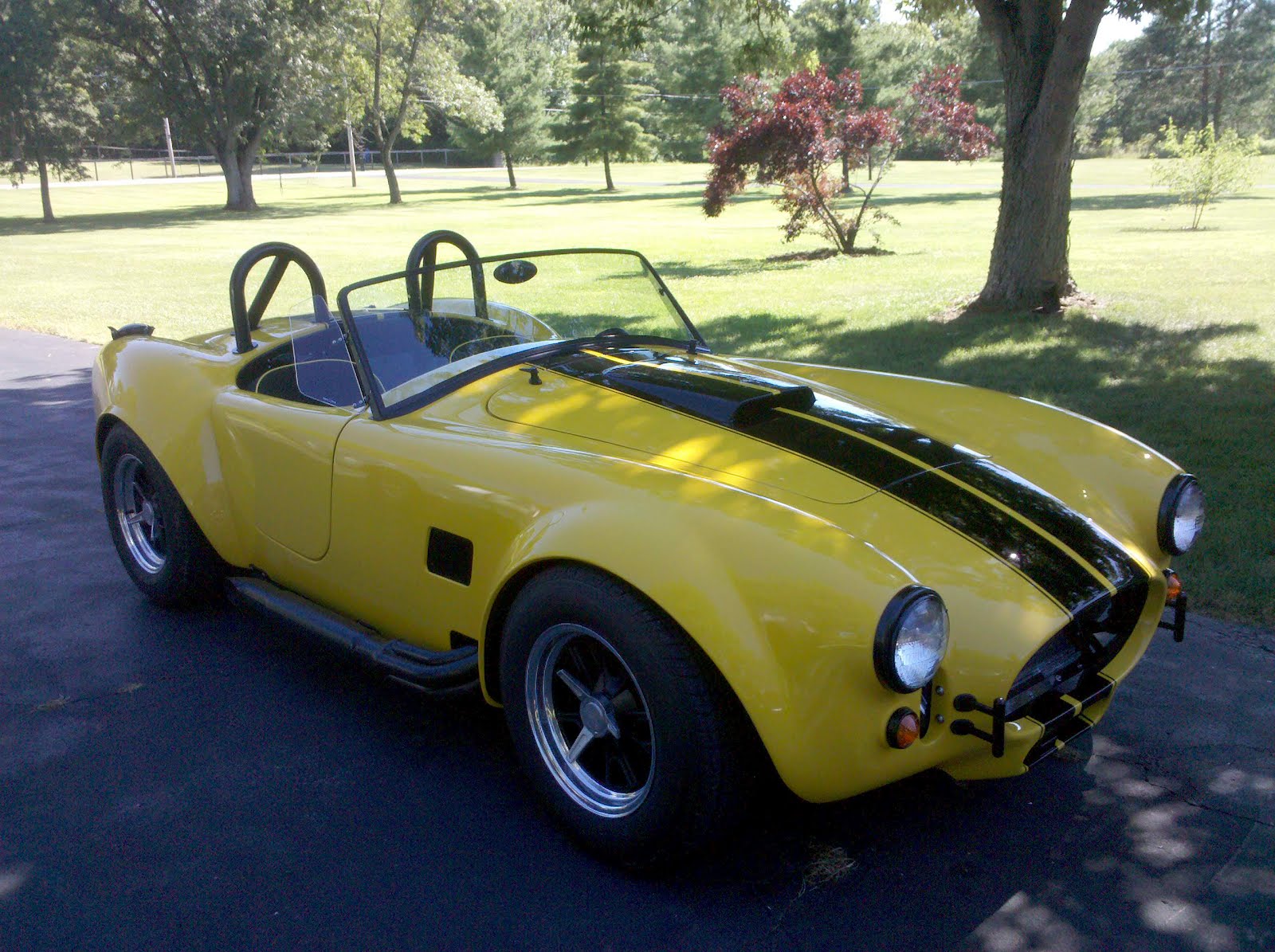
After my father’s first major back surgery, he was forced to medically retire – hence the truck project. Well, after making every part on that truck chrome and getting the truck exactly the way he wanted it to look and run, he decided he needed something else. On September 9, 2008 the Factory 5 Racing kit for a ’65 Shelby Cobra arrived in the mail. Dad had always loved these cars, so he decided he was going to build one for himself. He worked long hours in the barn, and only came in when he had to. He installed seat warmers per my mother’s request, a back-up camera, a RADAR detector/jammer, a surround sound radio with DVD player and subwoofer. He finally took it out on the road for the first time on July 4, 2010. It was a very memorable moment that I was happy I got to witness. Unfortunately, since I was at college most of those two years, I couldn’t help as much as I wanted to. But, I am very pleased that dad allows me to drive it in the warmer months. I love hitting that pedal and hearing the engine roar! We take it to many car shows and I love listening to my dad talk about it to other people. He’s proud of his work and people can definitely appreciate his effort (if they aren’t idiots and actually know what they’re talking about).
My love of cars even got me into a co-op position down in Greenville, South Carolina. I went to work for BMW Manufacturing at their Spartanburg plant. I spent two semesters there and loved every minute of it. I was one of the lucky students who got to drive the automobiles as part of my job. I would drive the auto over cobblestone events and listen for any type of noise I could hear. BMW being a luxury brand, the car is supposed to be silent for the most part. I then, would take apart the car and try to find the culprit and a way to fix the issue. It was a lovely job, but when I was frustrated I was able to take the cars to the track and press my foot to floor and take my anger out that way. “Red-lining” the X6 Motorsport at 8500RPM is one of the best feelings in the world. I am very much my father’s daughter in the sense that I have no fear behind a wheel – I loved that job!
I am now at present-day in my timeline, and realize I have failed to mention the car I started driving in. I have a ’95 Chevy Blazer that we bought off my uncle. It was my older cousin’s car. It was in great shape and even had a cool radio that would turn flat screen when powered off. My dad put two 12” speakers and an amplifier in it so I could look “cool” at high school. I would wash it once a week, and clean and sweep it out every other week. I played volleyball, basketball, and softball, so from books, changes of clothes, softball bags, and muddy cleats – my car was a mess quite often. But, needless to say, I was voted for the senior superlative for the yearbook as “best car”! It was a happy day. An even happier day was back in October of this year, on the 23rd of 2011, when I accepted a full-time job offer from Cummins, Inc. I will be starting work as a mechanical engineer on June 11, 2012. I will be living in Columbus, Indiana and designing the 11.9 and 15.0 liter engines. It amazes me the path that my life took and where I’m headed!

Wednesday, February 8, 2012

Where UD student Tom Kimberly's Love of Cars Began: A Ford Model A, A Spyder, and Family


Hi folks -- for those of us who love cars, a central quiestion is always one of where and how did it begin? Almost always, one can point to childhood experiences, and PEOPLE! For me, it was a much older cousin, Fred, whom I incidentally dedicated my book, The Automobile and American Life to. For Tom Kimberly, it was those irreplaceable times with his father and grandfather. The Model T and the Spyder are important, but they just set the stage for the memories that followed.


Tuesday, February 7, 2012

UD Student Autobiography: Tyra Campbell and her Barbie Jeep


Tyra Campbell

Auto-biography

Professor Heitmann

24 January 2012

If only I could still drive the BARBIE JEEP!

Ring! Ring! My attention turns from the cartoons I am engaged in as I hear the doorbell sound. I run to my room and grab my baby doll by her arm and swing a diaper bag over my shoulder as fast as possible. Then, I sprint down the stairs to the door to greet my best friend, Kelsey Wood, who, like me is six years old. I hug my mom as I walk past her and prance out of the door, holding Kelsey’s hand tightly. Her beautiful pink and purple Barbie car awaits us in the drive way. The car’s bright purple tires glisten in the sun. Oh, how I love the colors! The car merely stands three feet tall, the perfect size for us.

As we approach the car, we toss our dolls in the back compartment of the car and I put my diaper bag behind them. Kelsey hops in the driver’s seat and I climb in as her passenger. We do this naturally, without discussion, as it has become a daily ritual. Seat belts are strapped across our chest and Kelsey turns the key to start the engine. Our perfect baby car is ready to hit the road.

The cool morning breeze blows our shiny hair back behind our faces. Smiles illuminate our faces as we head down the street away from our houses. I turn to Kelsey, who is focusing on the road ahead and ask, “Where are we headed today?” She pulses for a second and responds, “I was going to ask you the same thing.” We laugh at each other because we both know we are only allowed to go to the end of our street and back. But, our imaginations get the best of us and we pretend we can go anywhere we want. We spend hours laughing, talking, and riding in our perfect Barbie Jeep. What a perfect day!

Now as I look back, I vividly remember the Barbie Jeep and the joy that filled my life on those summer days. The Barbie Jeep allowed me to explore the meaning of true freedom through what I would call me first car. Although we were limited to one street, my best friend and I were able to decide where we were going and what we were going to do. We were in control!

My enthusiasm for the freedom and control acquired through driving was quickly demolished the day I nearly totaled my mom’s SAAB convertible. It was a beautiful Saturday afternoon in November and my parents had allowed me to drive my mom’s car since mine was in the shop. I was ecstatic because the SAAB was exceptionally better looking and certainly more exciting to drive than my Ford Explorer. Before I left that day, my dad gave me the keys and said, “Make sure you don’t mess up the wheels.” I told him I wouldn’t and left for work.

The drive to work was like any ordinary day. However, the drive home from work was an entirely different story. I was driving on Mason-Montgomery Road, a road that I had driven on numerous times. Traffic had picked up significantly since I had gone into work. The light up ahead was green and cars where quickly passing through the main intersection. So I speedily followed... a little too close. Before I knew it, my foot slammed the break pedal to the floor and the front end of the car was crashing into the red car in front of me at full speed. I shut my eyes and screamed.

Seconds later, I opened my eyes to the music blasting into my ears. Out of the window I saw the hood of the car in the shape of an accordion. Streams of tears began to trickle down my face as reality set in. Cars were flying by me and I had no idea what to do. A considerate pedestrian saw the accident and came to help me. The events that followed that day have since become a blur to me. I think this is because I do not want to remember all the details of the cops questioning me, my parent’s shock, and my own disappointment in myself.

From that day on, driving has not been the same for me. I do not drive for freedom or enjoyment anymore. I drive to make my life easier. I wish I could still jump in my car with the excitement that was once almost impossible to contain. But, the freedom and joy of driving as a young adult will never compare to the summer days I spent with my best friend in her beautiful Barbie Jeep.

Friday, February 3, 2012

UD Student "Auto" Biography -- Ryan Shepard and his 1989 Toyota Camry


Ryan Shepherd
HST 344
Professor Heitmann
January 25, 20012

Autobiography My First Car
I was born in 1989 and ironically that is the same year my first car, a Toyota Camry was born for the first time. My uncle Bob spotted my car while driving down the road on his way to work. It was the summer of 2005 he’s driven down the same road many times and saw the same old, dull car sitting under a tree covered up by dirt and leaves. One day my uncle asked me to take a ride with him. He drove me down the road and pointed out the old car and asked, what do you think? I really didn’t know what to say. On a whim, my uncle and I drove down the long driveway of the home where the car sat. Honestly, I was feeling a little uneasy about being on a stranger’s property. Anyway, we knocked on the door and after a while, an older man came to door. He looked at us curiously; he probably thought we were trying to sell him a vacuum cleaner or something. My uncle introduced himself and asked him if the car sitting under the tree, at the end of his property belonged to him. He said yes, is there a problem? Uncle Bob told him that he had seen the car there for many years and was just wondering if it might be for sale. Now his look went from curious, to surprised and shocked. Needless to say he said “SURE!” He told us that he had owned the car since it was brand new. He drove it for six years and then passed it on to his son. His son drove it for almost two years until it had engine problems in 1998. The car had not run since that time which meant the car had been sitting under the tree not running for the past eight years.
Uncle Bob being a bit of a “gear head,” asked him some questions about the engine; we then went down to look under the hood. I had no clue what we were looking for but hey, I looked. Uncle Bob saw potential and I saw a car that had no mirrors, busted tail lights, flat tires, and an interior that appeared to be a garbage can for the last eight years and most importantly, didn’t run. The paperwork on the car said that it was black but I couldn’t tell, it just looked like color of dirt. Well as you can guess, my uncle bought the car for $200.00.
From towing the car to eventually getting the car to run it was a learning experience I’ll never forget. For the next year Uncle Bob and I worked on the car together. Working on the car was a labor of love in many ways. Uncle Bob and I got along, but never really had many common interests. The car became something that we both had in common. He loved working on cars and I wanted one to all my own. I learned how to rebuild an engine, work on brakes, replace a fuel pump, change belts, buff, wax and generally rebuild a car. Most of all, I learned how to build and nurture a relationship. We bumped our heads, cut our fingers, and brain stormed together. I learned that everything has potential. I’m still no “gear head,” but when we were finished working on my car, I felt like it was really mine. I’ll never forget the first time the engine turned over and it started. My car was “born again” and the purr of an engine was music to my ears. My car was awesome! No, it wasn’t brand new, but it was to me and that’s all that mattered. Now looking at my car, I saw all the blood sweat and tears that we poured into it. It was like the ugly duckling that turned into a beautiful swan. I loved that car.