Popular Posts

Sunday, March 18, 2012

My Porsche 911 has a black hole! Repairing a Hand Throttle and Loosing Clip!


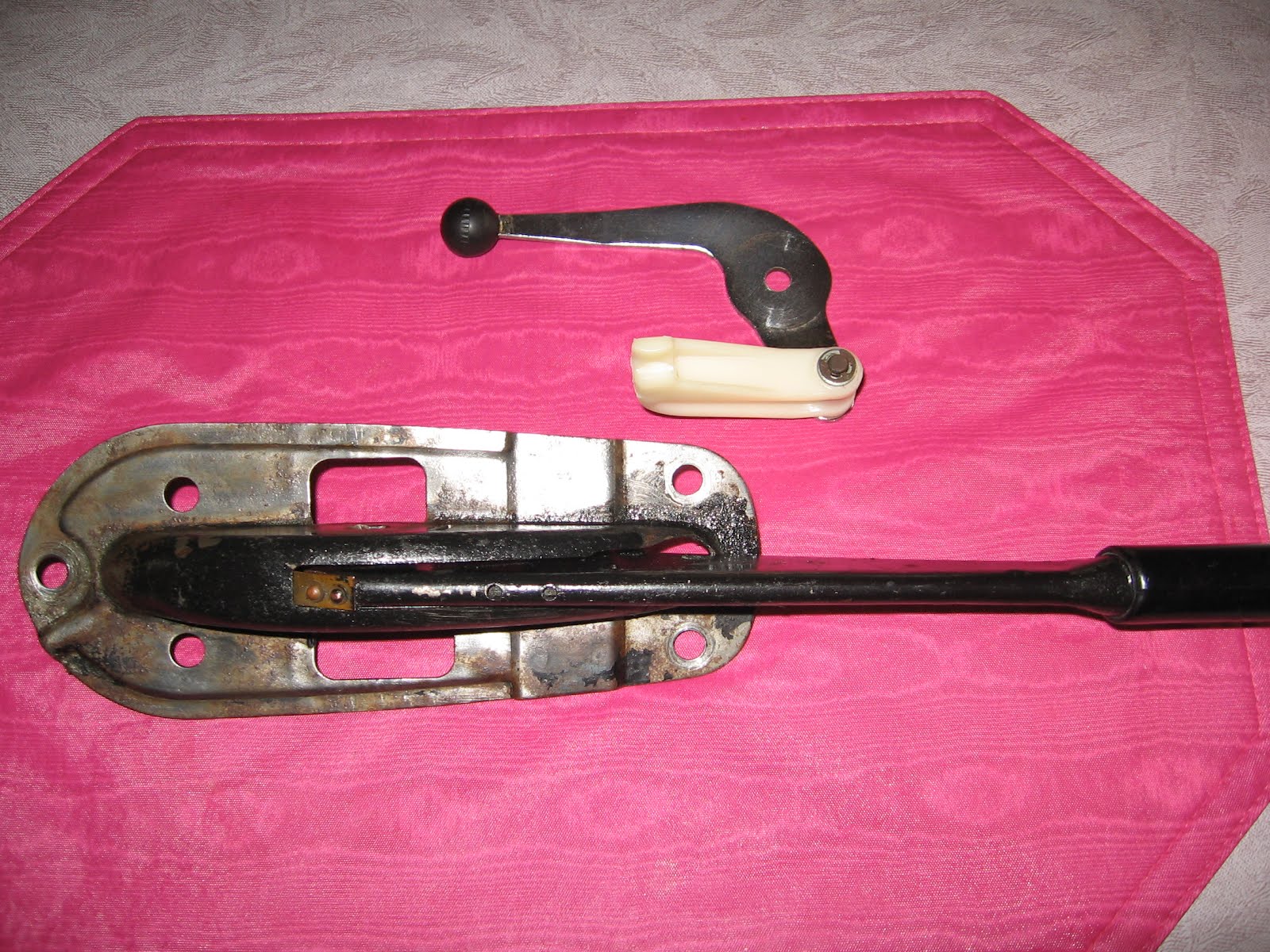
Heater control on the right, equalizer bar below. The tube is the shifter connector that goes to a back coupling.


Hi folks -- a bit bored this weekend as I had a sore knee after playing tennis Friday night. So I decided to install a new hand throttle "schlepper" with my extra time as I bowed out of a USTA tennis match Saturday. I began by taking out the drivers' side seat to make things easy. Work went as planned until I was putting everything back today. The last big thing to do -- put in the clip pin that connects the handbrake ratchet with the equalizer, and I dropped the thing into the hole. OK it should go very far, right? Well, somehow I can't find it -- even after shining a bright light from the other end of the tunnel and dragging the tunnel with a magnet! Where the hell did it go? So now I have a hand throttle that works, but a hand brake that does not. And I have to find a clip!

Thursday, March 15, 2012

Turbine Cars of the 1950s -- The British Rover


Despite all the attention Steve Lehto's book on the Chrysler Turbine has received, the first gas turbine car was a Rover. Dubbed the "Whizzard" because of its deep hissing power plant, the turbine Rover hit speeds of 151.196 mph in a 1952 test run.
The car was first demonstrated in 1950, and then improvements to the engine, including the use of a heat exchanger followed. With the fuel tank under the hood and the engine behind the driver, the Rover could run on a variety of fuels, including kerosene. The issue then, and it was never solved, was one of fuel consumption. Superior in some ways to a piston engine, its design eliminated a transmission, clutch, carburetor, or ignition system.

Tuesday, March 13, 2012

Ford Motor Company and the Nazis -- Simon Reich Commentary


Hi folks -- the topic of auto history never is dull! As I was preparing for a lecture on Scott Bottle's book Los Angeles and the Automobile: The Making of an American City, I got into the work of Bradford Snell. And that took me to Snell's work on GM and the Nazis, which led me a bit further to the historical wok of Simon Reich and the Ford Motor Company, commissioned by Ford during the late 1990s. On the Internet I found an interesting short report by Reich entitled "Ford's Research Efforts in Assessing the Activities of its Subsidiary in Nazi Germany." What follows are some excerpts written by Reich:


"My conclusions regarding Ford's Actions in Germany during the Nazi period are clear and beyond reasonable dispute, based on the data collected and presented in the report. They are as follows:


The management at Ford's German subsidiary acted with growing autonomy from its American parent firm. American executives were often ill-informed about activities in Germany, as they were denied information buy their German employees -- a practice that extended to greater areas of policy over time. Ford's American management did try to influence policy in Germany where possible, but with decreasing effect. Ford's German management focused its efforts on gaining acceptance of the Nazi government in order to continue to do business in Germany, but foundered in this regard. Ford remained a marginal producer in terms of both volume and strategic significance to the German war effort.


Short of divestment by the American parent, Ford's German managers had little choice but to try to address Nazi demands. After 1933, government regulations and restrictions on production consistently reduced the company's capacity to act autonomously. As a comercial passenger vehicle production was slowly eradicated, government contracts became the sole source of business. Without these contracts, predominately for trucks in Ford-Werke's case, Ford would have lost all its German investment as the subsidiary withered due to a lack of market.


Slave laborers were used at Ford-Werke's Cologne plant in 1944 and 1945. The best available Evidence suggests that they totalled a maximum of 65 over time. Prisoners of war an forced laborers, mostly from Eastern Europe and the Soviet Union, but also a number from France and Italy, were also used. But according to the copious data collected regarding communications between the parent and its subsidiary, the parent company in Dearborn had no knowledge of, and thus no control over, these activities. the record reveals that communication between the American parent and the German subsidiary ceased by November of 1941, before the use of forced or slave labor began. There is no evidence that executives at Ford's other European subsidiaries acted as intermediaries between the U.S. parent and its German subsidiary at a any time between 1941 and 1945.


Financial records analyzed by Pricewaterhouse-Coopers suggest little evidence that Ford-Werke made profits during the war. The analysis reveals that modest profit figures were recorded during the first few years of the war, but were wiped out by the enormous losses in the last two years. Indeed, the actions of the Nazi government, a postwar claims commission, and the Congress of the U.S. government all provide evidence to support the view that there were significant damages inflicted on Ford-Werke. Each of these bodies awarded modest compensation to Ford or Ford-Werke, representing a small fraction of Ford's claims."

Monday, March 12, 2012

Film Review of CNBC's "Henry Ford," Aired 2/20/12 -- by HST 344 student Ryan Burg


Thank you, Ryan!

Film Review: Biography on CNBC, Henry Ford. Aired February 20th, 2012

Background: Henry Ford, easily the most well-known name in automotive history, was born July 30th, 1863 to live a long life of achievement and has gone down in history as an automotive legend. CNBC’s biography mainly focused on the later years and hardships Henry faced during his life. Before starting the Ford Motor Co. in 1903, Ford farmed and worked at a mill to support his family, Clara Ala Bryant and his only son Edsel Ford (1893). Throughout Ford’s life Clara and Edsel played a large role in some very drastic decisions. Ford worked his way up through the Edison Illumination company to become chief engineer in 1893. In 96 he created his first vehicle: The Quadricycle. In the upcoming years Ford would see the beginning of many companies. Detriot Automobile Company 99’-01’, with William Murphy; Henry Ford Company 01’-02’ Ford resigned due to Henry Leland’s hiring as a consultant. Murphy created Cadillac Automobile Company from these predecessors. Ford then joined forces with Tom Cooper and Alexander Malcomson and formed Ford & Malcoomson, Ltd. The Dodge brothers, John and Horace demanded payment and became investors in the newly reincorporated Ford Motor Company in 1903.

The Biography:

Starting with the Model-T in 1908, CNBC details the steps that were taken along Fords journey through the Model-T’s success and explained how in 1918 half of all cars in America were Ford’s model-T. Overall over 15 million were produced. This record stood for almost half a century. Historian Robert Casey was featured in this biography and further discussed the Tin Lizzy and ford’s relationship with his son Edsel. He goes on to explain how in 1927 the Model A was produced with a V6 but due to the depression production halted in 1931 with plant shutdowns. Throughout the production of these vehicles Ford was made famous for his $5 workday ($120 in today’s value). In 1932 Ford supported Herbert Hoover. March 7th 1932 “Marches on Ford” left four workers shot dead by the Dearborn Police Department and Ford’s security guards. Over 60 people were injured from gunshots and riot wounds, one more died months later from complications. As mentioned earlier Clara Ala Bryant, Henry’s wife, spoke up and put an end to the violence. At her command Ford was now a Union shop in 1941. David Moor was interviewed on the topic of working for Ford: “It was like hell” working with people looking over your shoulders the ‘star men’ managers.


CNBC does its best to inform the viewers of Fords family life. They go into the details of his relationship with his only son, Edsel Ford II. Henry wanted Edsel to be tougher and more assertive, they said. During the time of WWII, Henry Ford’s V8 Ford Triumph was the top vehicle in the states. He received many thanks from famous people including Salinger, and Bonnie & Clyde, on the handling and supreme speed and acceleration of the vehicles. The Biography finishes with more of a somber mood, explaining the later years of his life, and how Ford changed when his son Edsel died at 49 from a stroke. Ford was 80 and still running the company. Ford continued to do so until he was too fragile and Clara his wife encouraged him to pass the company on to his grandson Henry Ford II in September 1945. Ford Passed away in 1947 at the age of 83. A cerebral hemorrhage was the cause. Some 15,000 people walked by his casket the day of his funeral, roughly 5000 and hour. Over 7 million employees took part in some type of memorial act. Without a doubt, Henry Ford changed the course of history and will forever be remembered.

Sunday, March 11, 2012

A Problem with Tach "Bounce" on My 1971Porsche 911 -- Solved!


Hi folks --- out of the blue yesterday my Tach started to bounce -- a first just a bit at idle, then crazy no matter at what RPM. So I started by checking grounds -- and the one between transmission and body was a suspect because I moved it ever so gently when I re-did the rear calipers last week. I sincerely doubt that the ground underneath was the problem however. Since the Tach runs directly off the distributor the next thought was check all grounds around the distributor. And take off and put back on all major connectors, two of which are located in the engine compartment.
I then opened the distributor and found a rotor with a contact that was pretty much cruded up. I took a burnishing file, cleaned it up and ran the car for 45 minutes for so -- no more bounce! Of course, I ordered a new rotor from Rockauto -- probably should order two, one as a spare.

There is always something to do on my 1971 Porsche 911T!

Friday, March 9, 2012

Marilyn Monroe and the Automobile -- Photos


In Chrysler 300


A Big Nash


1953 Singer


1950s Jeep


Hi folks -- I was preparing a lecture on the post-WWII Jeep and found this photo of Marilyn. I began to wonder what else is easily available on the web. Here are a few other shots!