Popular Posts

Tuesday, January 9, 2018

Mercedes-Benz "Stroke/8" Sedans: W114 and W115 Models, Precursors to the E-Series


Mercedes-Benz 280 E Sedan from model series W 114. The new "Stroke/8" top model with two overhead camshafts and petrol injection made its debut in 1972 and in the upper medium-class segment at Mercedes-Benz it defined a new level of performance. Like the carburetor version 280, it has a twin bumper at the front and a rear bumper brought forward to the wheel cutout.

Precisely 50 years ago, on 9 and 10 January 1968, Mercedes-Benz unveiled the completely redeveloped sedans in the upper medium-size category in Sindelfingen. They are divided up into the model series W 115 (four- and five-cylinder engines) and W 114 (six-cylinder engines). The model series from the E-Class ancestral line impressed with its clear design idiom and a design autonomous from that in the luxury segment. The success of the "Stroke/8", as fans later nicknamed this vehicle generation, due to the suffix "/8" in the model designation, was overwhelming: for the first time more than 1 million units of a Mercedes-Benz vehicle family were sold. Alongside the sedans, they also include coupés, sedans with a long wheelbase and chassis for special bodies. Today the "Stroke/8" is a coveted classic model series family from the Stuttgart brand. Particularly attractive specimens are regularly to be found in the offering from ALL TIME STARS, the Mercedes-Benz Classic vehicle trading place.
Stuttgart. 50 years ago "The new Mercedes-Benz generation" celebrated its premiere. At the centre of the vehicle presentation with this motto on 9 and 10 January 1968 were the completely redeveloped sedans in the upper medium-size category. They superseded the "fintail" sedans launched in 1961 with four-cylinder engines (W 110).
The new vehicle family belonged to the model series W 115 (four- and five-cylinder engines) and W 114 (six-cylinder engines). On the exterior the respective models were identical in their dimensions. They could only be told apart by items of equipment plus radiator grille and bumper variants. At market launch the diesel-engine models 200 D and 220 D and the models 200, 220, 230 and 250 were available with a petrol engine. The range was subsequently extended yet further.
The stylistically and technically very modern vehicles represented a minor revolution. However the new upper medium-size category had nothing in common with the wild student protests of 1968. Instead Mercedes-Benz used the "Stroke/8" saloon to successfully sharpen the profile of this market segment – the future E-Class. This development took on particular importance because the Stuttgart brand extended the model series family in the same year to include coupés (market launch in November 1968) and saloons with a long wheelbase (market launch in December 1968). Mercedes-Benz was thus now offering an extensive portfolio of various body forms and engines in the autonomous upper medium-size category.
"Well-calculated perfection"
Even at first glance the "Stroke/8" impresses with its clear and harmonious design which Paul Bracq created in the Stylistics department headed by Friedrich Geiger. There were also new technical design features such as the rear diagonal swing axle. The engineers used it to achieve their aim of combining the brand's hallmark ride comfort with further improved driving comfort. The specialist journal "auto motor und sport" said the following in its 4/1968 issue about the 200 (W 115) and 250 (W 114) models: "The wet and icy Hockenheimring confirmed the experiences gained on the Targa Florio route: driving stability is considerably improved with the new axle". The article's headline sums up the overall impression given by the "Stroke/8": it calls the new upper medium-size category from Mercedes-Benz "well-calculated perfection".
Development of the new vehicle generation started in 1961. Prof. Dr Fritz Nallinger, Member of the Board of Management responsible for Development at the then Daimler-Benz AG, was keen right from the outset to differentiate the new model from the luxury-segment vehicles to a greater extent than before. This meant that an end was finally put to the universal body, as used for the "self-supporting chassis-body structure" and "fintail" saloons. The specifications book envisaged a more compact vehicle than the W 110, but one which still offered the same amount of space on the inside. New chassis designs were also to improve the handling yet further. An early decision was taken to extend the drive system palette to include engines with six cylinders.
A sedan with harmonious proportions was created with a wheelbase 50 millimetres longer than that of its predecessor, so 2750 millimetres, whilst the overall length was reduced by 55 millimetres to 4680 millimetres. The saloons were also 25 millimetres narrower and 55 millimetres lower than the small "fintails". Mercedes-Benz verified developments in passive safety with measures including 26 crash tests. They showed that the "Stroke/8" not only met the US standards in force at the time for a collision at up to 30 miles an hour with 100-percent coverage; it exceeded them significantly.
The chassis was also considerably enhanced compared with the W 110. The two subframes were linked with the body via soft rubber bushes. At the front axle, double wishbones with offset pivots reduced dipping of the front section during sharp braking. At the rear the newly designed "diagonal swing axle" was used, a semi-trailing-arm rear axle. It reduced track and camber variations in bends and during compression and rebound. For the first time in the upper medium-size category from Mercedes-Benz all four wheels were equipped with disk brakes. A power steering system and hydraulic level control system were optionally available.
Model of success in E-Class history
In the classic-car scene the vehicles built in the upper medium-size category by Mercedes-Benz from 1968 to 1976 were known as the "Stroke/8". But this designation for the model series did not originate from the brand itself. Rather, it came from fans' usage some time after the premiere in January 1968 – derived from the abbreviation "/8" which identified the 1968 models in the range.
The abbreviation "Stroke/8" then became the catchy name for all the variants in this upper medium-size category. These also included the top engine versions 280 and 280 E (1972) as well as the 240 D 3.0, the first five-cylinder passenger car in the world, which came out following the 1973 facelift.
The market launch came hot on the heels of the premiere of the four-door sedan in January 1968. The four-door sedan with six windows and a wheelbase extended by around 650 millimetres was built as of March 1968. In contrast to the standard sedan, Mercedes-Benz equipped this long version as a matter of course with the larger 15-inch wheels due to the modified angle of approach/departure and a correspondingly lower rear axle ratio. October 1968 then saw the construction of the two-door coupé. The sporty, elegant two-door model had the same wheelbase as the sedans but was 45 millimetres lower. The backrests of the front seats locked through a vacuum were automatically released when the doors were opened, thus facilitating good access to the bench seat in the rear. In contrast to the saloon the rear bumper was brought forward up to the rear wheel cutouts at the side.
The "Stroke/8" proved to be a runaway model of success: for the first time Mercedes-Benz made more than 1 million vehicles of one model series family – in total 1.8 million. And there were even more than 1.9 million units of all body variants sold. And it is fitting that the two millionth passenger car produced since 1946 by Mercedes-Benz is also a "Stroke/8". The model 220 D saloon rolled off the line on 9 May 1968 at the Sindelfingen plant. The last "Stroke/8" vehicles were built in 1976 – at a point in time when production of the successor model series W 123 was already under way.
Coveted classic
Today the "Stroke/8 sedans and coupés are coveted classics. At regular intervals particularly attractive vehicles from the model series are to be found in the offering from ALL TIME STARS, the Mercedes-Benz Classic vehicle trading place. The ALL TIME STARS range is based on maximum transparency and was founded in 2015 to include classic cars and young classics which are subjected to thorough 160-point checks. And each goes on sale with a Classic Data Certificate showing that it has scored at least 2 for technical condition. The vehicles are classified in three editions: Concours Edition, Collectors Edition and Drivers Edition. ALL TIME STARS has a permanent showroom on Level 0 of the Mercedes-Benz Museum, the web-based digital sales platform at http://www.alltime-stars.com/ and is present at numerous occasions such as specialist trade fairs and events.

Monday, January 8, 2018

Classic Mercedes-Benz Cars for Sale at the M-B Museum at Stuttgart


ALL TIME STARS by Mercedes-Benz Classic has become established in the market, as reflected in the business performance for 2017: transactions involving classic Mercedes-Benz vehicles grew by nearly 50 percent compared with 2016. This success is a perfect match for the new vehicle sales of Mercedes-Benz. ALL TIME STARS was founded as a start-up as recently as 2015 and is continuously expanding its product range: factory restorations carrying the quality seal of the manufacturer guarantee the highest quality. ALL TIME STARS will in future also showcase itself in a new showroom scheduled to open in the second half of the year in Motorworld München.
Stuttgart. Classic Mercedes-Benz automobiles were more valuable than ever in 2017: renowned market research firm HAGI has determined an increase in value for the classics from the Stuttgart-based brand of 8.6 percent in the first eleven months of last year. The late-model collectors' vehicles, the so-called emerging classics, even saw an increase in value by 19.3 percent according to HAGI. This development reflects the fascination for the brand and has also boosted Mercedes-Benz Classic with its own ALL TIME STARS vehicle business: almost 50 percent more vehicles were sold in 2017 than the year before – the line-up ranged from young classic cars and highly exclusive classics to rare racing cars. Prospective buyers can find the list of currently available vehicles at http://www.mercedes-benz.com/alltimestars
"2017 was a successful year for ALL TIME STARS", says Christian Boucke, Head of Mercedes-Benz Classic. "Our good performance is a perfect match for the outstanding development at Mercedes-Benz Cars." Patrik Gottwick, responsible for the vehicle business at Mercedes-Benz Classic: "We are proud that we have also been this successful on the market for automotive classics. Our offer to be able to purchase classics of the brand in the Mercedes-Benz Museum is immensely popular. "
ALL TIME STARS enjoys a presence with a permanent showroom on Level 0 of the Mercedes-Benz Museum, with the web-based digital sales platform at http://www.mercedes-benz.com/alltimestars as well as at numerous events such as trade fairs and car meets, from the Rétromobile in Paris and the Techno Classica in Essen to the Pebble Beach Concours d’Elegance in California. Another new showroom is scheduled to open in the second half of 2018 in Motorworld München.
The vehicle business of Mercedes-Benz Classic also sets trends with proprietary formats. They include the all-brand classic car meet Cars & Coffee at the Mercedes-Benz Museum and the stylish ALL TIME STARS Summer Lounge on the museum hill. The presentation and intensive use of the internet and social media fits the start-up character of ALL TIME STARS.
The highlights of the vehicle business of Mercedes-Benz Classic in 2017 included a 2005 AMG-Mercedes C-Class Racing Touring Car (W 203) used in the DTM racing series, an extremely rare factory-restored 300 SL Roadster (W 198) from 1958, and a Mercedes-Benz 190 E 2.5-16 Evolution II (W 201) high-performance saloon from 1990 – best-known on the scene as "EVO 2". The SL sports cars of the 107 model series and the saloons and coupés of the 123 model series were also highly popular.
Acquisition of special vehicles
ALL TIME STARS is expanding its product range consistently with the selective acquisition of particularly interesting vehicles from the long history of the brand bearing the three-pointed star. This includes, for example, a 300 SL Coupé (W 198) from 1954, which was delivered at that time in a unique colour combination of green-beige paint finish and green-grey leather appointments. Another absolute rarity is a 280 SL of the 113 model series ("Pagoda") from 1967 – it has chassis number 2. Both classics are factory-restored with maximum authenticity to the original specification for ALL TIME STARS in the Manufaktur restoration facility of the Mercedes-Benz Classic Centre in Fellbach. A unique offer as only the manufacturer can provide.
"After a successful year in 2017, we are now looking forward to 2018. We will enhance the market with rare and extraordinary young classic cars and classics bearing the three-pointed star", says Christian Boucke. The kick-off for the presence of ALL TIME STARS at trade fairs will be the Techno Classica in Essen (21 to 25 March 2018) and the Retro Classics in Stuttgart (22 to 25 March 2018).
The know-how of the brand specialists and the great enthusiasm for a culture of authenticity are the unique selling points for the vehicle business of Mercedes-Benz Classic. "Maximum transparency and a reliable assessment of all offered vehicles in different editions guarantees the prospective buyer that at ALL TIME STARS he finds exactly the vehicle he is looking for", says Patrik Gottwick to underscore the philosophy of the vehicle business in the Mercedes-Benz Museum. All young classic cars and classics undergo a thorough 160-point inspection and receive a Classic Data expert assessment. From a technical standpoint, they correspond at least to a grade of 2 for their condition – that is to say, good to very good.
ALL TIME STARS vehicles are categorised in three editions: the Concours Edition comprises young classic cars and vintage cars in rare original condition and with low mileage that have been elaborately restored by the Mercedes-Benz Classic experts in Fellbach. The Collectors Edition comprises vehicles in good technical and cosmetic condition. Their patina gives them a particularly special character. Finally, the Drivers Edition offers vehicles in good technical condition that still offer potential for restoration work – they are perfect for all lovers of classic vehicles who want to drive their young classic or vintage cars on a daily basis.

Friday, January 5, 2018

Ferry Porsche's Early 911S -- One of a Kind!


01/04/2018

Ferry’s Porsche

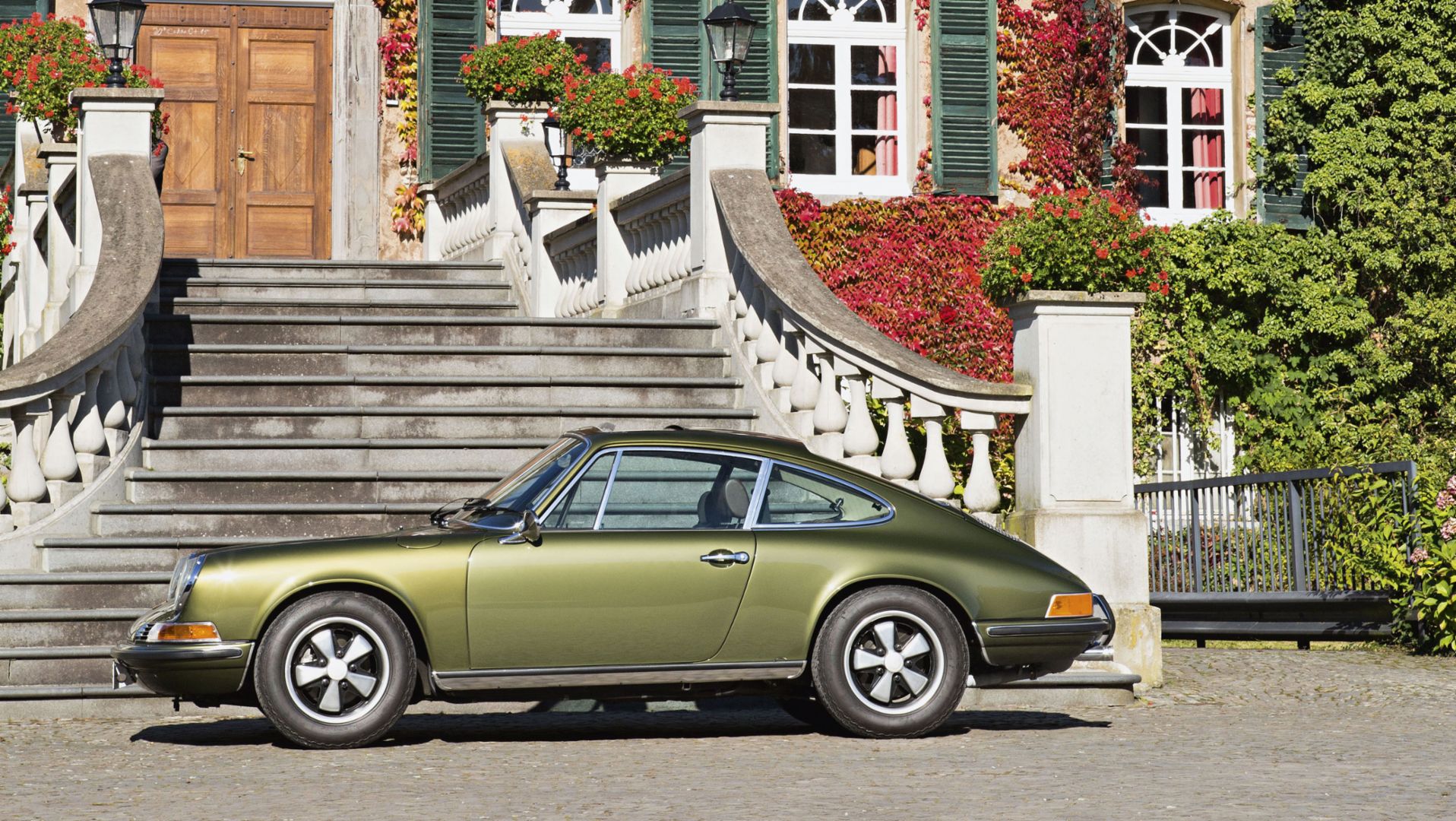
All Porsches are special, but some – like this one – take special to a whole new level. This car once belonged to Ferry Porsche, who has a reputation, shared with other members of the Porsche family, for customising each of his vehicles with extra details that had not yet been rolled out in series production, or that were simply not available on standard models. 
Porsche 911 S von 1969, 2017, Porsche AG
This Porsche 911 S in an olive green metallic finish is one such car.
Although the number plates are replicas, everything else on the car is original. We do not know why Ferry Porsche selected the number plate S-M 2000 for his Porsche 911 S when he registered it on July 30, 1969. Perhaps he thought the number 2000 sounded futuristic; after all, that would fit with the car. The chassis number – 911 0300014 – indicates that this was the fourteenth car with the new 911-S engine, built before the factory shut down for the summer holidays. Customers would only be able to experience the new 2.2 litre 180 hp flat engine after the summer.
Porsche had reserved the cars with chassis numbers 01 to 03 for the race team, who intended to use them at the Acropolis Rally, and number 13 was skipped for superstitious reasons. All of this means that this car is one of the first ten Porsche 911 S 180 hp cars to be built for the road, and is probably one of the oldest Porsche 911 S cars still in existence with a 2.2 litre engine. This fact alone makes this Porsche an interesting historical artefact, but its first owner, Ferry Porsche, added a number of unique details to the 911 S. Externally, the 911 S is missing the overriders on its front bumper; Ferry Porsche thought they detracted from the sporty look, although it’s unclear how that fits with a registered, ex works tow bar. Luckily, no such tow attachment is installed. A closer look reveals the aluminium rear lid, which is unusual in combination with the air-conditioning system beneath it.

The interior of the vehicle is inarguably original

The engine itself is also full of surprises; the injection system uses components that actually belong to the Carrera 6, although it is not clear whether these components were in fact added later.
The interior of the vehicle is inarguably 100 per cent original. The ergonomically shaped front seats are covered in material, while the sides are clad in aniline leather – an exceptionally hard-wearing artificial leather that, at the time, was used primarily on upholstered furniture. In the car, it looks thick, strong and smooth. At the time of production, these kinds of materials were very expensive, although the investment paid off, as the interior still looks like new today. The aniline leather shows no signs of age, and the electric power windows, sliding roof and Blaupunkt radio all work like new.
Cockpit, Porsche 911 S von 1969, 2017, Porsche AG

The Cockpit of the Porsche 911 S in olive green metallic

This 911 has clearly enjoyed a charmed life. Porsche sold the car on December 6, 1971 to Guy Jean Dubois, a fish merchant from Strasbourg, with 21,113 kilometres on the clock. Dubois’ son worked as an engineer at the company, and he put his father in touch with Ferry Porsche, who later sold him the car. 33 years down the line, the 911 S was still owned by the family; the car was enjoying a life in the sun at the family’s second home in Sainte-Maxime in the bay of Saint-Tropez.

Everything feels so new and untouched

In 2004, the car was officially put up for sale, and quickly found a new owner. But this brief moment in the spotlight was enough to bring it to the attention of collector Michael Heinemann. Heinemann had long been aware of the existence of the car, but had not been able to determine its whereabouts. After tracking down this unique 911, he asked a friend from France to write a letter to win over the new owner, the start of a negotiation process that eventually took around a year. The pair finally met in Biarritz in 2009. In 2013, Michael showcased the car at Pebble Beach and continues to maintain it to this day.
Driving this car is a special experience. Everything feels so new and untouched. The high quality of this zero-series car is evident in every detail of the design, and the sound of the 2.2 litre flat engine is captivating. It’s good to know that it’s still around, along with a few other of the most special Porsches. Maybe there are even enough for a small series – who knows.
Info
Text by Thorsten Elbrigmann // Photos by Aleksander Perkovic

Randy and his Model A

A very nice 1930 Ford Model A and Randy Hughes
So Sheila and Randy went shopping for a 1930s RCA Radio and found this in the seller's garage. It would be a great vehicle to drive to the tennis courts. Randy!  And to pick Sophie up at school!


Tuesday, January 2, 2018

"The Safest Place" (1935): a Film that Touts the Responsibility of the Driver Rather than the Automobile Manufacturer


This is a very interesting film.  It starts out rather hokey, illustrating dangers on the sea and in the home.  And it is true that home accidents take an enormous toll -- ladders are particularly dangerous, as you can ask my wife!


In my The Automobile and American Life, chapter 5, I discuss the notion that 1930s American manufacturers promoted concerning the idea that cars were to be designed like homes.  And that point is clearly made in this film -- the GM turret top, knee action suspension, living room interior. The car as a home was thus safer than your own home! And thus it falls to the driver in terms of safety, as the car is as safe a product as it could be, according to the industry.


What I found most interesting was the segment on self-driving, autonomous cars that needed no driver. And the argument was that this type of vehicle eliminates ALL accidents, the same point made today by advocates of autonomous vehicles who are rushing us into the future.  Will that be the case? Do we want to be driven, rather than drive? I for one enjoy the freedom and exhilaration of getting behind the wheel. In sum, I do not want to be carted around by computers guided by sensors!!

Reckless Rudolph verses Sensible Sam : "We Drivers", an Early Driver Education Film (1935)


The mid-1930s was a key transitional time in the development of a driver education movement and high school curriculum, This important film featured Max Fleisher's animation.  It hits on that key element of a driver's emotional state -- a condition where education can be superseded by a temporary but dangerous loss of judgment.