Popular Posts

Saturday, February 3, 2018

The Porsche 928 Story


Hi folks -- taken from a Porsche news release.  928s are fine cars but you better be good at doing your own repairs and have a very large parts stash. In purchasing one you may think you are getting a great deal, but the cost of upkeep will often be quite high.


Porsche Takes the Plunge

Spring of 1977: Porsche fans are shaken to the core when the brand comes out with its new top model, the 928. The car defies—and exceeds—all expectations.
Porsche 928, 2017, Porsche AG


“You cannot discover new lands without consenting to lose sight of the shore for a very long time,” said André Gide, French writer and 1947 winner of the Nobel Prize in Literature. Although Gide could not have known it, his quote beautifully captures the mood at Porsche in the early 1970s. What was going on in Zuffenhausen? The Porsche and Piëch families had just withdrawn from the company. In the United States, Porsche’s biggest market at the time, legislators were discussing new crash-protection regulations. And the Porsche 911 was seen as obsolescent due to the stricter emissions and safety regulations on the horizon. The winds of change were in the air, and a few individuals at Porsche started to tackle these changes in a comprehensive manner.
Ernst Fuhrmann, the new chairman of the executive board, favored a novel model concept—a radical renunciation of the rear-engine principle. He envisioned a sports car with the engine mounted in the front and the transmission in the rear, connected by something called a “fast shaft.” This distribution of the drive system components is known as a transaxle construction, and it was to be a defining feature of the Porsche 928.

The development started in February of 1972

The decision was daring, given Porsche’s tradition of rear-mounted engines, but “everyone was on board” when it was made, recalls Wolfhelm Gorissen, who directed the Porsche 928 project. Development started in February of 1972, and the engineers at the Weissach Development Center broke new ground in every way. The engine, derived from a water-cooled, 4.5-liter V8 racing assembly made of aluminum, became the first to appear in a European standard production car. The engineers gave the chassis a completely new passive-steering, rear-wheel suspension: the “Weissach axle.” The car body was a combination of steel, aluminum, and plastic. And the polyurethane bumpers—yet another absolute novelty—were completely integrated into the body. They easily passed the newly introduced impact (pendulum) tests, which didn’t allow dents at impact speeds of up to 8 kmh.
Porsche 928, 2017, Porsche AG

With the 928, the engineers at the Weissach Development Center broke new ground

Bumpers hardly seem radical today but, at the time, they brought the engineers, designers, and of course project director Gorissen to the brink of despair. It wasn’t just a matter of their complex, elastic mount. In particular, the paint job presented a challenge. “At that time, we simply didn’t have a paint that could cover steel, aluminum, and polyurethane equally well,” Gorissen recalls. “There were different shades wherever you looked.” The right paint for the job had yet to be invented—and it was, just in time for the series production.

Porsche’s first Gran Turismo

While engineers were working on hundreds of little details in their quest to gain every possible centimeter and lose every possible kilogram, experts from the testing department were taking each successive prototype to its physical limits. The nearly ideal 50:50 weight distribution between the front and rear axles, the large-volume V8 engine, and the sophisticated suspension created expectations of first-class performance, at least on paper. But the 928 actually outstripped all expectations. Gorissen recalls those nighttime test-drives in the Black Forest very clearly: “It was winter. Some of the roads were icy, and it looked like a real challenge.” But the drivers climbed out of the car as cheery as could be after their excursion. “The car drove a full class better than the 911 of that time.”
The 928 was something different right from the start. Above all, it was positioned higher on the market—as a sporty touring car, or Porsche’s first Gran Turismo. The new car had four seats, although the two rear ones were not designed for long rides. It also felt extraordinarily spacious and had a capacious trunk. The car was considered large at the time, although it seems incredibly compact by today’s standards. “No other V8 sports car is so flat and elegant,” said Harm Lagaaij, Porsche’s head of design from 1989 to 2004. And he planned to drive “at least three 928s” in his free time.

The 928’s world debut at the Geneva Motor Show was a sensation

The 928 seemed to glide rather than roll on the road. It generated significantly less noise than the air-cooled engine of the 911. It handled much more agreeably and offered outstanding comfort: The air-conditioning system cooled the glove compartment; the height of the steering wheel and seats could be adjusted; and drivers could also adjust their pedal positions, foot rest, and gear shift. The windshield wipers had a separate tank with a dedicated dosage pump that sprayed a special cleaning agent onto the window from time to time to keep the glass free of streaks. And finally, the car had a specially designed “Porsche cassette radio with excellent reception qualities and clear, user-friendly controls.”
The 928’s world debut at the Geneva Motor Show in March of 1977 was a sensation, and the public was thrilled. According to Der Spiegel, “Former Volkswagen head Rudolf Leiding bought one at once—for his wife.” The magazine also noted, “No other car has played a more crucial role in Porsche’s highs and lows than the 928.” In other words, this completely new, incredibly modern, and timelessly elegant sports car clearly had everything it needed to take on the legacy of the 911.

The production of the 928 stopped after a total of 61,056 vehicles

But events turned out differently, as we now know, forty years on, even though the Porsche 928 was the European “Car of the Year” in 1978—the first and only sports car to have received that honor—and even though it was continuously improved and upgraded. Its output increased from an initial 240 to 350 hp in the final evolutionary stage of the series (the 928 GTS built in 1991). Production of the 928 finally stopped in 1995, after a total of 61,056 vehicles had been built.
Lagaaij has never stopped admiring the car’s design language. At some point in the conversation about its timelessly elegant aesthetics and coherent concept, he says something that seems to echo the words of André Gide: “The 928 was like a new continent in the Porsche world at the time.”
Andrew Phinney
Andrew Phinney, Porsche 928, 2017, Porsche AG

The fifty-one-year-old from Connecticut is the proud owner of the first Porsche 928 ever built. Eleven 928s, starting with chassis no. 9288100011, made their world debut at the 1977 Geneva Motor Show.
“As a teen, I would sit in front of the TV set, which is where I first encountered a Porsche 928: on The Six Million Dollar Man. I was smitten immediately. So far, I’ve owned around twenty Porsche 928s. But this particular 928 is something very special. I bought it from Jim Doerr, an enthusiast from Michigan. He first discovered it in 2011, relatively unloved and forsaken, in someone’s backyard somewhere in Michigan. The body was dotted with around forty holes and a number of special parts had been installed. But the original engine was still intact, as was the original paint job: Grand Prix White. I signed the deed of sale on February 22, 2017. That was the very same day, some forty years earlier, that the 928 must have left the factory in Zuffenhausen. On the following day, February 23, 1977, eleven new Porsche 928s made their world premiere. There’s scarcely a gap in the car’s documentation. In 1979 Porsche sold it to a private citizen in Hamburg. By 1983 the 928 was back in America where, because of import regulations, the original tachometer was replaced with one that indicated miles per hour. It now has almost 150,000 kilometers under its belt. I know what a treasure I have. Sometimes I take a seat next to it in the garage and wish it could talk about what it was like back then.”
Hans Clausecker
Hans Clausecker, 2017, Porsche AG

Born in 1940, Clausecker became a suspension expert and joined the 928 development team shortly before the car’s premiere. He was involved in testing winter tires—and in making the only factory race car of this model type.
“I joined the testing team about a year before the 928 was introduced. We were focusing on winter tires and running tests in Austria near the Turracher Höhe Pass and on frozen Lake Falkertsee near Bad Kleinkirchheim. To see how it handled, we drove to the Nürburgring or the Contidrom near Hanover. Thanks to its nearly ideal weight distribution, the 928 was much less problematic to drive than the 911. I thought it was extremely good-natured and found it to be a wonderfully comfortable touring car. My colleague Günter Steckkönig and I both thought this car would be an ideal candidate for the European Touring Car Championship. As a matter of fact, we received authorization to proceed; the 928 was ready to go in 1983. It did well at the Veedol Endurance Race on the Nürburgring and at the 24 Hours of Daytona as well. But unfortunately, it didn’t meet the requirement for the European Touring Car Championship of five thousand production cars sold in a year. That put an end to the dream of a racing career for the 928. More than thirty years went by before the 928 race car was resuscitated by Porsche apprentices and two Porsche retirees—Günter Steckkönig and me. Now the car is back, at the stage it was before its first race in 1983.”
Hans-Georg Kasten
Hans-Georg Kasten, 2017, Porsche AG

After studying design and automotive body construction in Hamburg, Kasten promptly joined Porsche in 1970 at the age of twenty-three. He worked on the 928 from the start, first as an interior designer, then on the exterior and as an assistant to studio director Wolfgang Möbius.
“I joined Style Porsche in August of 1970 and started working on interior design under Hans Braun, who was the director at the time. The future sports car soon became the big project, and everyone thought it should defy the zeitgeist and break with the usual wedge-shaped, angular bodies. It should look completely different: more organic, more modern, ‘Porschier.’ I think that’s why the 928 still has an interesting and timeless aesthetic to this day. My first job was to put Hans Braun’s design for the interior into practice. Completely new features included a cockpit that could be adjusted in tandem with the steering column and a central console that rose up to the dashboard and nearly enfolded the driver and front passenger. I transferred to exterior design in late 1973. The biggest challenge there was integrating the bumpers into the body, which had never been done in a car. The problem was that these bumpers had to meet new and very strict U.S. crash regulations, which took an enormous amount of development work. We finally came up with an excellent solution. But that was only possible because we not only designed a completely new sports car but also established an entirely new type of cooperation between engineers and designers at Porsche.”

Friday, February 2, 2018

A 1951 Packard and a Close Call: Sometimes an Inch Makes a Big Difference


A contribution from Ed Garten:

John, you may find this story interesting:  In summer 1957 my parents were separated pending a final divorce.  My grandfather Garten loaned my mother a car from his used car lot -- a 1951 Packard with the Ultra-matic transmission.  I was only 9 years old but I still remember every detail of that car.  Mother took my sister and me to the State Fair of West Virginia about 40 miles from home and as we were going down a very long hill into Lewisburg, West Virginia, the brakes on the Packard went out.

My mother screamed at me: "What should I do?"  Of course as a nine year old I had no idea other than to yell at her "pump the brakes, pump the brakes."  Which did no good as the petal went to the floor (those Packards had pedals that went through the floor as opposed to later cars with suspected pedals.

Clearly a brake line had burst or the master cylinder had gone out........but my mother hit a telephone pole at the end of the hill -- likely going 50 miles an hour.  My sister was int he back seat and she went over the seat hitting her head on the hard metal dash and my head missed a protruding radio knob by about an inch.  One more inch to the left and I would have died for sure.  The car was demolished.  We three were taken to the local hospital -- all three safe but really beat up.

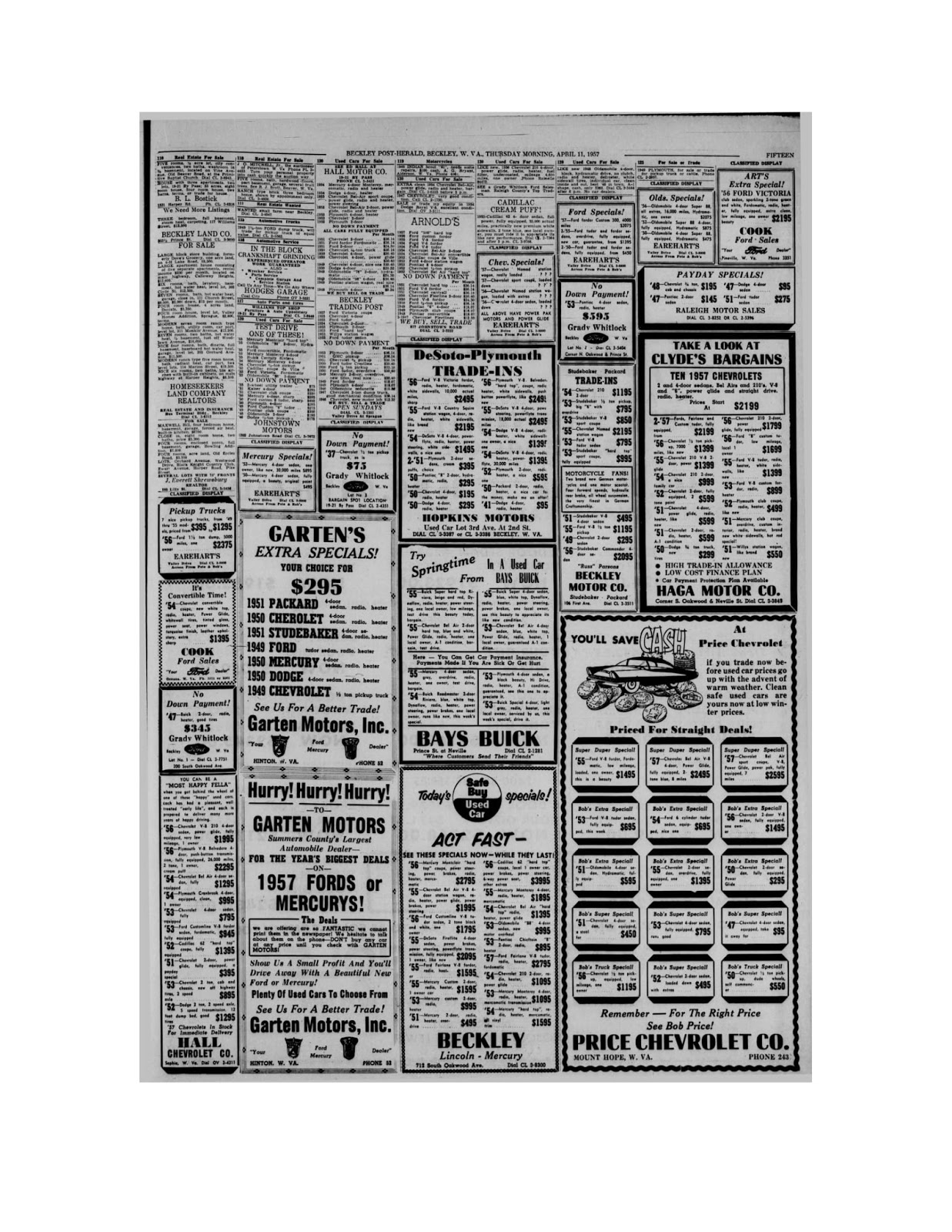
But today, I was searching some newspaper archives online and actually found the car that my grandfather had loaned my mother -- that 51 Packard -- which he had listed for sale for $295.  Yes, two-hundred and ninety-five dollars.  If you can bring up this PDF I formatted, look toward the lower left and you'll see an advertisement for Garten Motors in April 1975 -- there are a bunch of used cars all listed for sale for $295 and the Packard that I might have died in is first on the list.

Two weeks from today I will turn 70 years old -- but for luck or the hand of God, I lived 61 years beyond that old Packard.  Great story, hey?


a 1951 Packard 200 -- not Ed's mother nor the way his car looked!


Thursday, February 1, 2018

“Capturing the Sounds of Sports and Race Cars: Bill Grauer and Riverside Records”

This is a revised draft of a paper I will be giving at the Popular Culture Association Annual Meeting at the end of March. Comments are welcome!


“Capturing the Sounds of Sports and Race Cars: Bill Grauer and Riverside Records”


John Heitmann
Department of History
University of Dayton
300 College Park
Dayton, OH 45469-1540
Copyright 2018.


Doing history often gets personal for me, and the story that follows is a prime example of why I chose the topics I pursue. For some time, I have been interested in the history of sports cars in the U.S., particularly during the 1950s when sports car sales and SCCA participation took off. It was the result of rising middle class expectations and ambitions, a response to the ungainly Detroit “dinosaur in the driveway,” and popular literature that included Don Sanford’s The Red Car and Tom McCahill’s Mechanix Illustrated articles. And as a teenager during the mid-1960s I got caught up in it, as I purchased a 1959 MGA after graduating from high school.
Lately as I reflect on my past I have often wondered how I got on the path of being so keenly interested in sports cars. One possible reason for my passion was the consequence of acquiring at age 12 the Riverside Records LP “Vintage Sports Car in Stereo.” On one side the record featured the sounds of a number of vintage cars I had never heard of before: a Frazer-Nash; Type 51 Bugatti; E.R.A.; P3 Alfa Romero; Alta; V16 Maserati. On the other side a vintage race was narrated by the famous David Scott-Moncrieff. I played that record over and over again, much to the anguish of my parents who thought I had gone over some sort of an adolescent cliff.  But as I have discovered from recent conversations, many others joined me in this obsession with the sounds of exotic motor cars. Today sounds are often a part of cars & coffee and weekly cruise-in events. A Saturday in October is devoted to sounds at the Porsche Museum in Stuttgart. However during 1950s and 1960s (and today if you have the LPs)  thunderous but also harmonic engine sounds could be heard in your home as well as on the track and street.
The Riverside Records story is worth telling, for it links 1950s jazz sounds with the concurrent burgeoning interest in sports cars. The Riverside label began in 1952 with the partnership of two Columbia graduates, Bill Grauer, Jr. and Orrin Keepnews. Seeing an opportunity to approach major record firms with a proposal to counter what was then seen as the release of “pirate” recordings of performances dating back to the 1920s and 30s, between 1952 and 1962 Grauer and Keepnews transformed a once-obscure Riverside Records into a major jazz label. Initially Grauer convinced RCA Victor to re-issue 78s from the 1920s and 30s in LP format. However, he then shifted focus to the contemporary music of Thelonious Monk, Randy Weston, Bill Evans, Sonny Rollins and Cannonball Adderly. Additionally, the partners established themselves by writing a definitive book on the history of jazz in the U.S, published by Crown in 1956 and reissued in 1971. In the midst of this artistic and business success, Grauer, like many upper middle class men of the day, also became a sports car enthusiast.

In a 1961 interview in his New York City office that featured a large photo of Bill behind the wheel of a 1937 Mercedes-Benz, he recounted how in “1956, just for fun, we recorded sounds of sports-car races down at Sebring, Florida (I’m a racing nut, you know). We decided to release it and then the roof fell in. It began to sell like crazy.” Thus this experiment into the commercial recording of sports car sounds It began with RLP 5001 -- "Sounds of Sebring:  The 1956 Florida International Twelve-Hour Grand Prix of Endurance." Grauer  recalled "At Sebring, everybody has problems and for the most part all this worry and fuss is just for the fun of it. And because it's for the fun of it, Sebring is a terribly wonderfully exciting spectacle."
The most unusual sound recording's A side began with interviews of drivers, a prelude to  the listener experiencing "sounds at rest:" a 3 liter Maserati; 3.5; 3.5 liter Ferrari; a Lotus; and finally a Porsche Spyder. Driver interviews connected us to ghosts from the past: Stirling Moss; Jean Behra and Carlos Medniteguy; Pochirio Rubirosa; Peter Collins; Bill Spear;Juan Manuel Fangio; John Gordon Bennett; Reg Parnell; Marquis de Portago; and finally Luigi Musso. The flip side included hour-by-hour reports of the 12 hour race. Who do you think would care about all of this? But this was not a one-off exercise, for over the next seven years many other vinyl discs of racing sounds and exotic cars would follow, and amuse a generation or two of sports car enthusiasts. A label with a reputation for jazz recording certainly left a legacy for the automotive historian to explore.
An advertisement in the December 1956 Sports Cars Illustrated touted the “Sounds of Sebring” album this way:
For the first time ever: a superb high quality 12 inch long playing record of all the sounds that make up America’s greatest sports car race. Over 60 minutes of interviews with the world’s greatest drivers…Fangio, Moss, Collins, Behra, Hill, Musso, Menditeguy, Bennett, Rubirosa, Portago, Parnell. The sounds of Ferraris, Maseratis, Jags, Aston martins, Porsche, Corvettes, Lotus, etc. warming up, revving, roaring at speed, coming out of corners flat out.  The fabulous Le Mans start, pit activity, the fantastic sounds of Fangio shifting up and down as he makes the five mile circuit, and dozens of other remarkable on the-spot sounds which are so exciting to the driver and spectator alike.

            Other releases that followed the “Sounds of Sebring” included the chronicling of the Sebring races between 1958 and 1962. Additionally, drivers were featured. In 1957 titles included “The Marquis de Portago: The Story of Racing’s Most Colorful Driver – a Memorial Tribute;” “Phil Hill: Around the Racing Circuit with a Great American Driver;” “Carroll Shelby: The Career of a Great American Racing Driver;” and “Stirling Moss: A Portrait of Britain’s Great Racing Driver, Told in his Own Words.”  These recordings then serve as primary source material not only of the races and the engine sounds – distinct of brand and vintage, a sort of original language speaking to us – but also of the best drivers of the day, speaking in their own words.
But we can’t neglect the focus on sounds. From the dust jacket of Riverside Records RLP 5002 [1957?]:

The theme here, then is engine noise: exhaust, valve, camshaft.  The variation on the theme are endless. As long as men design and build engines, there'll be enthusiasts trying to make them perform better. When they blow up, they'll simply build engines that won't blow up. The automobile is unique in the history of civilization. It has provided man with effortless transportation -- freed him, as it were, from the bounds of his physical limitations. And to the men who own and run these cars, it is given, more than to most men, to create as well as to savor the magic bouquet of speed.

There is one other aspect of the Riverside Records sports car series worth mentioning. Namely the record jackets are often works of art in their own right. Often the work of Bill’s wife, Jane Grauer, the covers are at times stunning representations of cars, engines, wire wheels, race scenes and Bugatti grills.  
During more recent times ex-Pink Floyd drummer Nick Mason and collaborator Mark Hales revisited the theme of sound and race cars with the 1998 publication of Into the Red, a book that included an accompanying CD. A number of the cars whose sounds were reproduced by Mason and Hales were also featured in the Riverside series.
Given the technical description of the pains taken to capture exhaust engine and track sounds in 1998, a renewed appreciation of Grauer’s pioneering efforts emerges. Musician Mason has the ear, sensitivity and prose to capture the sounds of cars on the track at Silverstone that Riverside Records had captured at Oulton Park, in Yorkshire some 40 years before.  Mason described the sounds emanating from a 1931 Alfa 8C 2300 (p.30) as


At first, the noise from this gleaming mass of metal is a disappointment. Folklore still says eight straight cylinders make a noise like ripping fabric, but not this Alfa. It’s more of a boom than a rip. Push in the ignition key to switch on the electrics and illuminate the a starter button. The electric motor whirrs the eight pistons past compression with barely a stutter and the Alfa gently comes alive, moaning and chuffing as a thousand pieces of metal bump and grind before bathing themselves in a fresh coating of lubricant. And then, as you wait to warm the oil, there’s more to be had by listening carefully, just as with any good piece of music. You can hear the boom become the bass, and now there’s a gentle wail from the supercharger, which swells as you rev up, disappears when you lift off. Just beneath that there’s another, more musical warble from the exhaust. Not the demented pigeon noise of a modern five-cylinder Audi, but a more orchestrated, subtler kind of rhythm, like a string bass shimmering in the background. If that little chrome-rimmed rev counter with its flickering needle were to fail, it would be the rhythm which would say how fast the engine was turning. Otherwise the hum of eight straight cylinders is so seamlessly subtle that you could hardly tell.


Music is often made by instruments – technologies not that dissimilar from machines including internal combustion engines. Those musical instruments or machines reflect the work of human beings who very creatively made artifacts of power and awe and those players or drivers that blow their stuff in unique ways.
            Another example of Mason’s genius in articulating the musical tones of a race engine comes from a 1936 ERA at idle (p.44):

The ERA makes a noise like a bass saxophone and cello in duet. The strings are the tremendous whine of the supercharger that feeds the one and a half litre six cylinder engine and the sax is the rich, reedy, deep-throated, metallic sound of the exhaust. When the engine is driving hard, the clamor gargles from deep within the engine’s chest, then vibrates down the long metal pipe that runs just below the cockpit side before blasting out like a freshly lit firework. When you lift off the accelerator, there’s a muted crackle like a thousand ball bearings cascading over a wooden floor while the underlying bassy boom dies away with the fading engine revs. The disparate layers of sound seem to come form opposite ends of the car like two speakers each at end of a room. Walk around it and you hear different amounts of each. A supercharged methanol-fueled exhaust note is deeper and richer than anything you will hear today and although the concert is nothing like as loud as the BRM’s, it is still noisier than one and a half litres has any right to be. It brings a smile to the lips.


Rarely is one consumer technology worshipped alone. Art, jazz, and sports cars, along with watches and cameras, all came together during the 1950s and 1960s. Riverside Records, still recognized for its achievements in the arts, also left a legacy in automotive history. The sounds from an automobile reflect what is under the hood, and what the owner of that car values.

Discography – Riverside Records on Sports Cars, Racing, and Miscellaneous Motor Sports

Riverside 5000 series (12 inch LP)
·       RLP 5001 - Sounds Of Sebring 1956
·       RLP 5002 - Sports Cars In Hi-Fi
·       RLP 5003 - Pit Stop
·       RLP 5004   interview - Stirling Moss
·       RLP 5005   interview - Phil Hill
·       RLP 5006   interview - Carroll Shelby
·       RLP 5007   interview - The Marquis De Portago
·       RLP 5008/5009 - Sounds Of Sebring 1957
·       RLP 5010 - Cuban Corners
·       RLP 5011  - Sounds Of Sebring 1958
·       RLP 5012  - Mercedes-Benz
·       RLP 5013  - Vintage Sports Cars In Hi-Fi
·       RLP 5014 - Sounds Of Sebring 1959
·       RLP 5015 - Sports Cars At Sebring In Hi-Fi
·       RLP 5016 - Grand Prix Of The U.S. Sebring 1959
·       RLP 5017 - Grand Prix Cars In Action At Sebring
·       RLP 5018  - Sounds Of Sebring 1960
·       RLP 5019   Paul O'Shea - Sing A Song Of Sports Cars
·       RLP 5020 - The Race Mercedes-Benz 1937-1955
·       RLP 5021 - Grand Prix Of The U.S. 1960
·       RLP 5022 - Farewell To A Formula
·       RLP 5023 - Sounds Of Sebring 1961
·       RLP 5024 - Sebring Corners
·       RLP 5025/5026  - 75 Years Of Mercedes-Benz
·       RLP 5027 - Sounds Of Sebring 1962
·       RLP 5028 - Grand Prix Cars At Watkins Glen
Riverside 5500 series (12 inch LP)
·       RLP 5501 - Bullring
·       RLP 5502 - Hot Rods And Dragsters
·       RLP 5503 - Hot Rods In Action
·       RLP 5504  - On The Drag Strip
·       RLP 5506  - Griff Borgeson Presents Bonneville 1960 - Sounds On The Salt Flats
·       RLP 5509  - Hot Rod Heaven
·       RLP 5515 - Hot Cars At Winternationals
·       RLP 5516   V.S. - Super Stocks
·       RLP 5517 - Rods 'N' Rails
·       RLP 5518 - Hot Rods, Dragsters And Super Stocks
·       RLP 5519 - Burning Slicks
·       RLP 5520 - Hot Rods And Dragsters

·       Discography from https://www.jazzdisco.org/riverside-records/catalog-5000-5500-5700-7000-box-set-series/album-index/