Popular Posts

Friday, June 12, 2020

Famed Porsche Engineer Hans Mezger Dies at Age 90

Porsche owes him not only the Porsche 911's air-cooled, six-cylinder boxer engine but also the overall construction of the 917 and its twelve-cylinder engine as well as his creation of the TAG Turbo Formula One engine. For more than three decades, Hans Mezger was responsible for Porsche's most successful racing cars and engines. “The news of his death represents a very sad loss for us. Our thoughts are with his family,” says Michael Steiner, Member of the Executive Board, Research and Development. “We thank Hans Mezger for his extraordinary engineering achievements, which he has done for motorsport in general and for Porsche in particular. His innovations for our series sports cars will remain unforgotten forever.”

Hans Mezger, 2019, Porsche AG

Hans Mezger was born on November 18, 1929 in Ottmarsheim, a small village near Ludwigsburg on the outskirts of Stuttgart. The youngest of five children, his parents ran a country inn. Art and culture were very important to the Mezger household. From an early age, aeroplanes and flying also fascinated the young Hans, and he occasionally undertook a trip to Kirchheim/Teck with a group of gliding enthusiasts from his neighbourhood.

Mezger continued his grammar school studies in Besigheim through the 6th grade, then followed by German A-levels in Ludwigsburg. "In 1946, I experienced my very first car race. It was at Hockenheim where old pre-war race cars lined up, along with Hans Stuck, whom I photographed with my old camera."

Hans Mezger decided to study mechanical engineering at the Technical University, now the University of Stuttgart. However, at this time the universities were very crowded because the young men who had returned from the war were given preferential treatment for admission. Hans Mezger used the university requirement for a twelve-month internship to practise numerous stages such as machining, welding, model making and a few weeks in the grey cast iron and aluminium foundry. "At that time I was riding a motor scooter, an NSU Lambretta. Apart from my brother’s 250 cc DKW it was my first and last motorised two-wheeler. I rode the Lambretta until 1960, when I bought my first car, an old and quite worn-out 356. It was not until years later that I came into contact with motorised two-wheelers again, when in the late 1970s it became necessary to develop new motorcycle engines for Harley-Davidson.”

He joined Porsche on October 1, 1956 in the calculation department.

After graduating in 1956 at the time of the German economic miracle, there was a veritable flood of job offers. “There were 28. But Porsche was not among them. I wanted to join Porsche because the Type 356 sports car inspired me. So I applied, got an interview, and the company offered me a job in diesel engine development. Until then, I didn’t even know that Porsche had such a thing. But I envisioned working on sports cars. They showed understanding and that's how I started in the calculations department at Porsche," said Hans Mezger about his start at the Zuffenhausen sports car manufacturer. A little later in 1958, Hans Mezger and his wife Helga got married. This was followed by the move to their first flat together in Ludwigsburg and, shortly afterwards, their two children, Daniela and Oliver.

Things then began happening one after the other. Hans Mezger gained his first experience with the four camshaft engine Type 547, developed a formula for calculating cam profiles and became part of Porsche's first Formula 1 project in 1960. He was involved in the development of the 1.5-litre eight-cylinder Type 753 as well as the corresponding chassis of the 804. “On this Formula 1 project I also learned a lot about the design of combustion chambers. This also directly benefited the design of the 6-cylinder boxer engine for the later 901/911. Ferry Porsche, with his visionary leadership of the company, his human qualities, dignity and great dedication, became my role model. I wholeheartedly shared his philosophy of racing in order to build the best sports car for the road, was impressive and had a lasting impact on myself and my work during the entire period I spent at the company," he reported from that early era at Porsche.

Design of the 911 engine and head of "Race car design"

His career included designing the world-famous “Mezger engine” for the 901 and 911 in the early 1960s. In 1965 Mezger was promoted to head of the department for race car design initiated by Ferdinand Piëch. This department was the key to a new quality and dynamism in motorsport for Porsche. It was an exciting, fascinating time in the mid-1960s. “Sometimes we also worked around the clock – like in 1965 when we created the Ollon-Villars Bergspyder in just 24 days and shortly thereafter the 910.” With its construction of a tubular frame, fibreglass body and design for new Formula 1 tyre technology, it became the blueprint for all the race cars that were built in the years to follow.

From the 917 to the TAG turbo for Formula 1

Porsche also relied on this design principle for the development of the 917 in 1968. With the 917, the first overall victory for Porsche at Le Mans was now finally possible, and once again Ferdinand Piëch relied on the skilfulness of Hans Mezger, who was responsible for the overall construction of the vehicle and its 12-cylinder engine. The 917 dominated at Le Mans and in the World Sportscar Championship in 1970 and 1971. In 1972 and 1973, and right from the start, the 917/10 and 917/30 showed good responsiveness even on the curvy stretches of the CanAm series, thanks to a novel exhaust turbocharging technology developed by Porsche itself. For the first time, turbocharging was successfully given a responsiveness that allowed racing cars and series-production vehicles to be used on all race tracks and public roads. A technology that makes Porsche a pioneer in this field and Mezger and his team brought to series production in 1974 in the form of the 911 Turbo. Many other victorious developments followed: for the 24 Hours of Le Mans, the World Sportscar Championship and the US Indy series.

Hans Mezger in front of 917 legends, Porsche AG

But perhaps the most outstanding project took off in 1981 when Ron Dennis and his McLaren racing team set out in search of a powerful turbo engine for Formula 1. In the end, Porsche was chosen and the decision was made to design and build a completely new engine, as well as to provide on-site support during the races. Again, Hans Mezger was the creative mastermind behind the 1.5-litre, V6 engine with an 80-degree bank angle, which would later produce more than 1000 PS. In 1984, Niki Lauda became world champion with it, and again in 1985, followed in 1986 by Alain Prost. The TAG Turbo won a total of 25 races, plus the two Constructors' World Championships in 1984 and 1985. "This was a resounding success and also the most significant development contract for Porsche from an external company.

Always closely connected to Porsche

His commitment to Porsche has made him reject all offers from other manufacturers throughout his career and he still owned his 911 Carrera 3.0 in Grand Prix white – a coveted Porsche classic which has "his" engine. His loyalty and connection to Porsche was unbroken. He was available to journalists, technicians and interested fans as a discussion partner. The Porsche Museum hosted a celebration for his 90th birthday with family, friends and former companions. He accompanied Porsche at events, trade fairs and festivities until the very end.

Career and highlights at Porsche

1956–1960 Technical calculation department in the design department. Responsible for valve control of all engines, among other things.

1960–1962 Move to the Porsche Formula 1 project team. Collaboration in engine and chassis design.

1963 Design of the 901/911 engine. Responsible for design and further development of all racing engines.

1965 Design and project management of the Ollon-Villars Spyder. Management of the newly established department for race car design.

1966–1970 Design of the 910, 907, 908, 917, 2-litre four-cylinder engine for the 914 production sports car.

1971–1973 CanAm race cars 917/10 and 917/30 with turbocharging. 

1974–1976 Design, development and further development of six-cylinder turbo engines and the Type 935 and 936 race cars.

1977–1978  Development of the water cooling and four-valve concept for the Type 935 and 936 six-cylinder turbo engines.

1977–1980   Design of the four-cylinder engine for Harley-Davidson. Development of the Indy engine based on the Type 935/936. Further development of the 935/936 race cars and engines.

1981–1982 Development of a 2.65-litre engine based on the 935/936 for Group C (956/962).

1981–1987 Design, overall project management and further development of the "TAG-Turbo – made by Porsche" Formula 1 engine.

1987–1988 Design of the Type 2708 Indy 2.65-litre engine.

1990 Design of the Type 3512 12-cylinder Formula 1 engine

Honours and awards

1974 The Starley Premium Award (GB) for the best automotive presentation of the year on the Porsche Type 917.

1984 Behind the Scenes Award (USA) for the development of the TAG Turbo Formula 1 engine.

1984 Trofeo Colin Chapman (I) for the development of the TAG Turbo Formula 1 engine.

1984 Prince Metternich Prize (D) for outstanding technical achievements in motorsport.

1984 Trophée de L'Exploit (F) for the development of the TAG Turbo Formula 1 engine.

1984 Caschi d'Oro (I) for winning the Formula 1 Constructors' World Championship (presented to McLaren).

1985 Prof. Ferdinand-Porsche Award (A) of the technical university Vienna in recognition for the accomplishment of developing the combustion engine. Hans Mezger is still the only person from the Porsche company to have won this award.

1987 Médaille Spéciale (F) for the development of the TAG Turbo Formula 1 engine.

Winton Engines Building: Can Anyone Identify where this Photograph was Taken?


Can anyone help Jean with an identification of the location of this image?


Attached is a photo of an unidentified woman standing in front of a building with the name "Winton Engines" on it. It was in a group of old family photos associated with a caption sheet. For many of the photos, there isn't enough information on either the caption sheet or the photos, for me to be able to match the photo with its caption. 
This of course is yet another example of Why You Must Caption Your Photos Before You Forget What They Show - And Before You Die And Leave Your Heirs Wondering What/Who They Show.
I am playing a massive version of the old game show "Concentration". Unless I find another photo of her which identifies this woman, I'll never know who she was. She meant something to one of my parents. All are long dead. 
The reason I'm asking you about it is that I'd like to know where this photo was taken. Wikipedia has a lot of information about Winton Engines in its various name versions. It was sold to GM. Obviously, part of automotive history. 
I tried to find photos which might reveal the location of this building, but failed. Search engines don't understand syntax - and I still don't know how to enter a Search which would find any any possible online photos of this building. 
If you can help me find the city where this photo was taken, I'd very much appreciate it.

Thursday, June 11, 2020

Those Who Control History Shape the Future


Confederate flags are no longer welcome and removed from NASCAR events. Statues that had survived to date are now toppled. Christoper Columbus has finally been removed from public history. Objects of racist oppression, no matter from what century or circumstance, are no longer are part of American, and indeed Western memory.  

This movement towards redefining the past and the taking away of "sensitive" material culture has not taken place overnight.  But over the last few days our American memory centering on the Civil War, other historical figures who were slave holders, and 1492  has been challenged with a form of  Electroconvulsive Shock Therapy. In graduate school I seem to remember that a good historian makes moral judgments by the standard of the time under consideration -- but that modicum has is now "gone with the wind."

As a former resident of New Orleans, I was always struck by the Statue of Robert E. Lee at Lee Circle,  Beauregard in front of the Art Gallery, the Confederate Museum on Camp Street, and more. The memorials placed me in a particular complex context during the 1970s. I had no relatives who fought in the civil war, who were slaveholders, or who were a part of the "Peculiar Institution." But the statues did situate me in a matrix of time and space.

Yes, it is a new world that is being ushered in during 2020. As a 71 year old man I realize that perhaps my time has passed. Will I move forward into a new present and future, or be stuck in the past?Was the past all that great anyway? Certainly not from my personal perspective. I have no love for the police, FBI, or the judicial system. So maybe it is time to be "revolutionary," and restructure an America with some very debilitating flaws. 

Let's embrace the new NASCAR, new race relations and diversity, a new American society. We can either move forward, enjoy the drive and benefit from it, or be relegated to an America that never was as free as it was intended to be. The automobile gave us an illusion of freedom; now it is time to explore ways for freedom  and greater equality to ring.

Saturday, June 6, 2020

First Local Cruise-In in 2020 -- at the Horsepower Farm, Middletown, OH

Plenty of folks there this morning -- all that pent-up car enthusiasm burst on the scene. Thanks to Opie for opening his farm for this event.


Friday, June 5, 2020

A History: The Evolution of the Steering Wheel


The world´s first car race from Paris to Rouen, 22 July 1894. Alfred Vacheron´s vehicle with petrol engine. Vacheron was awarded joint 4th place in the contest.

1 – Precision: In 1894, the motorcar was fitted with a steering wheel for the first time. It celebrated its première in the first motorsport competition in history – the race from Paris to Rouen. French engineer Alfred Vacheron equipped his Panhard & Levassor vehicle, powered by a Daimler engine, with a steering wheel. Compared to the control levers that had been used up to that point, the steering wheel allowed him to steer more accurately – and therefore also to increase his speed. His steering wheel consisted of a circular grip ring connected to the steering column by spokes – a basic principle which is still valid to this day.
2 – Crank or handlebar: Before the steering wheel became the norm at the turn of the century, there were many solutions, including some that resembled bicycle handlebars. In his three-wheeled Patent Motor Car of 1886, Carl Benz used a rotary crank that transmitted the driver’s steering action to the steering column. Gottlieb Daimler equipped his four-wheeled motor carriage from 1886 with a cross-shaped handle.
3 – Importance: In the end, the steering wheel prevailed quite simply because it could be operated intuitively. Along with the pedals and seat, it is the most important interface between the driver and the car. Key advantage: It was possible to determine the exact driving direction much more accurately than with levers because the wheel principle allowed the steering lock to be translated through the gearing into several revolutions.
4 – Additional functionality 120 years ago: On the Mercedes-Simplex models, from 1902 on, the steering wheel was equipped with levers that were used to adjust important engine functions ─ in particular, ignition timing and mixture formation. In the 1920s, a steering wheel ring for operating the horn was added – an early implementation of Car-2-X communication, so to speak.
5 – Additional functionality today: Today’s steering wheels are used to operate numerous systems, such as the on-board computer, voice control, telecommunications and multimedia. In addition, there are a number of stalks arranged in the immediate vicinity. In the summer of 2020, Mercedes-Benz will be presenting the next generation of the steering wheel as a command centre – the capacitive steering wheel with digital control zones.
6 – Ergonomics and emotion: There are considerable technical demands placed on the steering wheel – and the tactile experience. If the steering wheel is not perceived as pleasant to touch, this can have an effect on the way the vehicle is driven. In addition to the materials, the design also plays an important role.
7 – Ideal location: Steering wheel ergonomics also includes its position in the vehicle. The Daimler Phoenix racing car from 1900 and the innovative Mercedes 35 hp from 1901 had already proved this point: Their steering columns were inclined much more than before. This made it possible to steer the cars much more effectively and more dynamically. This contributed both to driving safety and also to the overwhelming sporting success of the Mercedes 35 hp in Nice Week in 1901.
8 – Size and weight: The first steering wheels provided a fair guide as to how big and heavy a vehicle was. Trucks, buses and representation vehicles initially needed enormous steering wheels. This was the only way to generate sufficiently large leverage from pure muscle power to achieve the necessary steering force. This can be seen very clearly on the Mercedes-Benz O 10000 in the Mercedes-Benz Museum (Collection Room 2, the “Gallery of Carriers”): The steering wheel is huge. It was not until the advent of power steering that it became possible to make steering wheels in large vehicles smaller. That development began in passenger cars. The Mercedes-Benz 300 was the first saloon car, in 1958, to be fitted with such a system. From the 1960s onwards, Mercedes-Benz commercial vehicles were also equipped to an increasing extent with power-assisted steering.
9 – Padding: Mercedes-Benz is a pioneer in passive safety. As part of the safety concept implemented in 1959 in the W 111 model series, the “tail fin” saloon was the first to feature a steering wheel with a large, padded impact cushion, which reduced the risk of injury. In 1967, Mercedes-Benz introduced safety steering with a telescopic steering column and impact absorber as standard equipment for all vehicles. Then, in 1981, the driver’s airbag fitted in the steering wheel was introduced. This world-first innovation in production cars was introduced by Mercedes-Benz in the S-Class model series 126.
10 – Research: A car without a steering wheel? Mercedes-Benz has toyed with this scenario at least in test and research vehicles. The F 200 Imagination concept vehicle presented in 1996 was controlled with the aid of side-mounted joysticks. The innovative system worked perfectly. However, the steering wheel remains the preferred option, which applies just as much to production cars as to modern racing cars with their highly complex control systems. Perhaps tomorrow’s autonomous cars will be able to do without a steering wheel completely. Until then, however, the new Mercedes-Benz capacitive steering wheel supports autonomous driving functions more comprehensively than ever before. A brief history of the steering wheel is also given in a press release from Mercedes-Benz Cars.

Porsche Wins at LeMans for the First Time, June 14, 1970

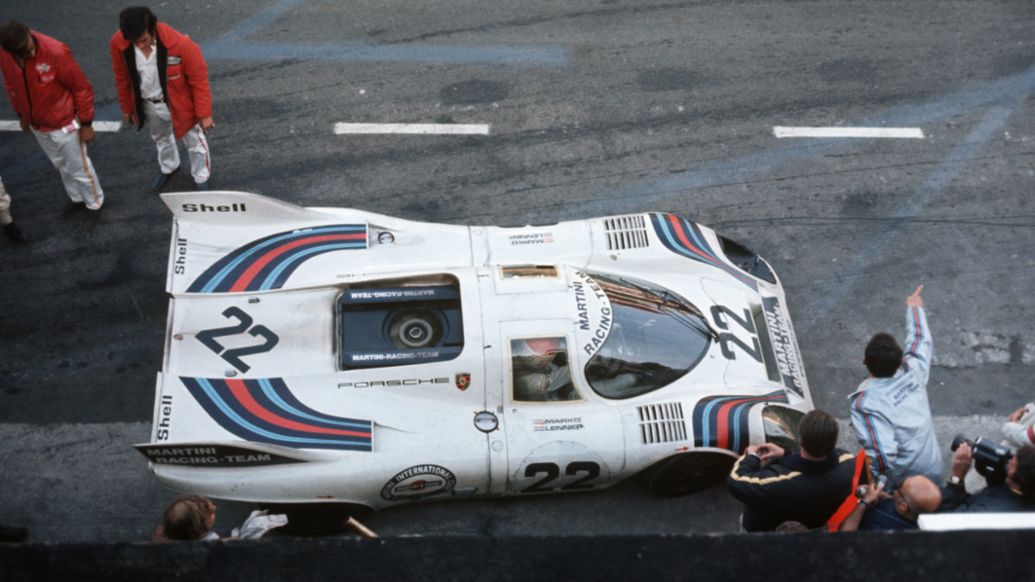
Ever since Porsche participated in this endurance classic for the first time in 1951 and took an immediate class victory with the 356 SL, this race has become indispensable for the sports car manufacturer. But it was a long way to the first big triumph. Until the late 1960s, Porsche skilfully played the role of underdog and successfully concentrated on the smaller displacement classes. So Porsche initiated a change in strategy in the late 1960s. In 1969 Porsche was only 75 metres or a good second short of victory in the closest Le Mans finish in history. But already in the preparation phase for the 1970 race much of what had been learned in the years before was incorporated: Gerard Larrousse and Willy Kauhsen in the Martini Porsche 917 LH, followed by Rudi Lins and Helmut Marko in the Porsche 908/02 took second and third places respectively, making it a triumph for Porsche.
917 KH, 24 Hours of Le Mans, 1971, Porsche AG
In 1971 Gijs van Lennep and Helmut Marko also won the race in the 917 KH
This first win set a precedent: One year later, 33 of the 49 starters were driving a sports and racing car made in Stuttgart-Zuffenhausen – a record which is still held today. A Porsche 917 KH also won the race in 1971. In 1974, Porsche heralded the turbo era at Le Mans with the launch of the 911 Carrera RSR 2.1 Turbo. Porsche recorded the first turbo victory in the history of the race with the 936 Spyder in 1976 with the same car winning again with the works team one year later in 1977. A customer team first entered the list of winners two years later. The success with the Porsche 935 K3 marked the first-ever victory of a rear-engine racing car at Le Mans – and a production-series racing car based on the Porsche 911.
Between 1981 and 1987, Porsche racing cars remained unbeatable at Le Mans. The longest winning run in the history of the 24 Hours began with the third and last victory of the Porsche 936 Spyder. In 1982, the works team launched the new type 956, taking all three places on the podium on its début at Le Mans. The 956 featured Porsche’s first aluminium monocoque chassis and innovative aerodynamics which allowed a powerful downforce without any noticeable increase in air resistance. In the 956 and its successor, the 962 C, the sports car manufacturer drove forward the development of electronic injection and ignition systems as well as today’s very popular Porsche dual-clutch transmission (PDK). From 1983 onwards, Porsche customers also started the race in the 956 and 962 C. Nine Porsche 956 cars featured in the top ten winning teams in 1983 followed by eight in 1984 and 1985 respectively.
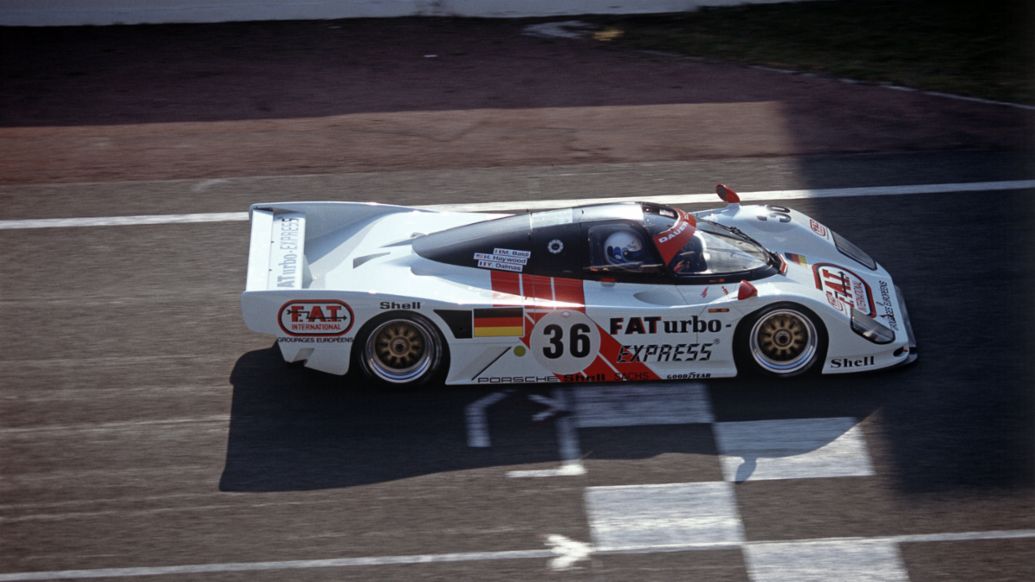
962 Dauer Le Mans GT, 24 Hours of Le Mans, 1994, Porsche AG
In 1994, the 962 Dauer Le Mans GT developed on the basis of the 962 C in Weissach won the race
The 1990s saw four overall victories by the works team and Porsche customers in three different types of racing car, starting in 1994 with the Porsche 962 Dauer Le Mans GT, developed in Weissach and based on the 962 C, followed by the TWR Porsche WSC Spyder developed by Porsche, in which a customer team won in 1996 and 1997. In 1998, the Porsche 911 GT1 `98 entered the race with the first carbon fibre monocoque designed by Porsche as well as the first carbon fibre brakes used by the works team – and won to coincide with the 50th anniversary of Porsche receiving an operating permit for the first sports car, the 356 “No. 1” Roadster.
Following this success, Porsche turned its attention in motorsport to developing close-to-production race versions of the Porsche 911 and its support of private teams. At Le Mans, this commitment was rewarded with eleven class victories between 1999 and 2018. 2014 saw the works team return to compete for the overall victory. Designed "from scratch" in Weissach, the Porsche 919 Hybrid featured unique technical solutions. Only the Porsche generated electric power for the high-performance battery by converting kinetic energy produced when braking and additionally by means of a turbine generator unit in the exhaust gas stream of a V4 turbo engine. The overall system comprising the electric motor and combustion engine delivered around 900 PS. This avant garde solution proved to be a success: from 2015 to 2017, Porsche scored a hat trick at Le Mans.
With 108 class wins and 19 overall victories under its belt, Porsche is the most successful manufacturer in the almost 100-year history of Le Mans. In 2020, Porsche continues the unique tradition of a Porsche sports car taking part in Le Mans every year since 1951: In the virtual 24 Hours of Le Mans, the newly created Porsche Esports Team will take to the start on June 13-14 with four Porsche 911 RSR cars (model year 2017). On the Twitter channel @PorscheRaces current information about the race is shared. A historical review of the 1970 race can be followed on the anniversary weekend on the Twitter channel @PorscheNewsroom.