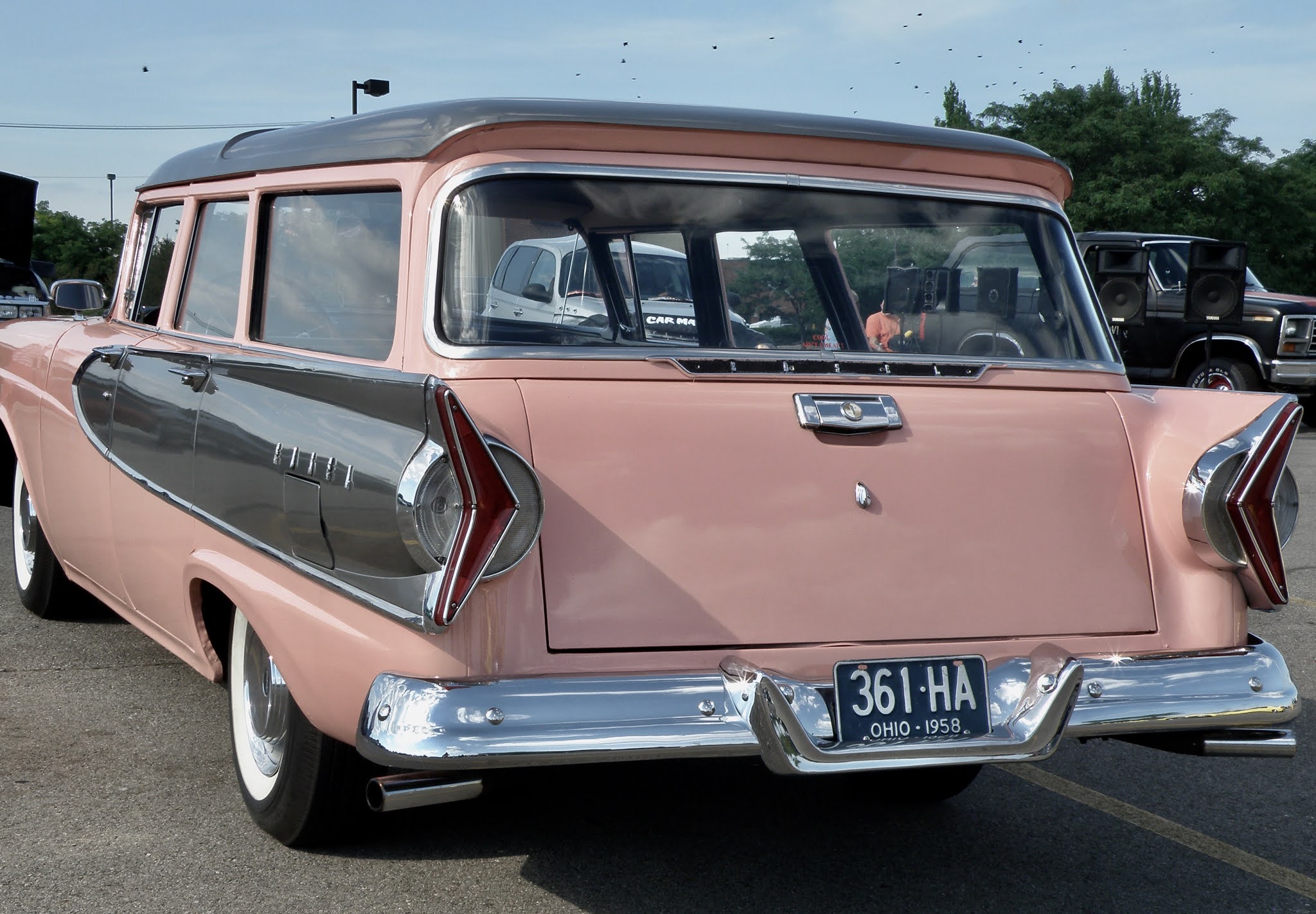
A color revolution took place in the 1950s, and the car pictured below typifies that. Beautiful pastel shade! Rare wagon -- note the push-button shifter located in the steering wheel hub. A pretty car.








From the NYT Obituaries.
John J. Mooney, an inventor of the catalytic converter, the small and ubiquitous device that makes the engines that power everything from cars to lawn mowers less polluting and more fuel efficient, died on June 16 at his home in Wyckoff, N.J. He was 90.
The cause was complications of a stroke, his daughter Elizabeth Mooney Convery said.
Mr. Mooney was a high school graduate working as a clerk at a gas company when his colleagues encouraged him to pursue a college education. After earning a bachelor’s degree and two master’s degrees, he went on to receive 17 patents during his 43-year career with the Engelhard Corporation in Iselin, N.J. (now the Catalyst Division of the German chemical manufacturer BASF).
Among them was the three-way catalytic converter, which has been described by the Society of Automotive Engineers as among the 10 most important innovations in the history of the automobile.
The Environmental Protection Agency has estimated that tailpipe emissions from the newest passenger cars, sport utility vehicles, trucks and buses generate about 99 percent less smog-producing exhaust and soot than those from the 1970 models did.
Development of catalytic converters was spurred by federal regulations that mandated the production of gasoline without lead, which greatly impaired the effectiveness of existing antipollution devices. While early converters were able to reduce emissions of carbon monoxide and hydrocarbons, the 1970 Clean Air Act imposed limits on another pollutant, nitrogen oxides.Mr. Mooney and Carl D. Keith, a chemist, collaborating with their Engelhard colleagues Antonio Eleazar and Phillip Messina, successfully experimented on a 1973 Volvo station wagon to create a catalytic converter that reduced all three kinds of emission.
Simply put, the device filtered the exhaust through tiny passages in a ceramic honeycomb coated with a combination of various oxides, platinum and rhodium. It was introduced on assembly lines in 1976.
Installing a computerized feedback link to the converter resulted in fuel savings upward of 12 percent. Similar technology was later applied to an array of devices, including mining equipment, motorcycles and wood stoves.
Mr. Mooney’s most recent patent, in 1993, was awarded for a converter that reduced emissions from chain saws and leaf blowers by up to 40 percent while improving fuel efficiency.
John Joseph Mooney was born on April 6, 1930, in Paterson, N.J., to Denis Mooney, a lineman for Public Service Electric & Gas, and Mary (Hegarty) Mooney, a nurse.
He went to work for PSE & G after high school (“I was basically a clerk,” he said) but then enrolled in Seton Hall University, where he earned a bachelor of science degree in chemistry.
After serving in the Army at the Enewetak Atoll atomic testing site in the Pacific, he earned a master’s in chemical engineering from the Newark College of Engineering (now the New Jersey Institute of Technology) and, later, a master’s in marketing from Fairleigh Dickinson University.
“Although I liked my chemistry courses well enough, I’ve always had a practical bent,” he once said. “I like to make things happen, and that’s what engineers do — they take the basic science and make things happen.”
In 1960 he joined Engelhard, where he initiated a process to produce hydrogen from liquid ammonia, which enabled the Air Force to inflate weather balloons more efficiently.
In 2002, Mr. Mooney and Mr. Keith received the National Medal of Technology and Innovation from President George W. Bush for their “incredible impact in curbing smog and eliminating some of the most damaging side effects of the internal combustion engine on the environment and on human life.” In 2014, Mr. Mooney was awarded the Science and Technology Medal by the Research & Development Council of New Jersey.
As president of the Environmental and Energy Technology and Policy Institute, Mr. Mooney worked with the United Nations to encourage African countries to ban leaded gasoline.
He retired from Engelhard in 2003.
In addition to his daughter Elizabeth, Mr. Mooney is survived by his wife, Claire (Ververs) Mooney; his son, John D. Mooney; three other daughters, Marybeth Stachowiak, Noreen Dominguez and Kathleen Mooney; 14 grandchildren; and his sister, Kathleen Heintz.
“He is one of a very few individuals that can claim to have made contributions to the automotive industry that led to saving the lives of millions and extending the lives of countless more with cleaner air around the world,” Rasto Brezny, executive director of the Manufacturers of Emission Controls Association, which Mr. Mooney once headed, said by email.
Mr. Mooney had, his daughter Elizabeth said, “an engineering mind.”
“He would say, ‘If you don’t think there’s a solution, then you just haven’t asked the right questions.’”
Correction: June 29, 2020

Fiat Chrysler Automobiles and Waymo are moving well beyond developing self-driving minivans together.
In a dramatic expansion of their four-year-old partnership, FCA and Waymo, once known as Google's Self-Driving Car Project, plan to fit Ram ProMaster Vans with Waymo Driver, the autonomous brains behind the hundreds of Chrysler Pacifica Hybrid minivans in Waymo's ride-hailing fleet. Developing self-driving technology for light commercial vehicles, such as the ProMaster Van, highlights the growing importance companies see in delivery services, particularly since the onset of the COVID-19 pandemic.
But perhaps more significant for the long term in the announcement early Wednesday (late Tuesday on the West Coast) is news that Waymo is now slated to become the "exclusive, strategic partner" for higher-level self-driving technology across FCA's fleet.
No financial terms for the deal were released, and no timeline has been provided.
The moves come as FCA has stopped working with Amazon-backed Aurora Innovation. The two companies signed a memorandum of understanding in June 2019 "to investigate the development and deployment of self-driving commercial vehicles," but the decision was "made to discontinue discussions," according to a statement provided by FCA spokesman Nick Cappa.
Highlighting the strides from the original FCA/Waymo deal, FCA CEO Mike Manley noted that the Waymo-equipped Pacificas operating in the Phoenix area represent a partnership deploying autonomous technology "in the real world, on public roads."
"Our partnership is setting the pace for the safe and sustainable mobility solutions that will help define the automotive world in the years and decades to come," Manley said in a news release, referencing level 4, which would be one level below self-driving technology able to manage all roads and conditions.
Self-driving technology development has continued to move forward in recent years, although many of the rosy early projections about the deployment pace for robocars have not materialized. A fatal crash in 2018 involving a self-driving Volvo operated by Uber boosted public scrutiny considerably.
Much of the development that has come to pass involves driver-assistance technology now available in many models. Waymo, however, has continued its self-driving push and is clearly one of the leaders.
Waymo CEO John Krafcik noted some milestones for the partnership with FCA to date, saying the Pacificas in Waymo's fleet have "safely and reliably driven more fully autonomous miles than any other vehicle."
According to Waymo, its vehicles have driven more than 20 million miles autonomously on public roads in 25 U.S. cities, with 15 billion miles of simulation testing.
Together, we’ll introduce the Waymo Driver throughout the FCA brand portfolio, opening up new frontiers for ride-hailing, commercial delivery and personal-use vehicles around the world,” Krafcik said in the release.
FCA's brands include Jeep, Ram, Chrysler, Dodge, Fiat, Alfa Romeo, Lancia and Maserati.
The Ram ProMaster is built at FCA's Saltillo Van Assembly Plant in the Mexican state of Coahuila. It's based on the Fiat Ducato, which the company builds through a partnership with Peugeot maker PSA Group. FCA and PSA Group are working toward a merger, which would create the world's fourth-largest automaker. They recently announced that the new company would be called Stellantis.
The proposed merger's possible impact on reducing competition in the commercial van sector is an area of concern for European regulators, who last month announced a more in-depth investigation of the companies' plans.
European Commission Executive Vice President Margrethe Vestager said in posted remarks that commercial vans are an "increasingly important market in a digital economy where private consumers rely more than ever on delivery services."
The commission noted in a news release that either FCA or PSA Group is the market leader in light commercial vehicles in many countries, and a merger "would remove one of the main competitors."
Contact Eric D. Lawrence: elawrence@freepress.com. Follow him on Twitter: @_ericdlawrence.
