Popular Posts

Wednesday, August 19, 2020

President Trump, "The Beast," and Goodyear Tires


While President Trump has urged his supporters not to buy Goodyear tires, oddly enough the President's custom limousine, known as the "Beast" rides on custom made Goodyear tires.  Goodyear said in a 2009 statement that it is "the exclusive tire for the presidential limo and the standard tire of the US Secret Service."

Tuesday, August 18, 2020

Joe Biden's Corvette -- Automotive Spiritualism


Note that in the material below mention is made of how when Joe drives the car it brings back thoughts of loved ones now gone. This is one important reason why people buy, restore, and drive old cars. I once had my father's 1979 Malibu. Every time I got behind the wheel I thought of  him. To this day I wish I had cousin Freddy's 1950 Oldsmobile Rocket 88 or 1964 GTO. Those gone seem to be in the car, as memories of what they once said or facial expressions become clear. You could call it rolling spiritualism.


Biden is the original owner of the car, which was a wedding gift from his father, who worked at a Chevrolet dealership. During his time as vice president, he often lamented that he wasn’t allowed to drive it due to security concerns.


In a new video, which appears to have been shot along the drive to his Wilmington, Del., estate, Biden says the car brings back memories of his father and his late son Beau.


Friday, August 14, 2020

One Story about a pre-A 356 Porsche Speedster

“So I spent the winter finding the money,” Hummel recalls, “selling two other Porsches I had, and some rare parts and a bunch of motorcycles that I didn’t need. I really felt like I connected with this car. When an old Porsche still has that charm and personality you’ve got to go for it. It’s become such a rare thing to find because so many of them have been restored and lost their character.” This was not to be a straightforward purchase, however. The owner had bought the car back in 1964 and cherished it ever since. It was a member of the family, and not something he could easily part with.

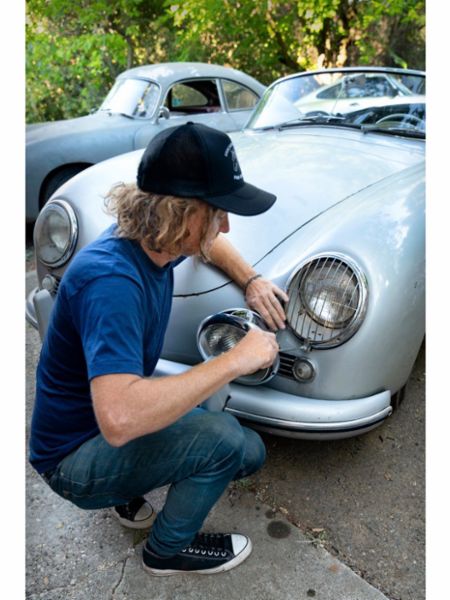
Matt Hummel, Pre-A Speedster, 2020, Porsche AG
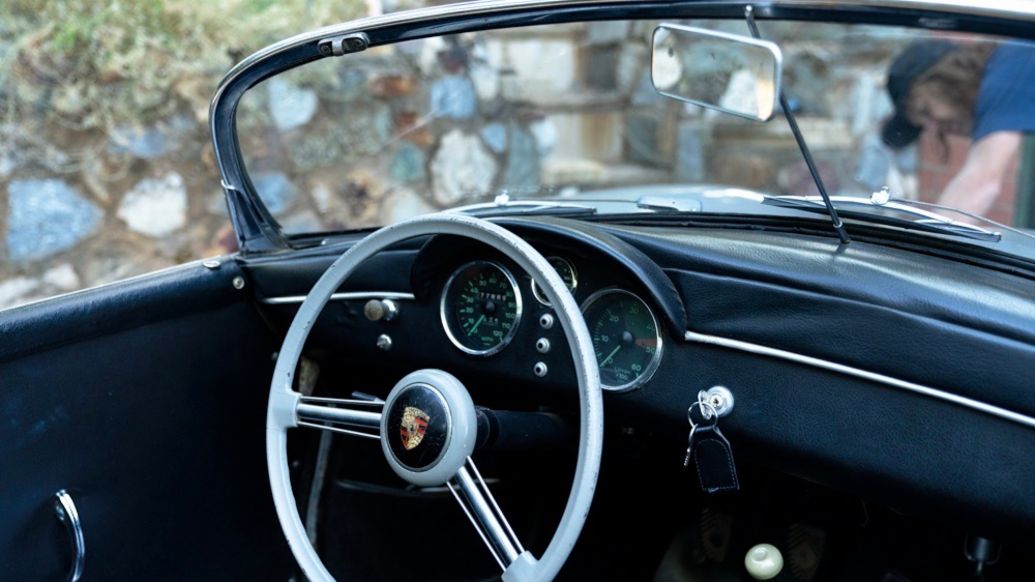
A look inside the Pre-A Speedster's cockpit 

“The owner was dragging his feet on it because it had been a significant part of his life and selling it was the end of an era,” Hummel explains with evident empathy. “And then something happened. He parked the Speedster behind his truck and forgot to set the brake, so as he got out it rolled into the back of the truck, denting the hood and braking a headlight. That’s when he called me and said “So, are you going to come and talk to me about the Speedster or what?” – he didn’t want his wife to know he’d dented it!”

Matt was back in Oregon within 48 hours and a deal was duly struck. He describes the Speedster as ‘an old shoe type of car’, weathered and worn but also familiar and comfortable. It has never undergone a full restoration, instead being carefully maintained with replacement parts and paint over the years, and at some point a colour change to the interior from its original red to black.

"Now I’m part of this Speedster’s log book and history."Matt Hummel

“I have all the documents and receipts from 1964, so everything the owner did he kept a record of. It’s a genuine 77,000-mile car, so it drives pretty nice and I’m very fortunate that he took such good care of it. Now I’m part of this Speedster’s log book and history. I’ve already started adding my receipts and it feels so good to be connected to a car that been so respected through the years.”

Matt Hummel, Pre-A Speedster, 2020, Porsche AG

Anyone familiar with Hummel’s previous 356 projects will not be surprised to learn that he immediately began removing any replacement parts in a bid to return the Pre-A to its correct 1954 specification. “Over the years a lot of original parts had been changed out or upgraded – like reproduction taillights, a new shifter knob or ignition switch. So I’m changing everything back with unrestored factory parts that fit the overall image of the car. It feels like restoring a painting or something now, putting all the fine details back into it. I love doing it – returning an old Porsche to its original glory.”

Hummel has also put the car back onto its original 16-inch rims and correct cross-ply tyres. Future plans include some minor rust repairs to the chassis and, if he can find enough original red upholstery with the right degree of wear, a return to the correct interior specification. But the exterior will remain absolutely untouched, save the one repair to that all important dent.

“A lot of people see what I’m doing and want to help out,” Hummel says. “Some of them have even given me free parts to help bring the car back to absolute originality. The Porsche community is great for that – people are so helpful and supportive. I’m having so much fun working on it and it’s a blast to drive. I really value the experience and cherish the car so much that I actually look on owning it as a gift. It is an honour to take on this car and it’s going to be with me for a long time.”

A History of the Driver's License


Permit for the automotive pioneer: On 2 June 1888, the Mannheim district office in the Grand Duchy of Baden granted Carl Benz permission to “run test drives with the patent car he produced”


1 – Benz: Carl Benz, the inventor of the car, was probably the first ever person in history to be granted a driving licence – even if, back then, a document by this name had not even been developed yet. However, in as early as 1888, the Mannheim district office in the Grand Duchy of Baden granted him permission to “run test drives with the patent car he produced”.

2 – Worldwide: The German Empire officially introduced the driving licence as a certificate for “charioteers’ fitness to drive” in 1909. In the UK, the Motor Car Act, adopted in 1903, made ownership of a driving licence mandatory from 1 January 1904. In the US the first states introduced the licence in as early as 1903 and in France, where the car was popular particularly early on, driving licences were already a requirement in 1899. That first year saw the issuing of almost 1,800 driving licences in the Paris region alone. By the way, using horse and cart did not require a licence and the driving licence for horse-drawn carriages has only been mandatory in Germany since 2017.

3 – Lessons: Nowadays, you need to take lessons and get through a theoretical as well as a practical test before you get a driving licence. Those who pass the tests are handed the sought-after document, permitting holders to drive a car on public roads. This liberty has also been making the driving licence a ticket to adult life for more than 100 years. The history of driving schools goes back to the start of the 20th century. Among others, Mannheim-based vehicle mechanic and racing driver Jean Pfanz, an employee at Benz & Cie., established the first Benz driving school in 1904. The first German driving test was taken in 1904 in Prussia.

4 – Profession: For many people, the driving licence is the foundation for their profession: for instance, lorry drivers and taxi drivers, bus drivers and staff members at logistics companies. One of the “33 Extras” on display at the Mercedes-Benz Museum is a reminder of this in the form of the driving licence for chauffeur and Benz employee Josef Strassl, issued on 10 September 1910.

5 – Digital: Colloquial references in Germany for the driving licence originate from the old days when the permit used to be a grey or pink paper document. Ever since 1999 the driving licence has been a plastic card. However, digital versions have been gaining ground for some time. For instance, Estonia, Kosovo and, since autumn 2019, Norway have also been using driving licence apps.

6 – Sport: Anyone longing to experience their passion for motorsport first-hand needs a corresponding licence – a driving licence for racing drivers so to speak. Available categories range from novice to super licence for Formula 1. Nowadays, it takes a valid, standard driving licence to be able to race at the pinnacle of motorsport. Up to and including 2015 this was not mandatory.

7 – Future: In the foreseeable future we won’t be able to do without driving licences. However, when vehicles begin driving autonomously in the future, who will need a driving licence then? The vehicle owner or the vehicle?

Wednesday, August 5, 2020

Art Cars: The Mutant Vehicles at Burning Man, 2019

I have been interested in art cars since watching the documentary "Wild Wheels." I included a brief discussion of them in the introduction of my The Automobile and American Life. Then last year I wrote an article on VW Beetles and art cars for "The Conversation." It would be picked up by a number of media outlets, including Newsweek Japan. But until now the presence of art cars at the Burning man events totally escaped me. How did that happen?  

While my omission might have been due to my laxity its in keeping up with contemporary culture, it might also be the consequence of the extreme breadth of the topic of car culture.  These Mutant Vehicles have to be approved by a committee before inclusion into the Burning Man event.  Too bad no Burning Man in 2020! Each on of the following images -- and this topic has been widely covered by the media -- deserves some sort of commentary. I will try to do this the next few days, so you might want to check back.


So what does this vehicle tell us? It is a 1959 Chevrolet mounted on top of a tracked construction vehicle. The couple is not sitting together. While the man is manipulating the construction vehicle, the woman is sitting in the bak holding an umbrella. It suggests quite defined gender rilles:  man as the controller, the woman as a passive, fashion-oriented individual. In 1959, we are at the threshold of the Interstate Highway System. Families are going in vacation, enjoying increased leisure, and yet at the same time are distancing from one another. Men and women and living in two distinct worlds, while physically being
 together.

S
Passive and aggressive.


Some sort of God, perhaps? Not a friendly object. A crab claw. A fish with teeth? This bizarre biomimicry also conveys a sense of confusion, lack of integration and purpose. What do you think?
More biomimicry! Why all the sharks? Is the statement they are making one of danger and destruction? The car has plenty of teeth. So what! An exercise in bullshit.


Friday, July 31, 2020

The Hand Crank in Automotive History


What used to require serious muscle power is now just a push of a button: Starting a car engine Security aspects made the ignition key an integral part of the system “33 Extras”: Exhibits of motoring culture at the Mercedes-Benz Museum Stuttgart. 160 vehicles and a total of 1500 exhibits are presented in the varied permanent exhibition of the Mercedes-Benz Museum. The “33 Extras” are a particular highlight: they can bring the history of personal mobility and motoring culture to life using details that are often surprising. The Mercedes-Benz Museum Inside newsletter 1 – Starting procedure: The hand crank was used to start a combustion engine by hand. Switch on the ignition – turn the crank – the engine starts. The underlying technical principle is simple and, interestingly enough, pioneers Gottlieb Daimler and Carl Benz, who developed their motorcars almost simultaneously, chose two very different starting variants for their first vehicles: Benz initially had a horizontally mounted flywheel while Daimler used a hand crank. But the procedure was by no means a simple matter. Crank-starting a car looks easy, but it is, in reality, really heavy work. Turning over an engine requires considerable physical effort. In addition, the motorist must be prepared for a possible backfire, to avoid arm injuries such as the dreaded “chauffeur’s fracture”. 2 – Security level: Around the year 1910, the procedure began to change a bit. Cars began to be fitted with a key switch, which completed the circuit for the ignition system and, at the same time, protected against theft of the vehicle. However, this system was still far removed from an ignition key because after switching on the ignition, the engine still had to be cranked. 3 – Electrically powered assistants: Because cranking a car engine was dangerous and awkward, the electric starter became more and more common around this time, beginning with high-performance models. A permanently mounted, compact electric motor started the engine reliably. The motor was powered by a battery. The driver closed the ignition circuit and briefly turned on the starter. This improved simplicity helped motorcars with internal combustion engines to achieve a breakthrough. However, the hand crank was often still included with a car’s tool kit even into the 1950s – just in case it did not start with the starter motor. 4 – A turn for the better: From the 1920s onwards, the combined ignition and starter switch became increasingly popular; at that time it was considered a high-tech product. By turning the key, the driver closed the circuit and ran the starter motor in one go. In addition, the ignition-start switch was another anti-theft feature because after the key was removed, the steering wheel locked in a fixed position. In addition, now that increasing numbers of cars had closed bodies, their doors could also be locked with a separate key. 5 – Two into one does go: The ignition-start switch was standard for many decades. Through to the 1960s, it remained common practice to have several keys for the car. It was a real step forward when the keys for the doors and the ignition lock were merged into a single combination key. 6 – Symbol of mobility: The ignition key is an expression of mobility as it symbolises both access to the car and a certain independence. Sometimes there are special keys for special cars: Queen Soraya of Persia was presented with an ignition key made of solid gold when she took delivery of her Mercedes-Benz 300 SL Gullwing (W 198). 7 – Additional functionality: The next step was the central locking system. From 1963, Mercedes-Benz offered this system as a pneumatic version in the representative 600 (W 100). It had already been available as an optional extra in the 300 SE LWB (W 112) and, from 1972, it was available for the S-Class (model series 116). The need to walk right round the car to check that the doors were locked and pushing the buttons inside to lock them was a thing of the past. In the 1990s, the car key with built-in electronic circuitry could even be used as a remote control transmitter: unlocking or locking the car was a simple matter of pushing a button. 8 – Open sesame: In 1999, Mercedes-Benz introduced the KEYLESS-GO system in the S-Class. The doors could be opened as soon as one stood beside the vehicle and the state-of-the-art key stayed in one’s pocket. A start-stop button replaced the ignition lock, and the engine was started and stopped with a finger tip. And that was not all, because the motorcar had generally become more complex: that push of a button was the start signal that initiated all the underlying electronic systems in the background. 9 – Shaping up for the future: Over the decades, the ignition key not only lost its bit – it also changed its appearance as a whole and became, for example, credit card shaped. Today, there are compact smart keys – and smartphones can replace them completely. In the latter case, a virtual key is stored on the mobile device, which sensors in the car recognise as being a key and allow access to the vehicle. 10 – Motorsport: Starting the engine in racing cars has undergone a similar development. In the early years they were also started with a hand crank. Starting in the 1930s, the Silver Arrows were equipped with an external starter motor that was only used for starting the car and was then removed and stored in the pits. This is because a permanently installed starter would increase the vehicle weight unnecessarily. The external starting device is still standard in motorsport today. Before it is applied, the mechanics use their laptops to monitor whether all systems are “go”. Understandably, these cars do not need conventional anti-theft protection.