Popular Posts

Wednesday, March 24, 2021

David Coulthard and Mercedes-Benz

  • On 27 March 2021 the Scottish racing driver will celebrate his 50th birthday
  • In 1996 he joined the Formula One team and drove for McLaren-Mercedes for nine years
  • The first victory of the new Silver Arrows era in 1997 was to his credit
  • His head of motorsport Norbert Haug: “David is and always will be a highly valued friend”

It is a rare feat for a Formula One driver to race for the same team for nine years. David Coulthard is one of those exceptions. “Between 1996 and 2004 he raced for McLaren-Mercedes 150 times and won 12 Grand Prix races in Formula One. From 2010 to 2012 he drove an AMG Mercedes C-Class in the DTM,” says Christian Boucke, head of Mercedes-Benz Classic. “Coulthard retained a close link to the company after his racing career – he was active as a Brand Ambassador for many years. On 27 March 2021 he will turn 50. Congratulations, David!”


The winner at Interlagos: David Coulthard won in a McLaren-Mercedes MP4-16 at the Brazilian Grand Prix in 2001

The first victory of the new Silver Arrows: For Mercedes-Benz, David Coulthard’s triumph on 9 March 1997 at the Australian Grand Prix was outstanding. It was not only the first victory for the McLaren-Mercedes team, but with the new black and silver design of the MP4/12 racing car it marked the birth of the modern, new Silver Arrows, which are still so successful to this day. The 1997 season opener in Melbourne was the beginning of a third era of Mercedes-Benz Formula One racing cars after 1934 to 1939 and 1954/1955. The silver McLaren-Mercedes had Formula One World Champions in the form of Mika Häkkinen in 1998 (McLaren-Mercedes MP4/13) and 1999 (McLaren-Mercedes MP4/14) along with Lewis Hamilton in 2008 (McLaren-Mercedes MP4-23). With the Mercedes factory team Hamilton, and one time Nico Rosberg, impressively continued this series of World Championships from 2014 to 2020.

A long career: In his third year in Formula One David Coulthard moved to the McLaren-Mercedes team in 1996. For nine years he drove alongside Mika Häkkinen and Kimi Räikkönen for the British-German team. His most impressive successes included the victories at the Monaco Grand Prix in 2000 and 2002 and at his British home Grand Prix at Silverstone in 1999 and 2000. In 2001 Coulthard came second in the World Championship. After 246 starts in Formula One and 13 victories, Coulthard ended his career in Grand Prix sport in 2008. He drove 31 races for the Mücke Motorsport team between 2010 and 2012 in the DTM with an AMG-Mercedes C-Class and in his last year as a racing driver came fifth at the Norisring.

The head of motorsport on his driver: Norbert Haug, Mercedes-Benz head of motorsport from 1993 to 2013, worked closely together with Coulthard for nine years in Formula One and three years in DTM. He calls the Scot a “highly valued friend, who has been a member of the Mercedes-Benz family for a quarter of a century, which is more than half his life”. The driver duo of Mika Häkkinen and David Coulthard was characterised by the experienced head of motorsport as follows: “A real stroke of luck. Back then it was impossible to imagine a better combination of drivers – who respect and improve one another and, at the same time, have a great image and popularity.”

All-rounder: David Coulthard has handled the transition from elite athlete to entrepreneur, operating in many different fields very well. As a Brand Ambassador for Mercedes-Benz he was involved in marketing campaigns of new AMG models and in various events after 2011. “DC”, as he’s known in the paddock, runs his own film production company, accompanies Formula One as a TV commentator and is involved in hotels and restaurants. Coulthard enthusiastically drives historic racing cars on circuits or his own Mercedes-Benz 280 SL (W 113) on the streets of his home of Monte Carlo. He bought the “Pagoda” from the year of his birth, 1971, as his first very own car in 1995.

The early years: David Coulthard was born 50 years ago in Twynholm, Scotland, into a family obsessed with motorsport. His grandfather drove in rallies, his father Duncan Coulthard won a Scottish kart championship. On his eleventh birthday his father gave him his own kart and at 12 he became Scottish junior champion – the first of many titles. In 1989 he won the championship title of the British Formula Ford 1600 at the first attempt. David Coulthard was successful in Formula Three and Formula 3000 races. And he gathered Formula One experience as a test driver for Williams. When Ayrton Senna tragically died on 1 May 1994, Coulthard became a regular driver on the team of Frank Williams and in 1995 won the Portuguese Grand Prix in Estoril. In 1996 he switched to McLaren-Mercedes.

Friday, March 19, 2021

How the Electric Motor in Porsche Taycan Turbo S Works!

Please sit back. If you fully depress the accelerator pedal of a Porsche Taycan Turbo S, you will experience 12,000 reasons to choose a stable seating position. The driver and passengers are pressed into the upholstery in a manner that almost takes their breath away when the top model of the electric sportscar unleashes its collective torque of 12,000 Nm on all four wheels at once (Taycan Turbo S: CO2 emissions combined 0 g/km, Electricity consumption combined 28.5 kwh/100 km). The concentrated power is discharged in full without any delay and the thrust from the two electric motors on the front and rear axles remains virtually unchanged up to top speed.

This dose of adrenaline is the active ingredient in Porsche’s unique drive technology. It’s no coincidence that the renowned Center of Automotive Management (CAM) declared the Taycan the world’s most innovative model of 2020. At Porsche, innovation has always meant pushing technology to the extreme. In this case, that means exploiting the potential of the electric drive in a way that no one has ever done before.

Steered wheelhub motors from Ferdinand Porsche

Porsche did not come up with this concept just yesterday – or even the day before. In fact, it was more than 120 years ago. At that time, a young Ferdinand Porsche achieved a world first when he developed electric vehicles with steered wheelhub motors. The possibilities offered by electromobility spurred on his sporting ambition, and his racing car became the world’s first all-wheel-drive passenger vehicle. 

Porsche electric motor, 2021, Porsche AG
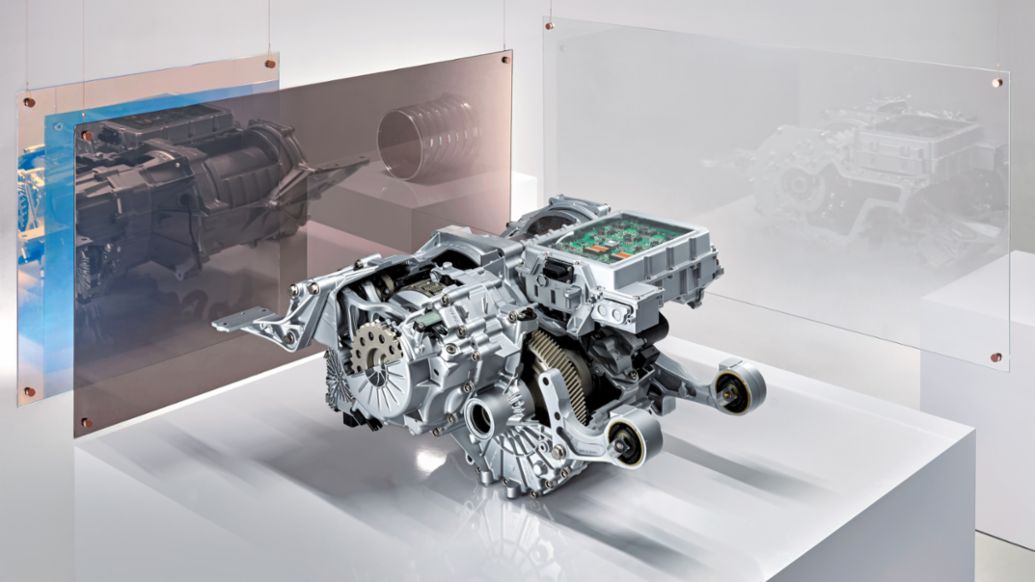
Powerhouse: the electric motor and two-speed gearbox (front) are arranged parallel to the rear axle. The power electronics are located on top.

The simple DC motors of yesteryear have long since been replaced by more sophisticated machines. However, the basic physical principle has remained the same: magnetism. A magnet always consists of a north and a south pole. Unequal poles attract; equal poles repel. On the one hand, there are permanent magnets, which are based on the interplay of elementary particles. On the other, magnetic fields also arise every time an electric charge is moved. To amplify the electromagnetism in play, the current-carrying conductor in an electric motor is arranged to form a coil. Electromagnets and – depending on the design of the motor – permanent magnets are arranged on two components. The stationary part is called the stator, the rotating part is the rotor, which turns when attractive and replusive forces are generated by periodically switching the electrical voltage on and off. 

PSM instead of ASM

Not every type of electric motor is suitable for propelling a vehicle. Porsche makes use of the permanently excited synchronous machine (PSM). Compared to the predominantly used design – the cheaper asynchronous machine (ASM) – the PSM offers higher continuous output because it overheats less easily and therefore does not have to be turned down. Porsche’s PSM is supplied and controlled via power electronics with three-phase AC voltage: the speed of the motor is determined by the frequency at which the alternating voltage oscillates around the zero point from plus to minus. In Taycan motors, the pulse inverter sets the frequency of the rotating field in the stator, thereby regulating the speed of the rotor.

Porsche electric motor, 2021, Porsche AG
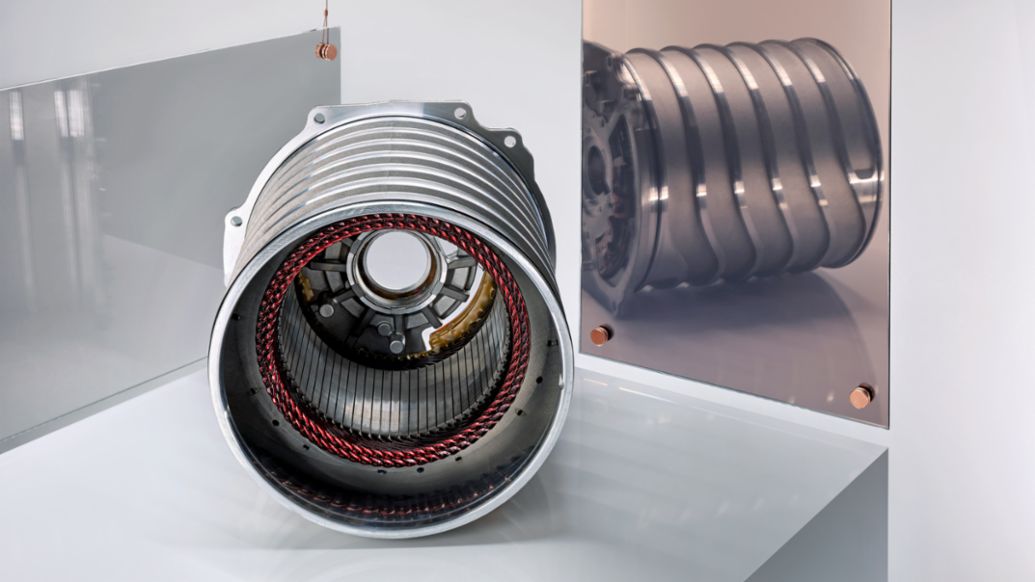
Centrepiece: the stator of the e-motor essentially consists of circular sheet-metal discs layered into a tube and the copper coils. U-shaped bent wires are inserted into gaps in the tube and connected to each other.

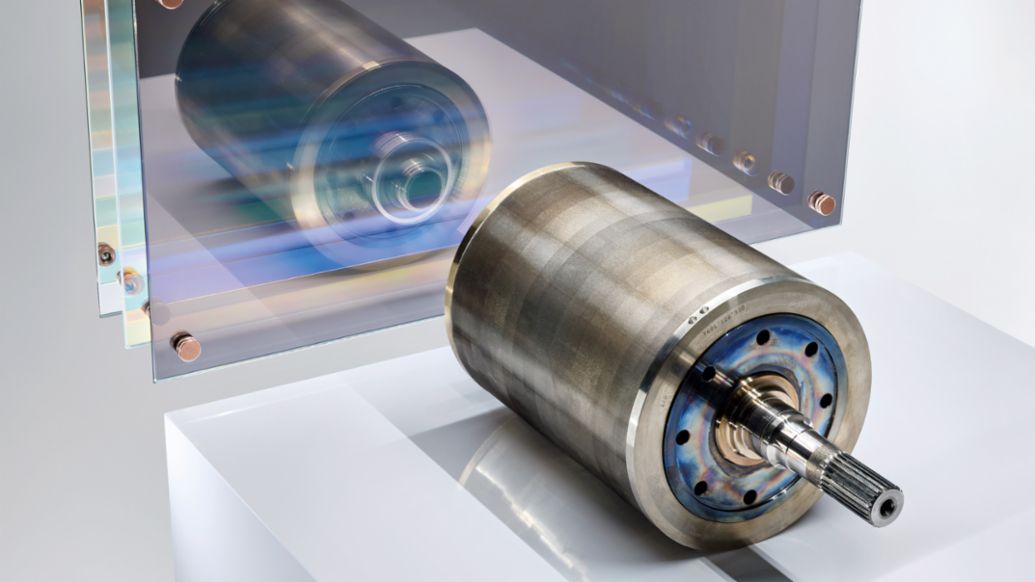
The rotor contains high-quality permanent magnets with neodymium-iron-boron alloys that are permanently magnetised during the manufacturing process via a strong directional magnetic field. The permanent magnets also enable a very high degree of energy recovery through recuperation during braking. In overrun mode, the electric motor goes into regenerative mode while the magnets induce voltage and current into the stator winding. The recuperation performance of the Porsche e-motor is the best among the competition. 

Hairpin winding: a special feature of the Taycan motors

Technology driven to its very limits: this Porsche gene is reflected in a special feature of the Taycan motors, known as the hairpin winding. Here, the coils of the stator consist of wires that are not round but rectangular. And unlike classic winding processes where the copper wire is obtained from an endless reel, hairpin technology is what is known as a forming-based assembly process. This means that the rectangular copper wire is divided into individual sections and bent into a U-shape, similar to a hairpin. These individual ‘hairpins’ are inserted into the stator laminations in which the winding is mounted in such a way that the surfaces of the rectangular cross-section lie on top of each other.

Porsche electric motor, 2021, Porsche AG
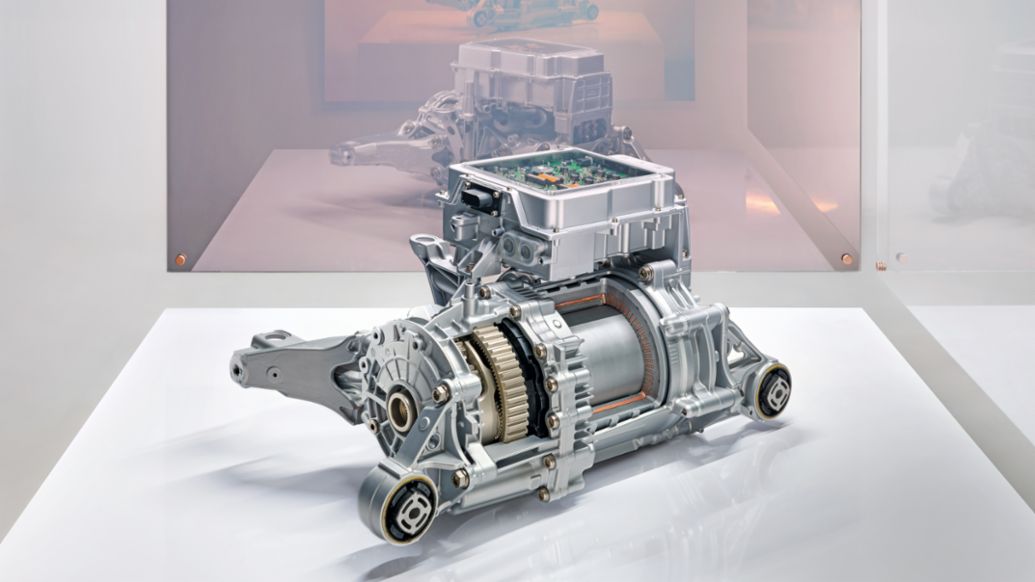
Compact: the front-axle drive of the Taycan is designed to be even more space-saving than the drive unit in the rear. The motor and gearbox are arranged coaxially; the rotor, gearbox, and axle shafts are in line.

This is the decisive advantage offered by hairpin technology: it allows the wires to be packed more densely, thereby adding more copper to the stator. While conventional winding methods have a copper fill factor – as it is known – of around 50 per cent, the technology used by Porsche has a fill factor of almost 70 per cent. This increases power and torque with the same installation space. The ends of the wire hairpins are welded together by laser, creating the coil. Another important advantage is that the homogeneous contact between adjacent copper wires improves heat transfer and a hairpin stator can be cooled much more efficiently. Electric motors convert more than 90 per cent of the energy into propulsion. But just as in an internal combustion engine, the losses are converted into heat that has to be dissipated. That is why the motors have a cooling water jacket. 

Culmination of Porsche expertise in the pulse inverter

In order to precisely control a permanently excited synchronous motor, the power electronics must know the exact angular position of the rotor. This is what the resolver is for. It consists of a rotor disc made of field-conducting metal, an exciter coil, and two receiver coils. The exciter coil generates a magnetic field that is transmitted via the encoder to the receiving windings. This induces a voltage in the receiving coils, the phase position of which are shifted proportionally to the rotor position. The control system can use this information to calculate the exact angular position of the rotor. This control system, known as the pulse inverter, is the culmination of Porsche expertise. It is responsible for converting the battery direct current at 800 volts into alternating current and supplying it to the two e-motors.

Porsche electric motor, 2021, Porsche AG
Flywheel mass: the rotor is filled with permanent magnets arranged in a V-shape.

Porsche was the first manufacturer to implement a voltage level of 800 volts. Originally developed for the Porsche 919 Hybrid race car, this voltage now reduces weight and installation space in series production thanks to leaner cables, enabling shorter charging times. The electric motors reach up to 16,000 revolutions per minute. To make optimum use of this speed range for Porsche’s signature spread between dynamics, efficiency and top speed, the front and rear drive units each have their own transmission. The Taycan is the first electric sports car ever to have a transmission with two shiftable gears on the rear axle, the first of which has a very short reduction ratio. On the front axle, an input planetary gearbox transmits power to the wheels.

These combine to give the Taycan Turbo S its mighty powers. At the front axle, the gear ratio translates the 440 Nm generated by the electric motor to around 3,000 Nm at the wheels. Some 610 Nm from the rear-axle motor are multiplied in first gear to about 9,000 Nm of axle torque. The task of the longer-ratio second gear is to ensure efficiency and power reserves at high speed. This is pioneering technology, applied to the smallest detail – and a continuation of Porsche’s tradition of innovation in the age of the electric drive.

Wednesday, March 17, 2021

The Geneva Motor Show: A Premier Venue for Mercedes-Benz and the 220SE Coupe (W 111)

Traditionally, this is the first major European motor show of the year and has a long history. The first of these was hosted by the Swiss Automobile Club (ACS) on 29 April 1905 at a polling station covering 1,200 square metres. The Mercedes-Benz parent company based in Stuttgart – rather than the Swiss representative – was on-site at the 1926 Motor Show for the first time. The exhibition area covered by the Motor Show, which took place annually, was constantly expanded. Compared to other trade fairs such as those in Detroit, Frankfurt and Tokyo, however, it remained comparatively small – but of a high standard, as one would expect in sophisticated Geneva. In 2020 and 2021, this exclusive show was cancelled due to the coronavirus pandemic.


Stuttgart. In the past, the Geneva Motor Show has always been a dazzling premiere venue for Mercedes-Benz. A look back over our shoulders brings back some very special memories: thus it was, 60 years ago, that the laid-back elegance of the 220 SE Coupé (W 111) thrilled the public. It was 30 years ago that the S-Class in model series 140 attracted the public eye in Geneva. In a less spectacular manner, but nevertheless of a high profile because of their tremendous utility value, two estate models aroused considerable attention 25 years ago: in 1996 Mercedes-Benz added a sporty estate variant (S 202) to the C-Class line-up of models for the first time. And the E-Class Estate (S 210) presented at the same time featured unrivaled spaciousness.


Mercedes-Benz 220 SE Coupé (W 111): In 1961, one of the most elegant coupés in the brand’s history was displayed at Lake Geneva. That luxurious two-door model – and together with it the cabriolet presented in autumn of the same year – was then built for eleven years with a range of different engine and transmission variants. Technically, the 220 SE Coupé was based on the “tail fin” saloon and, like the latter, was assigned the model series designation W 111. The unchanged floor assembly offered plenty of room for four seats and a large boot. However, the coupé’s body was 80 millimetres lower than that of the saloon, so only the radiator grille and the front light units could be carried over. The six-cylinder engine developed 88 kW (120 hp) from a displacement of 2.2 litres. The coupé and cabriolet are still coveted models today: the later versions with V8 engines, in particular, are amongst the most sought-after Mercedes-Benz classics.


Tuesday, March 16, 2021

Rule-Making and Rule-Breaking: Automobility and Film During a Decade of Constraints, 1970-1979


My favorite girls and my favorite car -- a 911 Targa


The Winners!


A Work-In-Progress


Rule-Making and Rule-Breaking: Automobility and Film During a Decade of Constraints, 1970-1979

By John Heitmann, Department of History, University of Dayton


Twenty years ago I considered the views of sociologist David Gartman as vulgar Marxism. But as I look at the post-World War II history of the automobile in America in 2021, I believe I was wrong.  In his book Auto Opium,  Gartman suggested that the two-toned, V-8 powered car of the era was nothing more than an opiate for hard-working Americans during the Cold War era. Accordingly, the automobile, no matter what model, was essentially the same. It served to lessen the rather harsh realities of a competitive capitalist system with its class structure, repetition, dehumanization, and repressive impulses. In short, it was at the heart of a “contradictory system.” It follows that during the 1950s, the car was a symbol and an expression of freedom at a time in American life when autonomy was in retreat. Freedom, then, was often quite illusory. 

The automobile was also at the center of American notions of freedom. Journalist George Packer summed up the meaning of American freedoms in his acclaimed book The Unwinding as  "freedom to go away, freedom to return, freedom to change your story, get your facts, get hired, get fired, get high, marry, divorce, go broke, begin again, start a business, have it both ways, take it to the limit, walk away from the ruins, succeed beyond your dreams and boast about it, fail abjectly, and try again." The automobile facilitated all that and more.

No discussion of freedom and the rebels that pursued that freedom during the 1950s could be complete without at least briefly mentioning Jack Kerouac’s On the Road (1957). The novel became one of the most important works of twentieth century literature and set the stage for innumerable travels and soul searching. A reflection of the social and cultural ferment of the early Cold War era, On the Road redirected the American road narrative as well.  It is a story about a people on the margins of society – transients, disaffected intellectuals, farm laborers, and racial minorities. On the Roadalso takes us into the world of the 1950s that was far removed from middle class suburbia of the day – bop music, spontaneity, recklessness, drugs, and promiscuous sex. It seems unlikely, however, that Kerouac was just aiming in On the Road to describe a dark underworld populated by fascinating characters, the composite of which is one snapshot of America usually not taken. Certainly On the Road is infected with youthful optimism, far different from the negativity displayed in Henry Miller’s The Air-Conditioned Nightmare, or John Steinbeck’s The Wayward Bus. It also is far removed from the dark tale of a road trip gone bad, best exemplified in the classic 1945 film Detour.

Despite the institutional constraints placed upon Americans during the 1950s – by government, religious organizations, educators, community, and family -- the American automobile industry had virtually no countervailing power placed upon its exercise of autonomy. The industry’s first critics only surfaced in the late 1950s, and were largely ignored by the public, who had little options but to buy from the “Big Four,” led by General Motors. However, the early 1960s marked winds of change, the result of General Motors unconventional Corvair, and the efforts of a crusading lawyer convinced that the car was unsafe at any speed.

This is not the time to go into the Corvair or Ralph Nader stories, but to say that the result was the unleashing of a political and consumer firestorm that led to the federal government placing reigns on the industry for the first time. And perhaps rightfully so. In absolute numbers, traffic fatalities had risen from 34,763 in 1950, to 39,628 in 1956, to 53,041 in 1966, and 56,278 by 1972. During those years, the holidays between every Christmas and New Year resulted in the death of approximately 1,000 Americans. The rise of the interstate highway system beginning in 1956 and the marked increase in younger drivers contributed to the alarming trend. Design also played its part; along with horsepower gains, cars of the mid‑1960s often possessed poor handling characteristics and abysmal braking capabilities.

The seminal legislative action that set in motion strict automobile safety regulations was the 1966 National Traffic and Motor Vehicle Safety Act.  Beginning in 1968, this Act mandated that seatbelts, padded visors and dashboards, safety doors and hinges, impact absorbing steering columns, dual braking systems, and standard bumper height be installed in all new autos sold in the U.S. Push-back emerged immediately. Critics to these regulations, however, argued that these measures would do little to save lives and prevent injuries. History has proved them to be somewhat correct. Economist Sam Peltzman demonstrated in the mid-1970s that automobile safety devices resulted in “off-setting behavior” on the part of a number of motorists who engaged in more risky behavior as a result of the introduction of features that were designed to increase their chances of surviving a crash. And while seatbelts, soft interiors, and improved glass reduced driver fatalities, risky behavior increased the chance that a bicyclist or pedestrian would be killed or injured.

A second area where government had to step in and force manufacturers to take responsibility was the environment, particularly air pollution. Air pollution and haze first became an issue in Southern California, and it was California that first responded legislatively to the problem, with the federal government subsequently following the state’s lead. For years, manufacturers had claimed that devices to reduce the level of pollutants would take considerable time and research to develop. Industry’s hand was forced, however, in terms of technical feasibility, by the California legislature. In 1964 California certified four emissions control devices designed by aftermarket companies, and then mandated that devices of these types be installed on 1966 car models. In 1966, of an estimated 146 million tons of pollutants discharged into the atmosphere in the United States, some of 86 million tons could be attributed to the automobile. 

            As in the case of safety, a seminal federal act related to automobile emissions was passed and enacted in the mid-1960s, the Motor Vehicle Air Pollution and Control Act.30 This act set limits in terms of carbon monoxide and hydrocarbons, and was amended in 1971 to include evaporated gasoline. Additionally, the emissions stipulations in the Federal Clean Air Act (1970) further reduced allowable pollutants with the newly created Environmental Protection Agency as the enforcer. 

In the wake of this legislation, however, Detroit responded shamelessly in terms of seriously tackling the issue. Rather than make substantial investments in a new generation of cleaner cars, the Big Three merely added aftermarket stopgaps to existing engines, thus minimizing their costs. In the process, they produced autos with very poor performance and drivability characteristics.

During the late 1960s and early 1970, Detroit manufacturers defied, circumvented, and publicly decried the new rules, and many Americans, including both auto enthusiasts and younger Americans did as well. Authority be damned, whether it be over illegal drugs, the Vietnam War and the Draft, policing methods, or speed. It was then that distrust in government heightened. Institutional controls gradually unwound, in part justified by Nixon administration lies and deception.

As younger Americans were taking to the road, there emerged a questioning as to whether the journey was a quest for self-knowledge or knowledge about others, and whether it was transformative or purposeless. It was in 1971, in the wake of the Kent State Shootings, the Attica Prison riots, blowing up or ROTC Buildings, the intensified bombing of North Vietnam, Mai Lai massacre, and increasing disillusionment, that two important road movies were released. Vanishing Point and Two Lane Blacktop.  Vanishing Point featured as its hero an ex-Marine, Vietnam War veteran, policeman and motorbike racer Kowalski (Barry Newman). At the beginning of the film Kowalski has just arrived in Denver, and despite the offer to spend time with a prostitute, instead decides to take a deliver a fast Dodge Challenger in a return trip. As the  jaunt unfolds in the vast spaces of the desert, we learn of the driver’s virtuous past through a series of flashbacks. Due to excessive speed, he becomes hunted by various State’s police as one might expect. But Kowalski has gained freedom for a time. Aided only by a blind black disc jockey named Super Soul (Cleavon Little), Kowalski is called “the last beautiful free soul on the planet.” Others who come to Kowalski’s aid include a black biker, two white hippies, and an old snake-catcher in a broken down car. All are individuals at the margins, like our hero, and like the primary characters in On the Road. As the road trip ends, as Kowalski accepts defeat, and rams his car into a police barricade.

While Vanishing Point was remade in the 1990s starring Vigo Mortenson as Kowalski, Monte Hellman’s Two Lane Blacktop, also released in 1971, has become a cult classic despite being a box-office flop. The film’s stars are nameless: the Driver (James Taylor), Mechanic (Dennis Wilson), G.T.O. (Warren Oates) and the Girl (Laurie Bird). Perhaps the unusual deaths of Wilson, Oates and Bird added to the mystique of this road movie to nowhere, where the characters are nameless, but the cars are listed in the cast as Chevrolet and Pontiac. The actors are largely silent, expressing themselves at times with facial expressions sensitively captured by Hellman. And the race is futile. Gratification is not forthcoming, echoed by The Girl who sings “I can’t get no satisfaction” while playing pinball.

One thing is undeniable about the influence of Two Lane Blacktop -- it  fired the enthusiasm of journalist Brock Yates to organize a series of coast to coast speed trials in 1971 and 1972 called the Cannonball, or Sea-To-Shining Sea Memorial Trophy Dash. Yates had asked himself, “When was the last time Ayn Rand sent somebody on a cross-country motor race?” With eight contestants, Grand Prix Driver Dan Gurney, assisted by yates, won the first prize in a Ferrari with an elapsed time of 35 hours and fifty four minutes and average speed of 80 miles per hour. A second event was sponsored by Car and Driver in 1972, and this time the winners, Steve “Yogi”Behr and Bill Canfield, won in a Cadillac with a time of 37 hours sixteen minutes and an average speed of 78.04 mph.

Oil Shock I in 1973 served to separate the earlier two runs from the latter two in terms of the motives of these adventures – the 55 mile per hour national limit chaffed drivers more than any forced design modification or governmental edict. The oil shocks of 1973 and 1979 also did more to forcefully influence Detroit’s direction in the manufacture of more fuel-efficient automobiles than the federal government’s Corporate Average Fuel Economy (CAFE) standards and the 1978 Gas Guzzler Tax. Indeed, the shortage of petroleum products and the rise in the cost of gasoline, along with foreign competition, carried more weight in transforming automotive technologies than consumer demand or government regulation. And it emboldened government bureaucrats to flex their muscles, including Department of Transportation heads John Volpe, who had previously argued that government can do a better job of designing cars than the industry.

As early as 1971 Volpe lectured to auto enthusiasts in the magazine Motor Trend that 

Actually, highway safety regulations do not violate a person’s right to a private life. Whenever a person drives a vehicle onto a public road, he leaves his private life behind him. Public roads belong to the State and the State can, indeed must, set appropriate standards regarding the use of those roads.

No man is an island unto himself when he is wheeling down a highway in a truck, an automobile, or a motorcycle. First of all he is a potential threat to anyone else using the same roadway – or along it if he should leave the roadway out of control. Secondly, if he has an accident, even if he is the only one hurt, it is going to cost the State money.…


            A 55 mile-per-hour national speed limit, the result of Oil Shock I, was undoubtedly the most significant federal mandate effecting everyday life of drivers after 1973. The National Maximum Speed Law, a provision of the Federal Emergency Highway Energy Conservation Act, took the authority of speed limits out of the hands of the states and remained in force until 1995. The intent of the law was to both save lives and reduce gasoline consumption. Loss of life from the measure proved minimal at best, according to Stephen Moore at the Cato Institute. The overall consumption results also proved disappointing; while it was projected that the national demand for gasoline would drop by 2.2%, it is estimated that it achieved saving only between .5 and 1%.

Many Americans both hated and defied the 55-mile-per-hour limit. Two technologies emerged during the 1970s to help circumvent ‘Smokey’ and his speed traps and radar guns. Citizens band (CB) radios were first used by truckers, and then by passenger car owners. CB radio users had individual ‘handles,’ or catchy names, that suggested one’s individuality and values.

Drivers unhappy with the “double nickel” speed limit also created a mass market for radar detectors.  Beginning in the early 1950s, police effectively used Doppler-effect radar systems to keep down speeds on busy highways, and reduce alarming fatality rates. The American Automobile Association denounced the use of these devices, and drivers tried to scramble signals by putting tin foil and steel marbles in their hubcaps, only to be charged with obstruction of justice if caught.

            In 1955 more than 20% of all speeding arrests were achieved by radar, with conviction rates between 90-100%. Radar detectors were soon built by electronic hobbyists, perhaps the most famous being John Davis Williams, a RAND Corporation scientist who had expertise in statistical radar detection for military applications. In 1958 the amateur radio magazine CQ published an article entitled “Radio Speedmeter Receiver.”  The technology for that device was ingeniously modified to create the first commercially available radar detector, the Radatron Radar Sentry, that was featured on the cover of Popular Electronics in September, 1961. The Radar Sentry remained in the marketplace until the early 1970s. It was later made obsolete by a host of competitors with names like Fuzzbuster, Bearfinder, Road Patrol, Wawassee Alley Cat, Snooper, and Whistler. The best perhaps, was the Electrolert Fuzzbuster, developed by Dale T. Smith. Incensed over a speeding ticket, Smith designed, and then promoted, the best radar detector of that day. Further, he proved to be an effective lobbyist for the devices, arguing that American citizens have a right to know when they are being watched electronically, even as they drive. 

With the national speed limit set at 55, Car and Driver magazine called for entries set for a Cannonball start on April 23, 1975. With 18 entrants, Jack May and Rick Cline took the prize in a 1973 Ferrari Dino 246GTS and a time of 35:53. In addition to the Ferrari, the contest featured a Dodge Challenger, Mercedes 450 SL, Porsche 911 RSR, a 1975 Buick Electra, and a very unlikely1951 Studebaker. The race was featured on the cover of the August issue of Time, andHollywood was quick to follow with Cannonball, and Gumball Rally. Cannonball, starring David Carradine, was a hastily pieced together film, with sloppy cinematography, bland landscapes, poor character development, and for the most part  unremarkable vehicles. The Gumball Rally, however, proved to be the best of the lot of these coast-to-coast films. With a relatively undistinguished cast led by Michael Sarrazin, Susan Flannery, and Gary Busy, it the cars and their sounds – a Cobra, Ferrari, Porsche 911 Targa, Mercedes 300 SL and Rolls-Royce that  emerged as the stars, along with wonderful road scenes and landscapes. It is a film still worth watching.

A final bash took place in 1979, with the winners finishing in an elapsed time of 32:51 driving a 1978 Jaguar XJS. A 1984 Hal Needham directed film entitled Cannonball Run followed.  It proved to be a corny and tiresome picture that demonstrated how no matter how many stars are featured -- including Burt Reynolds, Dom De Luise, Dean Martin, Sammy Davis, Jr., Jamie Farr, Ricardo Montalban, Telly Savalas, Shirley MacClain, Jackie Chan, Tim Conway, and Don Knotts -- a bad script can relegate the work to the level of crap. Roger Ebert gave the film half a star out of four, calling it "one of the laziest insults to the intelligence of moviegoers that I can remember. Gene Siskel also gave a harsh review of this film, calling it "a total ripoff, a deceptive film - that gives movies a bad name." 

Similar films from the 1970s that did not follow the Cannonball formula, but promoted a general defiance toward authorities and a celebration of autonomy and freedom. The best were Convoy and Smokey and the Bandit. The regional center of these speed limit defiant films was attributed to the Deep South, ironic in a way since it was by far the most conservative of all regions in America. In the case of Smokey and the Bandit  the iconic car of the 1970s became the 1977 Pontiac Firebird Trans-Am. 

Friday, March 12, 2021

Mercedes-Benz SL Class, Facts and Figures, 1952-2020


  • The abbreviation SL was derived from the designation “super light”
  • Lightweight roll cage whose elements were subjected only to tension and compression loads
  • Aerodynamic aluminium-magnesium body with a height of only 1,225 millimetres
  • Flat racing car front instead of the classic, upright Mercedes-Benz radiator grille
  • Coupés with gullwing doors hinged to the roof
  • M 194 engine based on the M 186, installed at an angle of 50 degrees to the left and with dry sump lubrication
  • Removable steering wheel to make it easier to get in and out of the car
  • Debut at the Mille Miglia in Italy with 2nd (Karl Kling/Hans Klenk) and 4th (Rudolf Caracciola/Peter Kurrle) places.
  • Success in the Bern Grand Prix (triple victory), the 24 hours of Le Mans (one-two victory), the Nürburgring Grand Jubilee Prize (quadruple victory) and the Carrera Panamericana (one-two victory). 

300 SL racing prototype (W 194/11, 1953)

  • In-line six-cylinder M 198 engine with direct petrol injection
  • Body with magnesium panelling
  • Rear single-joint swing axle with low pivot point
  • Transaxle gear arrangement
  • Development for the 1953 racing season, but not used due to preparations starting in 1954 for the planned Formula One entry 

Mercedes-Benz 300 SL (W 198, 1954 to 1957)

  • Lightweight roll cage
  • Coupé with gullwing doors hinged to the roof, which was structurally necessary because of the high sills in the roll cage that restricted access
  • First petrol injection in a four-stroke engine in a production vehicle
  • Twenty-nine 300 SL Coupés were produced with an aluminium body that was 130 kilograms lighter
  • One-off for testing purposes with a GRP (glass fibre reinforced plastic) body
  • Successful in motorsport: Including class victory at the 1955 Mille Miglia (John Cooper Fitch/Kurt Gessl), European Touring Car Championship titles in 1955 (Werner Engel) and 1956 (Walter Schock) as well as class victories in the USA Sports Car Championships in Production Class D in 1955 and 1956 (Paul O’Shea). 

Mercedes-Benz 190 SL (W 121, 1955 to 1963)

  • Modern four-cylinder engine with one overhead camshaft
  • Modern chassis for improved ride comfort and a high standard of safety
  • First open-top standard-production sports car in the SL tradition with a fully retractable folding soft top
  • Floor assembly from the planned Mercedes-Benz 180 (W 120) cabriolet
  • The successor to the previous Cabriolet A expressed the new product philosophy
  • Body design by Walter Häcker inspired by the shape of the 300 SL
  • The sport version was built as a small-batch run 

Mercedes-Benz 300 SL Roadster (W 198, 1957 to 1963)

  • Introduction of Dunlop disc brakes and light-alloy engine block from 1961 onwards
  • Seat belts available as optional equipment from 1958 onwards
  • Rear wheel suspension with single-joint swing axle
  • Available from 1958 as roadster, coupé and coupé with roadster soft top
  • Last Mercedes-Benz passenger car model with a separate frame
  • Basis for competition car 300 SLS, the winning car of the 1957 US Sports Car Championship in Category D (Paul O’Shea) 

Mercedes-Benz SL of the W 113 model series (1963 to 1971)

  • Remarkably easy-to-operate folding soft top
  • Initially, there were three versions: 
    • Roadster with a folding top
    • Coupé with a removable roof and roadster top
    • Coupé with a removable roof, but without the roadster top; more space for luggage
    • For all three: A transverse seat in the rear on request
  • As of 250 SL (1967) additionally available: Coupé with rear seat bench
  • Six-cylinder engine with six-plunger injection pump
  • Automatic transmission available for the first time on an SL
  • Safety body with rigid occupant compartment and deformable front and rear sections
  • Numerous other safety features such as interior designed so as to reduce injury hazards in accidents and an articulated steering column
  • Interior designed without hard edges and corners so as to reduce risk of injury in accidents
  • Steering gear moved from the crash-prone area at the front of the car to the firewall, articulated steering column to prevent the dreaded lance effect in a crash.
  • As of 1967: Telescopic safety steering column and the dashpot in the steering wheel were added
  • Disc brakes on the front axle, as of 250 SL (1967) also on the rear axle
  • Nickname “Pagoda” was inspired by the inwardly curved (concave) lines of the hardtop
  • First Mercedes-Benz passenger car with radial ply tires 

Mercedes-Benz SL from the R 107 model series (1971 to 1989)

  • Further developed safety body
  • Frame/Floor system with different sheet thicknesses and resulting carefully defined crumple behaviour
  • Roll-over protection: High-strength A-pillars and windscreen frame with bonded-in glass
  • Tank in impact-protected area above rear axle
  • Special air ducting on the doors ensures low soiling of the side windows and exterior mirrors
  • Dirt-resistant broad-band rear lights
  • First SL generation with a V8 engine (350 SL and 450 SL, 1971)
  • Contactless transistorised ignition, Bosch K-Jetronic, hydraulic valve play compensation (1975)
  • First SL with catalytic converter (1985)
  • Evocative model designation 300 SL was revived (1985)
  • Constructive basis for the SLC luxury class coupés of the C 107 model series
  • Following the great rally successes of the SLC Coupés, a 235 kW/320 hp rally car based on the 500 SL was built for the 1981 season, but was not used. 

Mercedes-Benz SL from the R 129 model series (1989 to 2001)

  • Fully automatic roll-over bar even with the hardtop in place (deployment time: 0.3 seconds)
  • Highly stable integral seats with complete belt system and electrically powered adjustment functions
  • Drag coefficient of 0.32 (with hardtop)
  • Automatic electric-hydraulics for the folding soft top
  • World premiere of the draught stop
  • Adaptive Damping System ADS (optional)
  • High torsional stiffness due to elaborate body construction
  • First twelve-cylinder engine in an SL (1992)
  • The SL 60 AMG (280 kW/381 hp) was the first AMG model in the SL tradition (1993)
  • Electronic Stability Program ESP® (1995)
  • Newly developed five-speed automatic with torque converter lockup clutch in the SL 500 and SL 600 (1995)
  • Brake Assist BAS (1996)
  • Cruise control down to 30 km/h (1996)
  • Top-of-the-range SL 73 AMG 7.3-litre engine (386 kW/525 hp, 1999) 

Mercedes-Benz SL from model series R 230 (2001 to 2012)

  • Folding Vario roof with sophisticated articulation mechanism and a deployment time of only 16 seconds
  • Design details reminiscent of the 300 SL of the 1950s
  • Full functionality of the sensor-controlled roll-over bar even with the folding Vario roof closed
  • Chassis with Active Body Control ABC
  • New head-thorax airbags in the doors
  • Drag coefficient of 0.29 (vehicle closed)
  • Use of lightweight components for best fuel economy
  • SL 65 AMG with V12 biturbo engine (450 kW/612 hp) was the world’s most powerful series production roadster (2004)
  • New front design as part of the facelift (2008)
  • SL 63 AMG modified for the racetrack as the official Formula One Safety Car (2008 and 2009)

Mercedes-Benz SL from the R 231 model series (2012 to 2020)

  • Body and other components made almost entirely of aluminium: While offering greater inside space, the car was up to 140 kilograms lighter than the predecessor model series
  • Boot lid as a composite construction made of steel and plastic
  • Improved side impact protection through solid external side members
  • Body-in-white construction up to 110 kilograms lighter than predecessor, at the same time with 20 per cent higher torsional stiffness
  • Engines up to 29 per cent more economical
  • Folding Vario roof made of double-skin roof elements with magnesium frame and plastic panelling
  • Available with optional glass roof and MAGIC SKY CONTROL – with adjustable tint and transparency
  • Drag coefficient of 0.27 (vehicle closed)
  • HANDS-FREE ACCESS: Hands-free and contactless opening of the boot lid via foot movement in front of a sensor in the bumper
  • Electromechanical direct steering with speed-dependent steering power assistance and transmission ratio which was variable by adjusting the steering wheel angle
  • Folding Vario roof with MAGIC SKY CONTROL (optional equipment): Glass roof with switch-controlled tint and transparency settings
  • MAGIC VISION CONTROL: Adaptive windscreen washer system with direct washing function through the wiper blades
  • Sun-reflective leather for the seats
  • Sound system with front bass system
  • SL 65 AMG: (V12 engine with 463 kW (630 hp) and 1,000 newton metres