Popular Posts

Thursday, April 8, 2021

The Mercedes R 107 Roadster -- 50 years now! And I own one that I love!


  • Eight-cylinder engines in the production SL for the first time
  • During the 18 years of its production, more than 237,000 Roadsters of this model series were built
  • The open SL was the basis of the SLC luxury class coupés in model series C 107
  • Continuous expansion of the model range with six- and eight-cylinder engines

Stuttgart. Fifty years ago, in April 1971, Mercedes-Benz initiated a new chapter in the fascinating history of the SL sports car: the 350 SL was the brand’s first SL with a V8 engine and the first model in the R 107 model series to bear the “R” abbreviation for “roadster” for the first time. The completely new development, as an open two-seater with a fully retractable fabric top and removable hardtop, was a self-confident, sporty but luxurious vehicle and combined both performance and ride comfort perfectly. In the same year, Mercedes-Benz derived the four-seater luxury class coupés of the C 107 model series from the R 107 model series.

The R 107 is a worthy addition to the ranks of the SL family alongside the 300 SL racing sports car (W 194) from 1952, the 300 SL standard-production sports cars (W 198, as a coupé from 1954 to 1957 and as a roadster from 1957 to 1963), the 190 SL (W 121, 1955 to 1963) and the “Pagoda” SL of the W 113 model series (1963 to 1971). In 2021, the brand with the star is continuing its tradition of SL sports cars by launching the Mercedes-AMG SL in model series R 232.

A model for success with 18 years of series production

The R 107 was produced from 1971 to 1989, during which time it was kept up to date with regular facelifts and new engines. With the exception of the G-Class, no other Mercedes-Benz has been produced for longer. Technically speaking, the Mercedes-Benz 350 SL launched 50 years ago had little to do with its direct predecessor, the W 113 “Pagoda” SL. Instead, the designers forged much closer links to the brand’s current passenger car range of the time: the front and rear suspension systems, for example, were based on the “Stroke/8” models of the upper medium-size category. The 147 kW (200 hp) V8 engine with a displacement of 3,499 cc was a carry-over from the premium-class Mercedes-Benz 280 SE 3.5 of the W 111 model series (coupé and cabriolet) and the W 108/109 model series (saloon).

The technical innovations found in the open sports car included the enhanced safety body development with an independent frame-floor unit made of sheets of different thicknesses to provide defined crumple behaviour, the fuel tank installed above the rear axle to protect it in the event of a collision, high-strength steels in the A-pillars and windscreen frame with its glued-in glass, as well as the interior with a new four-spoke safety steering wheel, padded surfaces and deformable elements as a contribution to passive safety. From March 1980, this SL was fitted with the ABS anti-lock brake system and, from January 1982, with a driver’s airbag and belt tensioners as a supplementary restraint system – these items were available as optional extras.

Wide variety of engine options

Following the debut of the 350 SL, Mercedes-Benz continued to expand the range of this model series. In 1973, the 165 kW (225 hp) 450 SL, also with an eight-cylinder engine, that had initially been reserved for export to North America from autumn 1971, appeared on the European markets. In 1974, the six-cylinder 280 SL (136 kW/185 hp) version followed. For the first time in the history of the SL, this meant that a model series was now available with a choice of three different engines.

As a result of the 1980 facelift, the 380 SL (160 kW/218 hp) replaced the 350 SL, and the 500 SL (177 kW/240 hp) took over the position as the top model in place of the 450 SL. As part of the extensive overhaul, the interior of the sports cars, among other things, was adapted to match the S-Class Saloons of the 126 model series. In addition, the engineers upgraded numerous technical items, such as the transmission. Externally, the facelift was restricted to a few discreet improvements, among other things involving new bonnets made of light alloy and a front spoiler. The 500 SL was also fitted with the light-alloy boot lid with a black plastic rear spoiler from the SLC Coupé with the 5-litre V8 engine.

In 1985, Mercedes-Benz once again presented a completely revised model range for the R 107 model series. Besides slight changes to the exterior with 15-inch wheels and a uniform front spoiler for all the models as well as improved front suspension with zero scrub radius, the main focus was on an updated choice of engines. A highlight for all the fans of the sports cars with the star was the 300 SL with a 3-litre six-cylinder engine – because this 138 kW (188 hp) sports car revived the model designation with which the SL story had begun in March 1952. The 420 SL (160 kW/218 hp) was a completely new addition, while the 500 SL (180 kW/245 hp) was given a redesigned engine with an electronic ignition system and the Bosch KE-Jetronic electronically controlled mechanical fuel injection system. The top model of the R 107 series was the 560 SL with a spectacular 5.6-litre V8 engine, which, however, was reserved for export to North America, Japan and Australia. All the models were now offered with a closed-loop three-way catalytic converter.

Production of model series R 107 ended in August 1989, after more than 18 years. Over that period, the Sindelfingen plant had produced a total of 237,287 cars. Today, these open two-seaters are sought-after classics: the combination of luxury and sportiness still fascinates enthusiasts to this day.

Friday, April 2, 2021

Happy Easter!


 He is risen! To set the captives free!

Tuesday, March 30, 2021

Cartoons and Caricatures of Driving in America, 1902-1909.

Puck began in 1871 as a German language cartoon, caricature, and political satire magazine. It ended its run in 1918. The artwork is remarkable and a statement of American attitudes concerning the automobile during the first full decade of its diffusion.  The illustrations are simply wonderful.


Puck
, April 16, 1902.This ilustration shows a wealthy old man as a passenger in an automobile driven by his chauffeur. They are racing through the countryside during a cross-country auto race and have struck several pedestrians who are not used to encountering automobiles on country roads. 


Puck
, 1903.This cartoon shows Buster Brown wildly driving a car with his dog, Tige, beside him and the Yellow Kid hanging onto the rear seat; the car hits a group of men who are tossed into the air.


Puck, 1907. This illustration shows a candlestick with flame labeled "Speed Madness" and speeding automobiles caught in the illumination with people falling out of the cars. The wreckage collects in the basin of the candlestick holder.


Puck, 1909. 
This illustration shows an automobile driven by a chauffeur speeding down a road, surrounded by newspaper clippings with headlines about numerous taffic accidents involving pedestrians struck by automobiles, including one where a chauffeur was charged with first-degree murder in the death of a 13-year-old boy.


Puck, 1907. Four young people are drunk.  They are riding in a speeding automobile driven by "Demon Rum".


Friday, March 26, 2021

A Sunday Drive on the Hakone Turnpike

Where

Hakone Turnpike, Kanagawa, Japan

Length

14 kilometres, one way

Type

A classic Japanese ‘touge’ mountain pass, with smooth and sweeping bends surrounded by lush vegetation, topped off with unspoilt views of Mount Fuji.
 

As she prepared to return and set up home on the other side of the world in Los Angeles, Japanese teenager Kyoko Yamashita asked for just two things from her father: braces and a driver’s licence. And so began an early love affair with cars and car culture that would influence the marketing executive and self-confessed petrolhead right into adulthood.

Having grown up between LA and Tokyo, Yamashita travels regularly back to the Japanese capital, and it is from here that one of her dream drives starts. “I like to meet up with a friend or two for an early morning coffee in Tokyo before driving for around 90 minutes to the Hakone Turnpike. This is the starting point for one of my most satisfying driving getaways, and because I don’t get to drive it that frequently, I like to plan a whole weekend around it.”

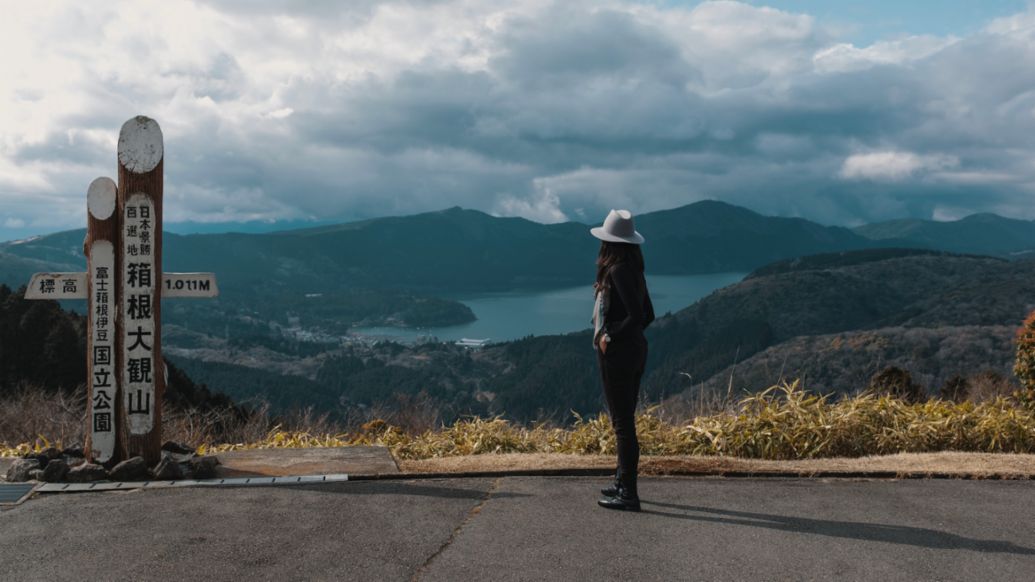
Kyoko Yamashita, Kanagawa, Japan, 2021, Porsche AG
Kyoko Yamashita on the Hakone Turnpike

The Hakone Turnpike is one of Japan’s most celebrated ‘touge’, the mountain roads synonymous with tuning and drift culture today. In this instance it is also a popular escape for many residents of the greater Tokyo area who want to get out of the city and back to nature. The area’s famous hot springs bring hard-working urbanites out in the droves for relaxing weekend breaks beneath the magnificent snow-capped peak of Mount Fuji.

Japan’s mini Nürburgring

“The road itself is quite short – about 14 kilometres,” Yamashita says, “but it’s a privately-owned toll road so it doesn’t get too busy. Obviously on the weekends you have your fellow motoring enthusiasts, both bikes and cars, but even then it’s not too bad. And the best part is that if you don’t exit the toll road on the other side, you can keep going up and down for as long as you like. Even though it’s a two-way road, lots of people refer to it as Japan’s mini Nürburgring.”

Around 100 km south west of Tokyo, the fastidiously maintained Hakone Turnpike climbs to over 1,000 m on an elevated road punctuated at regular intervals by rest areas and an observation deck at the summit complete with a cafeteria selling snacks and coffees for the onward journey. Surrounded by lush vegetation and with stunning views towards Mount Fuji, it’s a destination in itself but also a go-to route for local motoring media and manufacturers looking to put the latest hardware through its paces.

The Hakone Turnpike is not a typical alpine pass

“It’s not a super-twisty or high-speed road,” Yamashita says, “but it is very smooth and full of long, sweeping curves. It’s perhaps not as demanding as your typical alpine pass; I’d say it’s a little more relaxing while still being challenging enough. There are several blind corners and parts of the pass are high bridge sections, so you get a real sense of height as you climb the mountain.”

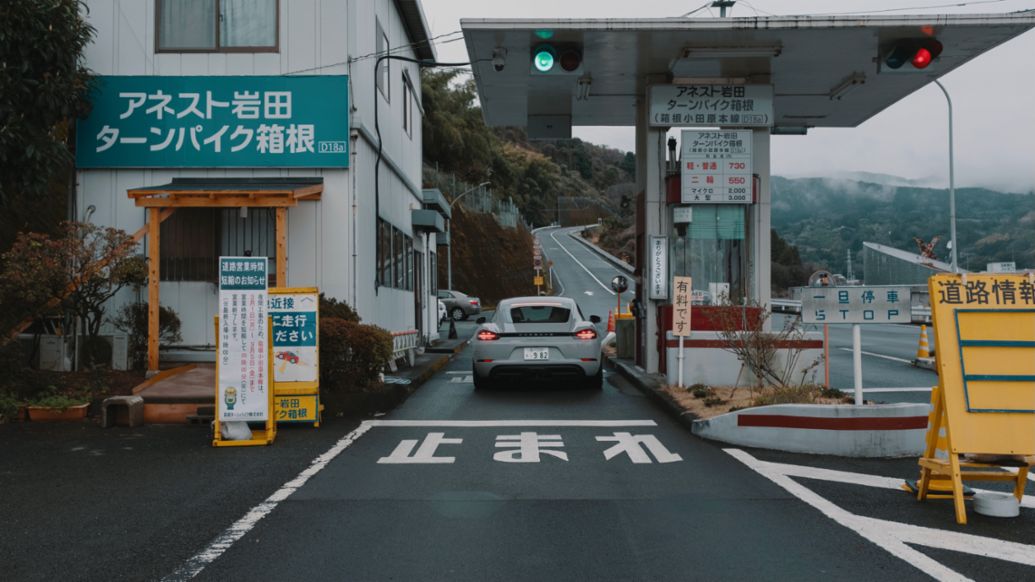
718 Cayman, Kanagawa, Japan, 2021, Porsche AG

Entry through the toll costs 1460 Yen (around 11 Euros) and except in extremes of winter weather it is open year-round. Yamashita suggests trying to make the trip on either side of the summer months, however. “The best season to go is Spring when the cherry blossoms start blooming, one of those truly iconic images of Japan. But Autumn offers an amazing array of colours too – you’re surrounded by beautiful foliage everywhere.”

Yamashita’s Porsche history started with a 987 Cayman S

With Yamashita’s own cars back home in California, her perfect accompaniment for this drive takes her back to when the Porsche bug first bit. “In LA I have a 997 Turbo and an ’88 911 Carrera 3.2, both with a manual gearbox. They are special cars to me and I love them for different reasons. But my Porsche ownership history started with a 987 Cayman S. It was my first mid-engine car and the first car I took to the track. Many, many times in fact. I lived in San Francisco at the time and would go to Sonoma Raceway, Laguna Seca and Thunderhill. I had that car for nearly four years and it was really hard letting her go! I loved that mid-engine driving feeling, so for a road like the Hakone Turnpike, my preferred car would be a Cayman. Or maybe the 718 Spyder.”

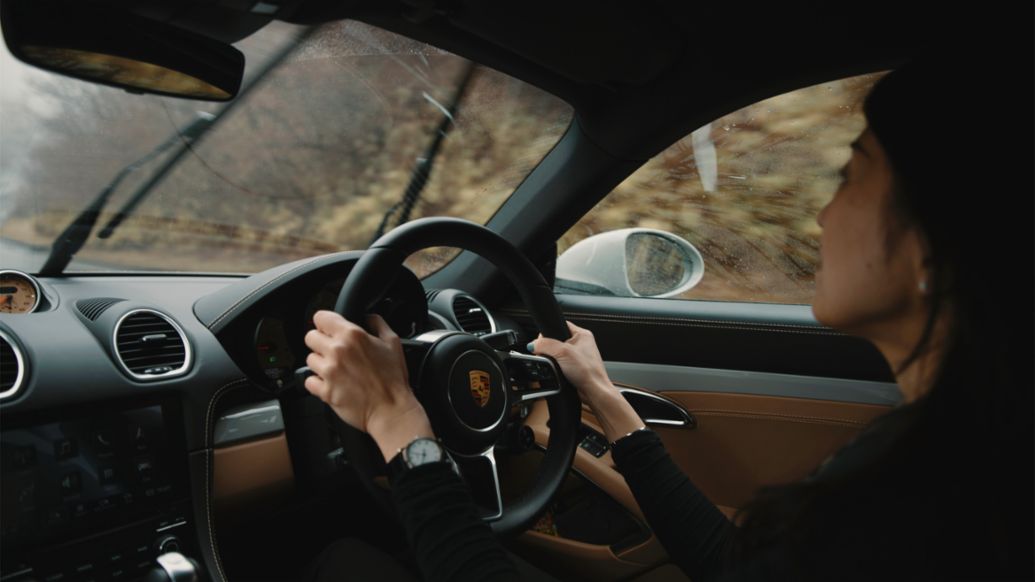
Kyoko Yamashita, 718 Cayman, Kanagawa, Japan, 2021, Porsche AG

A one-way trip over the Turnpike could take less than half an hour, but if you are determined not to double back, at the far end of the toll road you can pick up various alternative routes such as the Ashinoko and Hakone Skyline or the zig-zagging 401. “I usually jump on the road south for 40 or 50 km into the Izu peninsula,” Yamashita says, “where there is an area known for its early cherry blossom along the riverside. If I have the time I will drive down there and stay for the rest of the weekend.”

Relaxation is as essential an element of driving for Yamashita as the buzz it also clearly offers her. When asked if she has a go-to soundtrack for her road trips, her answer is enlightening. “I love music, but driving to me is a form of therapy. I used to be one of those drivers who had to have music on, but today I enjoy focusing on the road ahead and taking in the scenery. When I come back to Japan and get a chance to leave the busy streets of Tokyo behind, driving is very Zen for me. The sound of the engine gets the adrenaline going and I like the balance and the flow of just being in that moment.”


From Automotive News Europe, March 26, 2021


Mercedes-Benz is about to unveil a new flagship model it expects to boast market-leading battery range, following through on its pledge to compete in the luxury electric-vehicle segment with top technology.

The April 15 debut of the EQS -- the first Mercedes built on dedicated electric-car underpinnings -- will mark a milestone for the German brand that has been criticized for taking too long to embrace EVs.

Next year, Mercedes will be making eight fully electric cars on three continents, Chief Operating Officer Markus Schaefer said in a phone interview.

“We boosted flexibility of all factories worldwide so that we can produce hybrids, fully electric cars and combustion vehicles everywhere, depending on customer demand and individual market developments,” Schaefer said. “It took a while for us to prepare all this, but now it’s time to deliver.”

The more than 700 km (435 miles) of range Mercedes expects the EQS to achieve in lab testing is another indication Germany’s automakers will have something to say about Tesla's early domination of the EV space.

Volkswagen Group last week announced plans to become the new global sales leader no later than 2025, while BMW  forecast battery-car sales will account for roughly half of deliveries by the end of the decade.

Mercedes is in the midst of a fundamental overhaul that will include a painful restructuring of combustion-engine sites that the manufacturer depended on for a century. The revamp has culminated in parent Daimler AG’s plan to spin off its truck operation this year, the most significant strategic move since the company sold off Chrysler.


Thursday, March 25, 2021

Nice Week, March 25-29, 1901: The Mercedes Brand Name was Born


Nice Week, 25 to 29 March 1901. Nice–La Turbie hill climb on 29 March 1901. Several two-seater racing cars in La Turbie. The second car from the left is the Mercedes 35 hp of Albert “Georges” Lemaître (2nd place), to the right is the Mercedes 35 hp driven by the winner, Wilhelm Werner (starting number 5). (Photo signature in the Mercedes-Benz Classic archives: R10386)


Nice Week, 25 to 29 March 1901. Photo of Baron de Rothschild’s Mercedes 35 hp, driven by Wilhelm Werner, on the Promenade des Anglais in Nice. Emil Jellinek (with sideburns) is standing on the right behind the vehicle inside the barriers. (Photo signature in the Mercedes-Benz Classic archives: 1972M283)


Nice Week, 25 to 29 March 1901. Nice–La Turbie hill climb on 29 March 1901. Wilhelm Werner, who subsequently won the race, at the wheel of the Mercedes 35 hp owned by Baron Henri de Rothschild. Photo taken in La Turbie. (Photo signature in the Mercedes-Benz Classic archives: 71255)


No less than two milestones in the history of Mercedes-Benz were achieved by the important “Nice Week” racing event from 25 to 29 March 1901: 120 years ago, the era of the modern car began with the victory in Nice of the Mercedes 35 hp made by Daimler-Motoren-Gesellschaft and, at the same time, the Mercedes brand name was born. Emil Jellinek, at that time the most important dealer for Daimler-Motoren-Gesellschaft (DMG), named the high-performance car he commissioned after his favourite daughter Mercédès, who was born in 1889. In the years leading up to this, the motorsport enthusiast and businessman had already competed in a number of races under the pseudonym “Monsieur Mercédès”.

On 23 June 1902, DMG had applied to register the brand name Mercedes as a trademark, and on 26 September 1902 that brand name was registered and legally protected. In 1909, DMG also had the three-pointed Mercedes star registered with the Imperial Patent Office. The merger of DMG with Benz & Cie. in 1926 to form what was then Daimler-Benz AG resulted in the new Mercedes-Benz brand. Its tremendous global appeal since then was also reflected in the international brand report “Interbrand 2020”: Mercedes-Benz is the only German brand amongst the top ten “Best Global Brands” and the most valuable luxury automotive brand in the world.

The brand family of today’s Mercedes-Benz AG, as a globally recognised manufacturer of luxury vehicles, includes the car brands Mercedes-Benz, Mercedes-AMG, Mercedes-Maybach, Mercedes-EQ, G-Class and smart. This is supplemented by Mercedes me as the brand for digital services provided by Mercedes-Benz.

Crucial successes of the Mercedes 35 hp at Nice Week 120 years ago

Nice Week included a whole series of races and was a major motorsport event.

  • Nice–Salon–Nice endurance race over 392 kilometres on 25 March 1901: Wilhelm Werner won the event at an average speed of 58.1 km/h. This went down in history as the first ever racing victory by a Mercedes car.
  • Nice–La Turbie hill climb on 29 March 1901. Wilhelm Werner won in the two-seater racing car class in the Mercedes 35 hp owned by Henri de Rothschild (“Dr Pascal”) in a new record time at an average speed of 51.4 km/h ahead of Albert “Georges” Lemaître, also in a Mercedes 35 hp. The category of six-seater cars was won by driver Thorn at an average speed of 42.7 km/h, also in a Mercedes 35 hp.
  • A further milestone success was in the record-breaking achievement by Claude Lorraine-Barrow in a Mercedes 35 hp, who set a new world record for one mile from a standing start, averaging 79.7 km/h on 28 March 1901 in a series of runs, which was also part of the five-day Nice Week event.

Luxurious automotive lifestyle

At the turn of the 20th century, Nice on the Côte d’Azur was an international centre of motoring culture. Especially in the winter months, the sophisticated upper class from all over Europe and also from overseas met here. Motorsport was one of the highlights of the luxury motoring lifestyle. The Nice–La Turbie hill climb had been staged since 1897. It is considered to be the first hill-climb race in the world to be officially held as a competition.

From 1899, the hill climb was the highlight of Nice Week. It was organised by the Automobile Club de Nice and the magazine “La France Automobile”. Emil Jellinek, whose family spent the winter periods in Nice, entered a Daimler 12 hp racing car with a “Phoenix” engine in 1899. The car, driven by racing driver Wilhelm Bauer, won the Nice–Colomars–Tourettes–Magagnosc–Nice race over a distance of 85 kilometres at an average speed of 34.7 km/h. In the prestigious Nice–La Turbie hill climb, Arthur de Rothschild took second place in the category of four-seater cars at the wheel of a Daimler 12 hp “Phoenix” at an average speed of 41.1 km/h.

Jellinek insisted on even more powerful cars from DMG for Nice Week in the 1900 season. In this way, the ambitious businessman became an innovation driver of automotive technology, which was still in an early stage of development. DMG responded by producing the 23 hp “Phoenix” car. However, Emil Jellinek’s involvement with two of these cars during Nice Week from 26 to 30 March 1900 came to a tragic end. The car driven by Hermann Braun overturned during the Nice–Draguignan–Nice endurance race – fortunately without any major consequences. During the Nice–La Turbie hill climb, however, experienced works driver Wilhelm Bauer had an accident in the Mercédès II just after the start and died a short time later as a result of the accident. Private entrant E. T. Stead won the tourist class in the Nice–Draguignan–Nice endurance race and the Nice–La Turbie over 296 kilometres in his own 23 hp “Phoenix” at an average speed of 48.4 km/h.

For DMG, it was an open question after these accidents as to whether the company should still participate in motorsport at all. Once again, it was Emil Jellinek who saved the day: instead of giving up, he urged the development of an innovative, safe and even more efficient car. Wilhelm Maybach, the company’s chief designer at the time, accepted the challenge and it was this that resulted in the Mercedes 35 hp, that is rightly regarded as being the first real modern motorcar. The first of these was completed at the Cannstatt plant on 22 November 1900, after which DMG test-drove it and improved it still further. On 22 December 1900, the company sent the car to Emil Jellinek in Nice. No less than seven of these super sports cars of their time, which were intended both for racing and for use as sporty private cars, were entered for the race week event.

The first modern car

The characteristic features of the Mercedes 35 hp were the long wheelbase, the light, powerful engine fitted low in the frame and the honeycomb radiator integrated organically into the front end, which was to become a hallmark of the brand. This car, which was highly innovative 120 years ago, marked the final departure from the horseless carriage style that was prevalent throughout the industry at the time. The innovations extended to the frame construction and the clutch technology. The sum total of the innovations – which were perfectly coordinated as a holistic system – made this vehicle the first modern motorcar.

Wilhelm Maybach’s great achievement demonstrated once again why he was given the honorary title of “roi des constructeurs” (king of the designers) in France, a country that had fully embraced motoring. The Mercedes 35 hp thoroughly impressed the experts during Nice Week 120 years ago. Paul Meyan, Secretary General of the Automobile Club of France, commented in a review of the five-day motorsport event: “We have entered the Mercedes era” (“Nous sommes entrés dans l’ère Mercédès”).