Popular Posts
-
 My 1971 Porsche 911T Targa Written for younger readers: Sports car is an automobile designed more for performance than for carrying passeng...
-
 Raising an Alarm The wave of auto thefts in the early 1970s and the failure of manufacturers to make prod...
-
 Hi folks -- I was visiting with Ed Garten on Friday morning at a local Panera in Beavercreek, Ohio when Ed noticed that a Mary Kay Cadillac ...
-
 Hi folks -- when I was a kid I always noticed the OK used car signs at the dealers' lots. But where did the OK logo come from? I recent...
-
 So what is a rat rod? These are becoming increasingly popular, as witenssed by the several at the Friday night cruise in and today at the C...
Sunday, January 16, 2022

1981 Mercedes-Benz R 107 AMG
text is from Wiki:
AMG was founded as a racing engine builder in 1967 under the name AMG Motorenbau und Entwicklungsgesellschaft mbH (German for 'AMG Engine Production and Development Limited') by former Mercedes-Benz engineers Hans Werner Aufrecht and Erhard Melcher in Burgstall an der Murr, near Stuttgart. The 'AMG' stands for Aufrecht, Melcher and Großaspach (Aufrecht's birth town). In 1976, most of AMG moved to Affalterbach, with the racing-engine development remaining at the old location in Burgstall. At this time, Erhard Melcher ceased to be a partner, but he continued to be an employee at the Burgstall location.
In 1993, with AMG having become a high-profile purveyor of modified Mercedes-Benz cars, Daimler-Benz AG and AMG signed a contract of cooperation, allowing AMG to leverage Daimler-Benz's extensive dealer network and leading to commonly developed vehicles (the first one being the Mercedes-Benz E 50 AMG, in 1993).
On 1 January 1999, DaimlerChrysler AG (as it was called between 1998 and 2007) acquired 51 percent of AMG shares, and AMG was renamed to Mercedes-AMG GmbH. Racing engine development was divested and continues to exist in Burgstall under the name HWA (Aufrecht's initials). On 1 January 2005, Aufrecht sold his remaining shares to DaimlerChrysler, and since then, Mercedes-AMG GmbH has been a wholly owned subsidiary of Daimler AG.
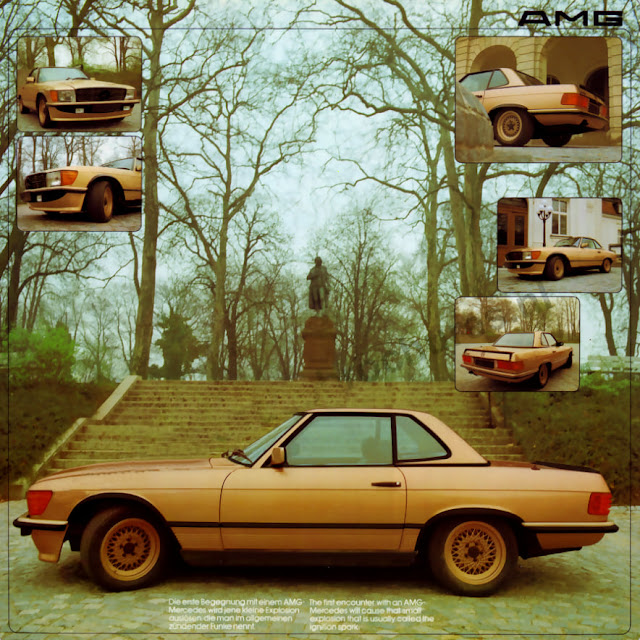
AMG started off by designing and testing racing engines. It expanded its business into building custom road cars based upon standard Mercedes cars. AMG initially produced a range of unofficial upgrade and accessories packages mainly for the Mercedes-Benz R107 and C107 (1971–1989 SL roadster), Mercedes-Benz W116 (1972–1980 S-class), Mercedes-Benz W123 (1976–1985 E-class predecessor), Mercedes-Benz W124 (1984–1997 E-class), Mercedes-Benz W126 (1979–1992 S-class), Mercedes-Benz R129 (1989–2001 SL roadster), and Mercedes-Benz W201 (1990–1993 C-class) models.
During the early 1980s and up until 1990, AMG offered a variety of engine performance packages, alloy wheels and styling products as an entirely independent company from Daimler-Benz. In 1990, AMG signed a co-operation agreement with Daimler-Benz, and AMG options and cars were then offered in Mercedes-Benz showrooms; in 1999 Daimler AG, then known as DaimlerChrysler AG, bought the controlling share of AMG and made them part of the official Mercedes-Benz line-up.
Typical AMG performance enhancements, which the buyer could custom order, included increased engine displacements (5.2 litre, 5.4 litre), performance top ends with port and polished heads and intake, lightened valve train, and more aggressive cams. The DOHC 32V engine had also just been developed and was the pinnacle of AMG performance. A Getrag five-speed manual transmission could be ordered from AMG, and Mercedes had not offered a manual transmission V8 since the early 1970s.
The performance wheels offered during the same period were 15-inch or 16-inch ATS AMG Five Spoke Road Wheels, commonly referred to as Pentas. Penta was actually a UK-based company that supplemented the high demand for the AMG wheel at the time with a replica and only a very slight styling difference, but they were not made or endorsed by AMG. The genuine AMG wheels were often coupled with an AMG performance suspension package that included uprated and lowered springs, and re-valved shock absorbers.
Another popular cosmetic upgrade were the AMG body kits. These ranged from subtle front spoilers to aggressive Wide Body kits for the W126 coupes. Other options included Recaro seats, smaller diameter steering wheels, instrument clusters, chrome delete option (all brightworks colour-coded or painted satin black), refrigerators, shift knobs, hi-fi stereo systems, custom upholstery and enhanced interior wood packages.
Saturday, January 15, 2022
The M116 V-8 Engine in Mercedes-Benz R 107 Roadsters


Mercedes-Benz M 116 V8 engine. In 1969, this power plant was initially available in the 300 SEL 3.5 (W 109), 280 SE 3.5 Cabriolet and 280 SE 3.5 Coupé (both W 111) models
The M 116 and M 117 had an overhead camshaft and two banks of four cylinders mounted at a 90-degree angle to each other. On the M 116, the bore-to-stroke ratio measured 92 × 65.8 millimetres, giving the engine an extremely short stroke. In addition to its wonderful ability to rev, the power plant was also a very smooth runner. The M 116 was the second engine from Mercedes-Benz to have the D-Jetronic electronic fuel injection system by Bosch. The M 117, on the other hand, had a bore-to-stroke ratio measuring 92 × 85 millimetres, which made the unit an extremely pleasurable “cruiser”.
Both the M 116 and M 117 were comparably lightweight engines. The 4.5-litre engine with a cast-iron block weighed just 250 kilograms, whereas the M 110 six-cylinder unit of the time tipped the scales at 240 kilograms.
The market launch: Both engines were earmarked for the new SL (R 107) and SLC (C 107) ─ which débuted in 1971 ─ as well as the S-Class (116 model series). The launch of the S-Class was postponed, however, and the model was not showcased until 1972. Since the predecessor six-cylinder engines were technically outdated after having been around for a long time, the company decided to start using the new engine variants as soon as 1969 in the W 109 and W 111 model series as well as in the W 108 later on. All of these vehicles were predecessors to today’s S-Class.
The career: The forward-looking design made it possible to keep both engines up to date for decades with only minor modifications and adjustments required. The M 116 and M 117 found their way into the S-Class, SLC-Class and S-Class Coupés, SL sports cars and G-Class.
The successor: In 1989, the thoroughly modernised M 119 V8 engine featuring two overhead camshafts was introduced and is largely the work of Wente’s staff member Ralf Ohlendorf. The power plant was initially offered with two engine block heights of the M 116 for 4.2 litres and of the M 117 for 5 litres displacement. When the LH-Jetronic system was launched in 1991, a standardised version of the engine was offered based on the lower M 116 engine block
In the Californian desert with the 500 SL - The Rally Variant
Friday, January 14, 2022
Mercedes-Benz R 107 450 SL in "The Long Goodbye.” (1973).Chasing Eileen Wade Scene.


Thursday, January 13, 2022
Mercedes-Benz Answer to the Problem of Clearing the Street from Snow: The Unimog U 500
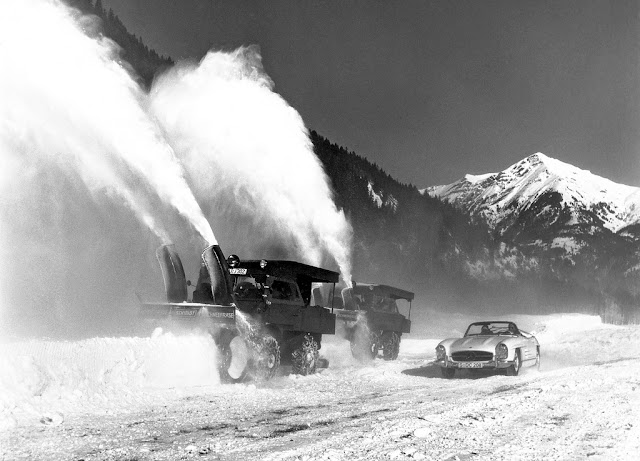
Two Mercedes-Benz Unimogs of the 411 model series with snow blower, powered by an additional engine on the platform. In the foreground, a Mercedes-Benz 300 SL Roadster (W 198). Photo from 1958. (Photo index number in the Mercedes-Benz Classic archives: 58003-82)
Snow blower at the front, heavy snow chains on all four wheels and a spreader at the rear: the Unimog U 500 of the model 405 series in the Mercedes-Benz Museum would be well prepared for harsh winters – it shows this to the viewer from all sides. But the 2004 implement carrier with portal axles and all-wheel drive could also work in the field, tow trams or carry out mowing work. For as spectacular as its individual performances are, the Universal-Motor-Gerät (universal motor machine – that’s what the abbreviation Unimog stands for) is admired even more for its versatility. This is made possible by compatibility with a wide range of attachments that can be mounted and driven at the front, rear and centre of the vehicle. If you look closely at the exhibit in the Museum, you will see the many connections for the hydraulic system. The attachments also include various solutions to keep roads passable even during heavy winter snowfalls.
Traditional winter king: Winter service under adverse conditions is practically in the Unimog’s genes: The all-rounder, which has been in production since 1949, was originally developed for agriculture. Because of its wide range of applications, however, it was also used for winter maintenance from the 1950s onwards – with a snow plough or snow blower as an attachment, the Unimog became the winter king. Both clearing techniques still play an important role in winter service today. In addition, there are rotating roller brushes for small amounts of snow and various spreading methods for de-icing salts or gritting materials.
Pushed, not flung: A snow blower and snow thrower – like the ones on the Unimog on display in the Museum – has a more elaborate technique than the snow plough. Any homeowner who has to clear the pavement in winter can understand this: a few centimetres of powder snow can easily be moved to the side with the pusher. Picking up and shovelling away larger amounts of snow, on the other hand, requires a lot of strength and several work steps. The viewer can also sense the high performance of the exhibit when they see the robust construction of the blowing machine and the many hydraulic hoses for driving various units.
Tossing the snow far and wide: The chimney of blue-painted sheet metal rises high above the snow blower in the Museum, the top of the channel shaped into an ejector. The message is clear: the snow is not only picked up, but also thrown to the side in a high arc. This is indispensable for large snow depths, which also occur in Germany in low and high mountain regions. This is because the considerable volume of frozen precipitation cannot simply be pushed to the side. Snow blowers therefore throw it up to 35 metres away from the road.
Powerful through the winter: A modern mounted snow blower like the one in the Mercedes-Benz Museum is driven by the vehicle engine via a power take-off shaft and is also controlled via several hydraulic lines. The black hoses are clearly visible on the 205 kW (279 hp) exhibit in the Museum with its 6.4-litre six-cylinder engine. From the 1950s onwards, the first Unimogs with powerful snow blowers generally had a second engine in addition to the vehicle drive. This usually also came from Mercedes-Benz, was located in the rear of the vehicle and drove the blower at the front from there via a shaft.
Cutting, blowing, throwing: Rotary snow blowers clear the snow in several work steps. Viewers standing directly in front of the Unimog in Collection Room 3: Gallery of Helpers can recognise the corresponding components: two round snow blades sit on the sides of the cutter drum, delimiting the working area with a clean cut. Two spiral-shaped cutting spirals with sawtooth cutting edges are attached to the inside. These shred even large amounts of snow and bite their way through hardened or icy layers. The cutting spirals transport the material to be cleared to the centre of the attachment according to the principle of the Archimedean screw. Here, the impeller located behind the cutter drum takes over in its cylindrical housing. It accelerates the crushed snow and ejects it upwards through the chimney to the side. This can be turned hydraulically by up to 275 degrees and its tip can be set at different angles – also hydraulically. In this way, the driver determines exactly where the Unimog throws the cleared snow.
Plough and blade as standard: Snow blowers are not necessary in all regions. Municipalities and road authorities in temperate latitudes such as Germany mostly use single- or multi-blade snow ploughs or snow clearing blades as standard equipment for their winter service vehicles. Often, the road is simultaneously gritted with de-icing salt to prevent icy roads. Both systems can be optimally mounted on the Unimog.
Fighting the slipperiness: Such a spreading system for de-icing salt is mounted on the rear of the Unimog in the Museum. Salting is one of the most important methods of winter service; it removes or even prevents ice on road surfaces caused by snow and freezing conditions. De-icing salts have been used in Germany for winter service since the 1950s. Used is either commercially available rock salt (sodium chloride) or calcium, magnesium and potassium chloride. The salts combine with the frozen water and lower its melting point. This keeps the road surface grippy even at temperatures below zero degrees Celsius. Modern winter service vehicles know exactly how much of each de-icing material is needed. To do this, they measure surface temperatures without contact (thermography), and in some cases information on road and terrain conditions from databases is also incorporated into the control system (telematics). To operate the winter service technology, there is a separate control unit with a screen in the cockpit of the Unimog.
It’s all in the mix: Today, road services rarely use dry salt granulate exclusively. Instead, spreading systems can apply so-called pre-wetted salt. This is a mixture of salt crystals and a liquid brine solution. The unit mixes both components directly on the vehicle as required, and the spreading disc at the rear applies the pre-wetted salt in exact doses. The advantages: the mix works faster than dry granules, so less salt is needed. In addition, the wet salt adheres better to the road surface, which reduces the chemical load on the vegetation next to the road. Depending on the mixing ratio of salt to brine, FS 30, FS 50 or FS 70 is spread in winter, for example. The number represents the proportion of brine in the mixture. If pure brine is used, winter maintenance experts speak of FS 100. However, this is not applied with the classic spreader, but sprayed with nozzles. The right carrier vehicle for this application? A Unimog, of course