Popular Posts

Tuesday, December 20, 2022

Cleveland, Ohio and Area-- nearly the center of the American Automobile Industry: Part 1

Below begins a listing of Cars and Trucks made in Cleveland to 1931.  Compiled by Alex Telatco and published on p. 168 of Clymer Scrapbooks, volume 3, 1946. I will add the images if easily available. This will be an ongoing compilation over numerous posts due to its breadth.


1.  Grant, 1916-1922.

Based in Finlay, OH.  Several thousand were made, and even exported to England as the Whiting-Grant.

1919 shown below


From the Cleveland Public Library Digital Collection.


2. Templar, 1918-1925

Manufactured in Lakewood, Ohio. 

Advertising themselves as "The pioneer builder of quality small cars", the first Templar car had a four-cylinder, overhead-valve engine of 3.2 liters capacity coupled to a three-speed transmission mounted in a chassis with a 118-inch (3,000 mm) wheelbase. The entry of the United States into World War I severely curtailed production, the company making artillery shells for the war effort. Only around 150 cars were made in 1918. Body styles included a coupe, a Victoria Elite tourer, a 3-door sedan and a sports model called the Sportette. The cars were extremely well equipped with a compassions and Kodak camera as standard equipment.

Full production resumed in 1919 with 3 body types, the coupe, Sportette and sedan. 1800 cars were built by the 900 employees. While the post war boom continued, the company could sell every car it made and Templar even increased prices in 1920 and 1921. The 1921 coupe, still basically the 1917 car, cost US$3785, as did the five-passenger sedan, while the five-seat tourer, four-passenger Sportette, and two-seat touring roadster were US$2885.

Competition was increasing, so in 1922, two cheaper models were announced, a roadster and a Deluxe Sports. Production was severely affected following a major fire which had swept through the factory in December 1921, and receivers were appointed in October 1922.

The company was re-financed and became the Templar Motor Car Company in 1923, and work started on a 4.3-liter six-cylinder engine, as the new management decided the future was in larger cars. The new models were based around a 122-inch  wheelbase frame with a range of four- and five-seat bodies. Four-wheel brakes were also introduced. However, only 125 cars were sold in 1923.

By late 1924 it seems the money ran out, and the company passed into the ownership of a local bank who had called in a loan, and production ceased.


1919 below


3. Peerless, 1900-1932 -- Steam and Gasoline

New Plant, 1910

1931 Below


Established in Cleveland in 1900 at 43 Lisbon Street, Peerless Motors began manufacturing automobiles while using DeDion-Bouton engines under license from the French company. Engineer Louis P. Mooers designed the first Peerless models, as well as several proprietary engines. The first Peerless-branded vehicles appeared in 1902, with a front-mounted engine driving the rear wheels through a shaft. This later became the standard vehicle propulsion layout for automobiles. In 1904, Mooers designed the Green Dragon racecar and enlisted Barney Oldfield to drive it. The Green Dragon brought notability and success to Peerless, as Oldfield used it to set a number of early world automobile speed records.

n 1905, the 35 horsepower (26 kW) Green Dragon competed the world’s first 24 hour endurance race in Columbus, Ohio. Piloted by Earnest Bollinger, Aurther Feasel, and briefly by Barney Oldfield, the Peerless led the race for the first hour before crashing into a fence, later finishing in 3rd place.

From 1905 to 1907, Peerless experienced a rapid expansion in size and production volume. As the Peerless namesake grew in fame, the company began producing increasingly higher-priced models with a focus on luxury. In 1911, Peerless was one of the first car companies to introduce electric lighting on their vehicles, with electric starters added in 1913.[1] In 1915, the firm introduced its first V-Eight, intending to compete with the Cadillac introduced a year earlier.[3] This model became Peerless' staple production vehicle until 1925, when engines produced by other manufacturers were first used in Peerless model

In 1929, the entire Peerless range was redesigned to compete with other vehicles produced by Stutz and Marmon.  This move saw increased sales, and for 1930 another design refresh was undertaken. The Peerless-designed V8 was replaced by a Continental Straight Eight as a cost-saving measure. However, the Great Depression that began in 1929 greatly reduced the sales of luxury automobiles. Peerless stripped down its production and attempted to market one line of vehicles to wealthy Americans who were not affected by the depression. In 1930–31, Peerless commissioned Murphy Body Works to design what the company envisioned as its 1933 model.  A single V-16 1931 Peerless was finished in June 1931, the last Peerless ever produced.


Friday, December 16, 2022

The 1899 Daimler “Business Vehicle"

Daimler motorised business vehicle. The first generation of this delivery vehicle had five models with 2.2 kW (3 hp) to 7.4 kW (10 hp) for payloads from 500 to 2,000 kilograms. (Photo index number in the Mercedes-Benz Classic Archives: A39773)

Increased power: What is the function of the circular component with the hole pattern on the front of the 1899 Daimler motorised business vehicle? The inlets behind the sieve-like plate are the air ducts of a tubular radiator invented by mobility pioneer Wilhelm Maybach. With this innovation, Maybach significantly improved engine cooling and thus the performance of the automobiles built by Daimler. The tubular radiator was first used 125 years ago, in the Phoenix model, and utility model protection was registered on 24 December 1897. December of that same year saw the introduction of the Daimler-Motoren-Gesellschaft (DMG) motorised business vehicles.

Evolution: DMG continued to improve its van models. The exhibit in Legend Room 1: “Pioneers – The invention of the automobile” at the Mercedes-Benz Museum was built in 1899, two years after the premiere of this model family. This motorised business vehicle was designed for a 500-kilogram payload. It is powered by a 4.1 kW (5.6 hp) two-cylinder engine with a displacement of 1,527 cubic centimetres and has a top speed of 16 km/h. By comparison, for the year 1900, the sales list mentions business vehicles with payloads of 800 to 3,200 kilograms and power ranging from 2.9 kW (4 hp) to 5.9 kW (8 hp) with a two-cylinder engine and 4.4 kW (6 hp) to 8.8 kW (12 hp) with a four-cylinder engine.

Innovation platform with the genes of a horse-drawn cart: Compared to the illustration in the first sales advertisement, the vehicle soon changed. In 1897, it was still a delivery van with the engine under the seat and a free-standing steering column. The example at the Museum, dating from 1899, has the engine located above the front axle, protected by a high bonnet. Directly below it is the tubular radiator with the starting crank in its centre. These innovative details stand in contrast to the traditional design features: the driver sat on an open bench with no protection from the weather. It resembles the workplace of a coachman delivering goods with his horse and cart. Nevertheless, the motorised business vehicle clearly represented a departure from the era of the horse-drawn coach: in front of the driver is the vertical steering column with wooden steering wheel. Outside, on the right, is the gear lever in an open shift gate. And the large horn commands attention in traffic.

Power transmission and rubber wheels: The engine power is transmitted to the rear wheels via two chain wheels and two roller chains. This distinguishes the transporter from the pinion-driven DMG trucks that had been built since 1896. The spoked wooden wheels are significantly larger at the rear than at the front, with solid rubber tyres all round. This was a real comfort feature in commercial vehicles at the end of the 19th century, as delivery trucks and lorries often drove on steel-tyred wooden wheels. Daimler charged an extra 350 to 400 marks for these solid rubber wheels in 1897. For vehicles with a payload of more than 1,200 kilograms, DMG advised against using the rubber-shod wheels: “Rubber tyres are not recommended for these larger wagons,” the DMG sales list states.

Five winners: The “business vehicle” was an expert when it came to flexible logistics. This strength still characterises Mercedes-Benz vans today. “Daimler business vehicles are a particular speciality among motorised vehicles,” the Daimler-Motoren-Gesellschaft (DMG) advertised in 1897. The sales advertisement highlighted the delivery van’s versatility: the loading area can be used with a box body, as a platform or with bench seats (“for excursions and for passenger transport”). The Cannstatt-based company offered five different versions of the motorised business vehicle. The payload was between 500 and 2,000 kilograms. Initially, the vehicles were powered by engines delivering 2.2 kW (3 hp) to 7.4 kW (10 hp).

Mini to maxi: The length (3,400 to 4,600 millimetres), width (1,700 to 1,800 millimetres) and weight (1,000 to 2,500 kilograms) of the motorised business vehicles varied according to payload. This underlined the diversity of this very recently introduced vehicle concept. Only the year before, Benz & Cie. had presented a comparable vehicle in Mannheim and founded the segment with its “delivery van”.

Monday, December 12, 2022

Al Jardine - PT Cruiser -- and other songs about the car


Simply Awful!  There are at least 4 songs about PT Cruisers out there:


Gotta Have A Cruiser Blues - by Bob McCall
PT Cruiser - by Al Jardine
Cat In The Cruiser - by Sha Na Na
PT Cruiser - by Paul Taylor (off his Hypnotic CD)(this is jazz and has no lyrics

Delbert McClinton and the Lyrics to his “Lay-Down Rambler"


Cars, Sex and Country Music -- One could write a great paper on the topic. I missed it almost totally in my The Automobile and American Life!

From Ed -- You will recall that old Nashes and Ramblers had seats that would lay down (nudge nudge, wink wink).  Years ago songwriter Delbert McClinton penned this song that also includes a DeSoto.

    Lay-Down Rambler

Caught a ride into South Dakota
With two girls in a light blue Desoto
One's name was Jane, the other was plain
But they both had racing motors.


Next I caught a ride with a gambler's wife
She had a brand new lay-down Rambler
She stopped outside of town
She laid the Rambler down
She said she could dig it if I rode her.


At a truck stop for toothpick and water

Caught a ride with a fruit picker's daughter

We drove into the nightSaid 'The fruit's just right'She said 'all you can eat for a quarter.'
Next I caught a ride with a hobo womanWho said she was from Texas tooThe way she did what she didWhen she did, what she did to meMade me think of you.
Doing my best to get back to you
Ain't nothing I'd rather do
Look for me Sunday, gonna be there honey
Something special just for you
Special just for you.

Where Do Old PT Cruisers Go to Die?

A Contribution fomo Ed! Thank you!

Where Do Old PT Cruisers Go to Die?


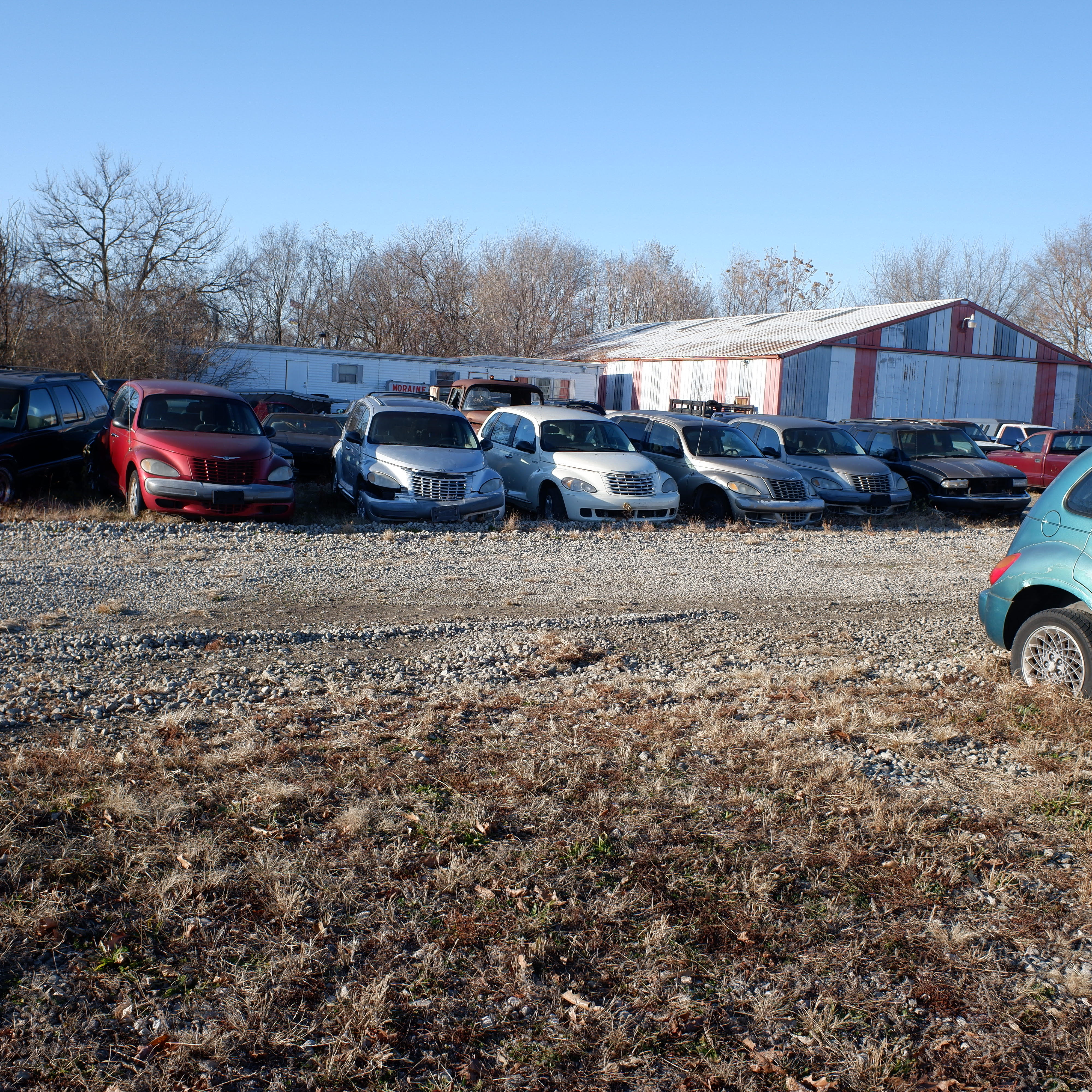
Recently I was driving just west of the old GM Plant in Moraine, Ohio, and on Dryden Road saw this lot full of old Chrysler PT Cruisers.  Counting the ones in the front row and the ones in the back there were around 30 of these vehicles.

Rest in Peace for what, at least for a few years, became somewhat of a cult car that was designed to mimic some of the styling cues of 1930s automobiles.  In my opinion certainly not the best retro design! Curiously, one still sees a few on the roads today.  The convertible version was an oddity and some might suggest a want-to-be Shriner Clown Car.

Manufactured at the Toluca Car Assembly in Toluca, Mexico, by March, 2006, DaimlerChrysler had built 1,000,0000 PT Cruisers (yes, that's one million folks).  The final PT Cruiser was built in July 2010.  A total of 1,050,281 PT Cruisers were marketed and sold in the US.

But what did the "PT" stand for in the name "PT Cruiser?"  No kidding, Chrysler said it stood for "Personal Transportation."  At least 30 of these "personal transportation devices" reside on Dryden Road here in Dayton, Ohio.  Come and get them before they're gone!

Friday, December 2, 2022

Packard Proving Grounds: Part IV. The “Graduation" Certificate


During the early weeks of production on any new model, at least five such Packards were taken to Utica, to be driven 250 miles for operational evaluation and then thoroughly inspected for workmanship. Subsequently, one of them would be taken for a thousand miles for quality checking, both full throttle on the track, plus round after round on the torture roads. Another car might put up 2500 such miles, yet another made to endure 25,000. On two such occasions, a Packard was driven at top speed, day and night, for the seven days to reach 15,000 miles, as effective as any test possible of performance and stamina.


All this resulted in a goodly many Packard miles being racked up, both on experimental and pr-production cars, as year passed year. During 1933 alone, the company reported test driving at Utica totaled 769,573 miles – a distance more than thirty times around the world at the equator. For the first four years of its production, every Twin Six or Twelve produced was drive 250 miles at the Proving Grounds in a break-in test including maximum speed checks and a thorough inspection, with a certificate signed by Milton and Vincent issued thereafter and a sticker with the acceptance date glued to the right side of the glovebox behind the instrument panel – or the car was returned top the factory for correction of any defect or weakness noticed. Every new owner got both his car and the “graduation’ certificate.


No one was ever killed at the Packard Proving Grounds, indeed no one was ever injured. During the same time GM had several men killed at their proving grounds.  “at one time we were testing tires for Goodyear…one man drove steadily at top speed just to blow tires. He did this constantly for three months and never had any trouble when the tires blew.”