This blog will expand on themes and topics first mentioned in my book, "The Automobile and American Life." I hope to comment on recent developments in the automobile industry, reviews of my readings on the history of the automobile, drafts of my new work, contributions from friends, descriptions of the museums and car shows I attend and anything else relevant. Copyright 2009-2026, by the author.
With snow and ice covering Centerville, Ohio, a good question to ask would be "when and where did tire chains come from." Well, Ed found out. Tire chains are still used in the western mountains -- indeed are mandatory at times. They are not the easiest to install , and I doubt many Americans would know how to put them on!
With the snow falling down here in Ohio and in much of the Midwest and Northeast, maybe we need to put a set of tire chains on our cars?
Winter driving has always been focused on getting someplace safe and warm without mishap. Bad roads and skinny tires plagued early motorists before Harry D. Weed invented the first known tire chains.
Weed got his idea from watching folks wind rope and vines through the spokes of slipping wheels. His invention was an immediate success. In 1908 the Thomas Flyer that won the New York to Paris race wore Weed Tire Chains.
Hi folks -- Ed sent this to me and graciously allowed me to post it. I will post my own review in the near future, perhaps after our President's Day snow storm, assuming the forecast is correct.
John, the Driving While Back book nominated for Cugnot Award consideration is a truly fascinating piece of scholarship and much better than I thought it would be. One of the things that struck me was a survey that was taken in 1950 among Black residents of Philadelphia, Baltimore, Pittsburgh, and Washington, DC -- to determine which brand of new car or used car was most popular with these folks. In all four cities, even though it was a substantially more expensive car than a Ford or Chevy, Buicks were the most popular car and vehicles of choice. In Pittsburgh nearly 20% of all new cars purchased by Blacks in 1950 were Buicks compared to 13% for Ford and 8% for Chevrolets. The other cities in that survey were quite similar.
And there is a whole section that speaks to Cadillac ownership among Black folks in the 1950s -- Blacks bought Cadillacs in the same proportion as Whites who bought Cadillacs even though, on the average, Black incomes were often half of what White incomes were.
Many Cadillac dealers would not sell to Blacks so lots of folks had a white friend buy a car for them and then later just transfer the title.
Reasons given: Black folks were willing to scrimp and save for a dependable and heavy car (which Buicks were considered to be). Heavy and roomy because often families needed to travel long distances -- back home to the South to visit relatives -- and often couldn't find places to stay so they slept in their cars and dependable because their was the belief (often true) that they would be ripped off by white-owned service stations if they broke down.
And later in the 1960s the first Black-owned dealerships were often Buick franchises.
Lots of interesting stuff on gasoline in this book. What was the main choice of gas among Black folks in the 1940s and 1950s? Esso. Typically other brand gas stations, while willing to sell Blacks gasoline, wouldn't allow them to use the restrooms......but Esso and Standard Oil had a national policy that urged individual station owners to provide restroom access to all.
Later the first Black-owned gas stations were Esso stations.
Speedometer: It measures the speed and indicates it as a numerical value. The photograph from the Mercedes-Benz Museum shows dials from several eras. They are on show in the large display case in Collection 2. (Photo signature in the Mercedes-Benz Classic archive: D587995)
Mercedes-Benz W 111/W 112 model series “Tailfin” Saloon (1959 to 1965), display concept. Photo of a long-wheelbase 300 SE, produced in 1964, taken in 2005. (Photo signature in the Mercedes-Benz Classic archive: 05C2263_139)
Mercedes-Benz W 108/W 109 model series luxury saloons (1965 to 1972), display concept. Photo of a 300 SEL 6.3, produced in 1970, taken in 2005. (Photo signature in the Mercedes-Benz Classic archive: 05C2263_122
Speedometer
Moderate start: 16 km/h – that was the top speed of the world’s first car. Not exactly fast as lightning, even in 1886 – considering steam locomotives had already smashed the 100 km/h barrier decades before. However, Carl Benz’s Patent Motor Car still reached twice the speed of pedestrians, but the innovative vehicle nevertheless lacked a speedometer. There wasn’t much of a point. There were no statutory speed limits.
Sought-after extra: However, with the increasing popularity of the car, speedometers became available as optional equipment as fast cars were considered good cars. And it goes without saying that you’d want to know how good your own vehicle was. The speedometer on display as part of the Mercedes-Benz Museum’s “33 Extras” in Legend Room 3 “Times of Change – Diesel and Turbocharger” represents such optional equipment. Its gauge went up to 100 km/h.
Limit: Speed limits were not introduced until vehicles became increasingly faster. Initially these limits were adapted to the traffic situation before the age of the car. As of 1909, 15 km/h was the top speed in built-up areas throughout the German Reich, which corresponds to the speed of a trotting horse. From that point onwards, cars without speedometers were a thing of the past. Not only did vehicle drivers have to keep an eye on the road and traffic situation, they also had to check their speed.
Indication: Speedometers measure speed and indicate it as a numerical value. The German term for speedometer, “Tachometer”, is derived from the ancient Greek terms “tachýs”, denoting “fast”, and “métron”, meaning “dimension”. For decades, an analogue dial with a needle pointed to the corresponding dot or line on the scale. Digital speedometers have been around since the 1990s. They are more flexible and are capable of changing the way they show data. Regardless of the technology: speedometers always indicate a slightly higher speed than the actual speed the vehicle is travelling at – giving us all a bit of leeway on everyday journeys. This was prescribed by law to compensate for inaccuracies in speed measurements.
Integration: The speedometer had initially not been positioned in the driver’s field of vision. It had only been placed there since the 1950s. The scale highlights important values, such as the top speed in built-up areas, 50 km/h in Germany. The dial is the dominant design, but there were also other variants: for instance, the horizontal indicator in Mercedes-Benz W 180/W 128 model series “Ponton” Saloons (1954 to 1959) or the vertical indicator, lovingly called “thermometer” by aficionados, in W 111/W 112 model series “Tailfin” Saloons (1959 to 1965).
Monitoring: If you don’t keep an eye on the speedometer and exceed the speed limit, you may become familiar with an unpopular device which has been in use in Germany since 1959: colloquially known as the “speed trap”, it is a stationary or mobile type of speed monitoring device used to enforce the highway code. On display in Collection 3 – The Gallery of Helpers and also one of the “33 Extras” at the Mercedes-Benz Museum.
Preventive strategy: Cruise control or – even better – limiters can help avoid speeding infractions. Mercedes-Benz assumed a pioneering role with these assistance systems. Simply set the desired speed and cruise control will maintain it. The limiter will prevent acceleration beyond the defined limit.
Rotational movement: By the way, technically speaking the speedometer is a rev counter. It indicates how fast the wheels are spinning on the road. On a side note: most racing drivers do without a speedometer. They focus more on the engine speed and, for this reason, the corresponding display gauge has been positioned in their field of vision. However, they know exactly how fast they are going in fourth gear at 6,800 rpm, for example. Consequently, the dial in racing cars fulfils a dual purpose. Series-production vehicles feature a separate dial to indicate the engine speed.
Narrow canyon roads punctuated with tight hairpins followed by faster flowing curves
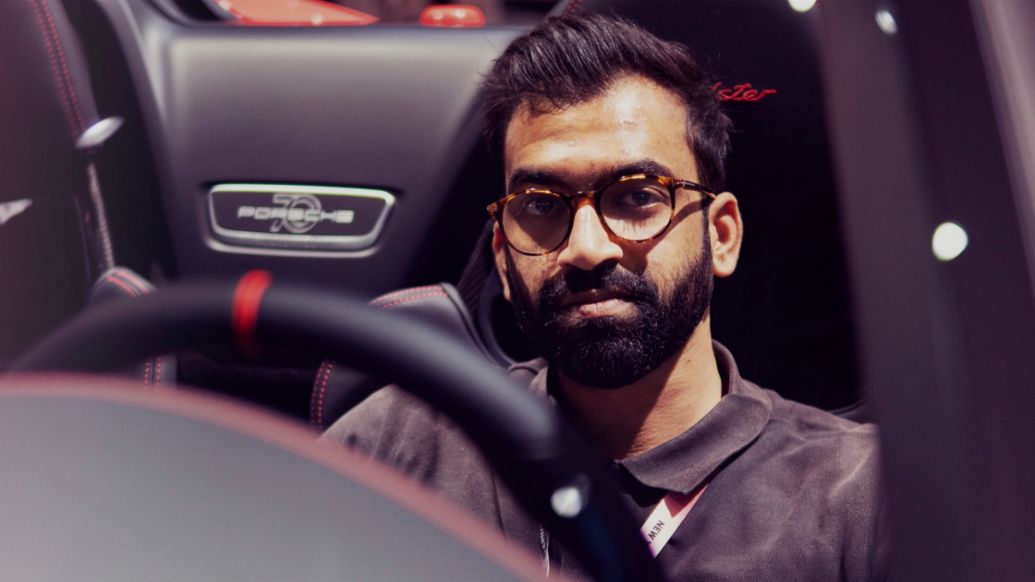
London-based Zaid Hamid has spent the last decade creating motoring content, and has driven some of the world’s most iconic stretches, but the pull of an undiscovered road remains strong. One route that had stayed in his mind was on the Balearic island of Mallorca.
“I’m always looking out for new roads to experience and Mallorca has been high on my to-do list since I saw a clip of a Boxster GTS snaking its way to the lighthouse of Cap de Formentor. The driver – a British journalist – was wearing such a sizable grin that when an opportunity to visit arose, I had to go.”
Journalist Zaid Hamid
The Ma-2141 road, known locally as ‘The Serpent’ for reasons that will become apparent, starts at the coast and rapidly ascends into the mountains in a dramatic hair pinned fashion. Sa Calobra was designed in the 1930s by the Spanish engineer Antonio Parietti and was built without any machinery, despite 31,000 cubic metres of rock needing to be cut away. There are 50 turns, the majority of which are hairpins, and driver focus is key as the tarmac is too narrow for traffic to flow in both directions. The road ascends for 12.7 kilometres, reaches a peak of 682 m and features gradients as steep as 11.5 per cent.
“The road starts at sea level and without much drama other than it being very narrow. It takes a couple of kilometres to start seeing the magic of how the road interacts so organically with the Serra de Tramuntana mountains, as the narrow band of tarmac cuts through towering rocks,” explains Hamid. “As you make your way higher up, the gradient becomes steeper and the hairpins start to bunch up. The straightaways between the near 180-degree bends become shorter and shorter, you start to get into a flow that is almost hypnotic.
“As the density of the zigzags begins to ease, the view over your right shoulder is filled with the ribboning tarmac you’re leaving in your wake. It is something you mentally photograph, the lactic acid burn from the upper body workout is worth it for this view alone. As the road levels off towards the peak of the Col you catch a glimpse of the diamond in the crown of Sa Calobra.
“The most memorable corner of the road is known as ‘Nus de Sa Calobra’, a knot of tarmac which loops 270 degrees under itself, mimicking something that would look more natural as part of a Hot Wheels setup than a real mountain road.” The route ends soon after this iconic twist under the arches of a viaduct where the Ma-2141 meets the Ma-10 which becomes the Ma-2200. This is a less complex road that acts as an interlude to reflect on the magnificence of Sa Colabra before reaching the second of Antonio Pariette’s roads on the island.The second ‘must drive’ road leads to the northernmost tip of Mallorca and ends at a lighthouse on Cap de Formentor. It’s another tourist hotspot but in the off-season and when it is raining, as it was when I was on the island, I had the place to myself. I was grateful to have the traction, surefootedness and exceptional ride of the Macan S I was driving at the time.
The quick gear changes, 260 kW (354 PS; Macan S: Fuel consumption combined 8.9 l/100 km, CO2 emissions combined 204 g/km) and 352 lb-ft of torque make the elevation changes light work for the turbocharged V6, the steering was communicative and ideally weighted and it was good to feel confident that the brakes wouldn’t fade on the downhill sections!”
The Cap de Formentor Road also starts from sea level at Port de Pollenca, and stretches 19 km to the lighthouse, by which point you’ve gained a massive 1,600 m in elevation. Those 19 km to the lighthouse are driving bliss,” says Hamid. “The greenery which sprouts from the rock lines the first half of the road and as you climb higher the handful of switchbacks provide gorgeous views of the Balearic Sea. The final kilometres really steal the show. As the land narrows, so does the road and the corners come thick and fast teasing views of the lighthouse which represents the end of the tarmac and Mallorca. You have to watch out for the baby goats that venture into the road but the views are jaw-dropping as the towering cliffs stop abruptly where they meet the sea. Even on grey days these are some of the most magnificent roads I’ve ever encountered.”
Are you a Volvo girl? My wife is (or more accurately was). Long before Subaru tried to forge a cult with love, diversity, and dogs, Volvo became a cult of those valuing safety, practicality, conservative ut unique design, and reliability (remember the 2 million + mile P 1800?). The image sis from a Volvo publication illustrating employee exercises, which were mandatory. But note these women -- they are healthy, strong, pretty but not too pretty, and with legs that are to die for! Volvo no longer has that brand. image, as it has succumbed to a niche that focuses on the upper middle class and some sort of ill-defined Scandanavian aesthetic. Now owned. by the Chinese but still with Swedish roots, Volvo has moved with a time influenced by globalism. But in 1945, and for a few decades thereafter, Volvo reflected a national culture, just as they women are unmistakably Swedish!
I purchased on sale a pair of "Cat Eye" Bosch turn signal assemblies on sale on eBay a week ago or so. The price was right, but I really had to scramble to take a "sows ear" and turn them into not quite a "silk purse." I knew I had to succeed, or otherwise eat crow for being a fool.
Currently there are three assemblies on sale at Ebay -- for $475, $700, and $1000. I paid $200.
The lenses had black (and also a layer of blue) paint on the top -- why? Maybe over spray. So I attacked that matter by using first some Scotch Brite type 3M paint stripper pads, followed by carefully polishing the plastic with Flitz.
But then there were other issues! First, one screw holding then lens was rust-frozen. As were both screws holding the plastic rear access covers covering wires and the lighting assembly. But first I had to dig out debris or mud from the holes before I could get at those screws. Those screws had a very narrow cut.
First, soak all these screws with PB Blaster overnight. then use a German screwdriver on the German screws! Finally, I moved them. Clean, clean clean!
This is what they now look like. I wish I could show the assemblies as purchased. Ebay photos are of too low resolution.
The upshot of all of this -- never give up, work deliberately, and preserve/restore those beautiful things from the past.