Popular Posts

Tuesday, January 18, 2022

The Beginnings of the Mercedes-Benz CLK Coupe Model 208, 1997


Mercedes-Benz Design, ideas competition in the run-up to the CLK 208 model series. On the right in the picture, Peter Pfeiffer, who played a decisive role in the design of the coupé alongside the head of design Bruno Sacco. The series made its world premiere in January 1997 at the North American International Auto Show (NAIAS) in Detroit. Photograph from 1997. (Photo index number in the Mercedes-Benz Classic archive: A96F5573)

Twenty-five years ago, the first phase of the Mercedes-Benz product campaign was in full swing: following the compact roadster SLK (R 170) presented in April 1996, the Mercedes-Benz CLK (model series 208) made its debut in January 1997. This second new production vehicle within the then dynamic expansion of the product portfolio was first presented to the public at the North American International Auto Show (NAIAS) in Detroit. The much-acclaimed world premiere made it clear that the winds of change were blowing at Mercedes-Benz.

In Detroit, the CLK underlined how serious Mercedes-Benz was about breaking into new segments. The brand’s goal was to address additional and younger target groups with new vehicles and thus strengthen its base in the market. The next products in this strategy were also already set for launch: the A-Class and M-Class also made their debut in 1997, followed by the CLK Cabriolet in 1998. In addition, all other series were kept up to date.

All in all, this product campaign was a tour de force for the company. And yet it was only the beginning, because another great display of models began in the early 2000s with even greater attention paid to the aspects of “fascination” and “emotion”. Two examples from this second phase: the SLR McLaren (2003) and the CLS (2004). Since then, Mercedes-Benz has not stopped putting new stars into orbit. The resulting comprehensive model range makes Mercedes-Benz the strongest luxury car brand in the world.

Harbinger of the new coupe

The story of the CLK in the public eye began in March 1993. A study by Mercedes-Benz caused a sensation at the Geneva Motor Show: it was an elegant four-seater coupe – and a new vehicle face for the brand, characterised by four eyes: a slender radiator grille, four single, elliptical headlights – two large ones on the outside, two smaller ones on the inside – flanked by strongly modeled mudguards provided food for discussion. This also applied to the “fastback” rear end with its large, glass tailgate: is this what a future vehicle of the brand looks like? “That was exactly the point: to familiarise the public with new design elements,” says Peter Pfeiffer, who at the time played a key role in designing the coupe study alongside head of design Bruno Sacco.

“It was the company’s first ever show car,” says Pfeiffer, classifying the significance of the coupé study. Since then, the brand has systematically used the opportunity of this format to introduce new designs. The four-eyed face first went into series production in 1995 in the E-Class 210 series. The reaction in Geneva to the question of how well a new four-seater coupé with the Mercedes star would be received in the market was unambiguous: there would be a good number of buyers thanks to the way it was presented.

With a four-eyed face to success

The big performance followed almost four years later in Detroit: the CLK – also with a four-eyed face – looked amazingly similar to the study from Geneva and was proof of how close to series production Mercedes-Benz design was long before the start of production. “We are not trying to create a crazy demonstration car packed with nonsensical showmanship that causes short-term astonishment but then disappears into oblivion after only a few motor shows,” Bruno Sacco said.

Technically, the CLK was based on the C-Class Saloon in many respects. In particular, its floor assembly and aggregates were used. However, numerous deviating detail solutions and not least the fundamentally new body design documented the independence of the model series. There was a choice of different design and equipment lines, starting with “Sport” and “Elegance”. The common denominator was a wealth of standard equipment including traction control (TCS), exterior temperature display, leather steering wheel, remote boot lid opening, heat-insulating glass and asymmetrically split folding rear seat backrest to increase boot space. The range of models was broad: it extended from the CLK 200 with a four-cylinder engine (100 kW/136 hp) and six-cylinder models to the top-of-the-range CLK 430 (205 kW/279 hp) and CLK 55 AMG (255 kW/347 hp) models with eight-cylinder engines.

It all paid off: the coupé of the 208 series was very well received. A total of 233,367 units are produced at the Bremen plant within five years until May 2002. That was 65 per cent more vehicles than from the production line of the 124 series coupés over a period of nine years. The most frequently built model was the CLK 320 with 68,778 units. Its successor was the CLK of the 209 series.

The product campaign had its roots at the end of the 1980s

The first CLK made a significant contribution to the success of the first product campaign. The top management, with decision-makers such as Werner Niefer, Helmut Werner and Jürgen Hubbert, had already started to think about this and the dynamisation of the brand by the late 1980s. An impressive harbinger of the product campaign came as early as 1990: the Mercedes-Benz 500 E (W 124). It set an important starting point for the changing image of the brand.

Motorsport also shared in the success: “The desire to dynamise the brand and later to position AMG as the ‘sports badge’ of Mercedes-Benz worked, as you can see today,” is how Norbert Haug, Head of Motorsport from 1990 to 2013, assesses this period in retrospect. “One of our maxims was not to start in racing series where you can lose inconspicuously, because winning there is also inconspicuous. Those interested in sport soon noticed that Mercedes-Benz was daring to try something new.” For the company, this turned into a success story. “The image in terms of excellent reliability, quality and safety was there. Now sportiness was added, which led to extremely positive reactions from the outside and inside, along with the corresponding sales figures.”


Monday, January 17, 2022

Mercedes 500 SL rally car - Sound

Nn


Not themes impressive sounding rally car. The R 107 is a roadster, not a sports car, and so one can be disappointed when comparing the car’s qualities with Porsches and perhaps other vehicles.

Answers to Questions About Automotive History from an 8th Grader


1)    How would you define “automobile”? 

 Automobile – “the combination of a light, sprung, wheeled vehicle (usually 4 wheels); a compact, efficient power unit (ICE, Electric, or Steam); and hard surfaced roads.” The commonly-used term automobile word was French, but key to its adoption in America was its acceptance by New York City’s high society. A French term first used in America in 1895 and fully adopted in the U.S. by 1899, other words were proposed and debated during this time – horseless carriage, motocycle, motor vehicle, automation, mocle, autom, polycycle. Members of high society in New York City owned the first cars, including William Rockefeller, George Gould, Edwin Gould, John Jacob Astor, Jacob Ruppert, C. P. Huntington, and Claus Spreckels. This Gilded Age aristocracy paraded their vehicles at Newport, Rhode Island in the summer of 1899, and influenced the newly-published editorial writers of the magazines The Automobile and The Automobile Magazine to endorse automobile as a universally accepted term.


2)  How would you define “Invent”?  

(For someone to invent something do they have to think it up, design it, create it?). To invent is to create something – a thing or possibly an idea – that is not obvious. I believe that is the measure that the U.S.. Patent office uses.

3)  Who do most people think invented the first automobile?

 It all depends where you are from. In the United States the typical person that is given credit is Henry Ford. Then there are the Duryea brothers from Springfield, MA. In Germany – and I think this is the best single answer – there is Carl Benz. In Austria, Siegfried Marcus is often given credit for his “wagen” of 1875. There are others one can find in the literature as well, from Britain and France. 

4)  Who would you say invented the first automobile?

 Carl Benz, because it was commercialized (socially by the French!).

5)  What do you think would be different today if automobiles were never invented?

 I cannot envision a world without the automobile. We would undoubtedly be living in more rural areas, much poorer, and much more provincial. But there could be possibly social and personal benefits of living in a slower world.


6)  What are some positive things automobiles do/cause?

They are foremost freedom machines. They give us freedom to go where we want to go, they make it difficult for governments to control us, they have enabled us to become far more prosperous, they save lives as well as take lives due to accidents. They open up a far vaster space for us to experience, and enable us to interact with people different than ourselves.


7)  What are some negative things automobiles do/cause? 

They depend (currently to a large extent) on fossil fuels and thus are non-sustainable, their exhaust contributes to a less than desirable air quality (and increased CO2 levels), and they have contributed to a materialistic society where things are more important than people. They fit right in traditional patterns of American individualism at the expense of community.

Sunday, January 16, 2022

K9 - James Belushi inside a Mercedes-Benz Showroom clip - Mercedes 560SL...

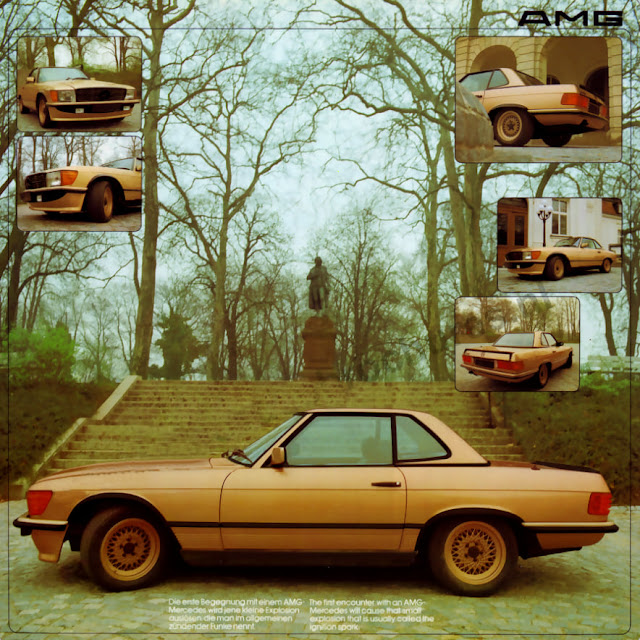
1981 Mercedes-Benz R 107 AMG

text is from Wiki:

AMG was founded as a racing engine builder in 1967 under the name AMG Motorenbau und Entwicklungsgesellschaft mbH (German for 'AMG Engine Production and Development Limited') by former Mercedes-Benz engineers Hans Werner Aufrecht and Erhard Melcher in Burgstall an der Murr, near Stuttgart. The  'AMG' stands for Aufrecht, Melcher and Großaspach (Aufrecht's birth town). In 1976, most of AMG moved to Affalterbach, with the racing-engine development remaining at the old location in Burgstall. At this time, Erhard Melcher ceased to be a partner, but he continued to be an employee at the Burgstall location.

In 1993, with AMG having become a high-profile purveyor of modified Mercedes-Benz cars, Daimler-Benz AG and AMG signed a contract of cooperation, allowing AMG to leverage Daimler-Benz's extensive dealer network and leading to commonly developed vehicles (the first one being the Mercedes-Benz E 50 AMG, in 1993).

On 1 January 1999, DaimlerChrysler AG (as it was called between 1998 and 2007) acquired 51 percent of AMG shares, and AMG was renamed to Mercedes-AMG GmbH. Racing engine development was divested and continues to exist in Burgstall under the name HWA (Aufrecht's initials). On 1 January 2005, Aufrecht sold his remaining shares to DaimlerChrysler, and since then, Mercedes-AMG GmbH has been a wholly owned subsidiary of Daimler AG.


From a 1981 AMG Brochure:

AMG started off by designing and testing racing engines. It expanded its business into building custom road cars based upon standard Mercedes cars. AMG initially produced a range of unofficial upgrade and accessories packages mainly for the Mercedes-Benz R107 and C107 (1971–1989 SL roadster), Mercedes-Benz W116 (1972–1980 S-class), Mercedes-Benz W123 (1976–1985 E-class predecessor), Mercedes-Benz W124 (1984–1997 E-class), Mercedes-Benz W126 (1979–1992 S-class), Mercedes-Benz R129 (1989–2001 SL roadster), and Mercedes-Benz W201 (1990–1993 C-class) models.

During the early 1980s and up until 1990, AMG offered a variety of engine performance packages, alloy wheels and styling products as an entirely independent company from Daimler-Benz. In 1990, AMG signed a co-operation agreement with Daimler-Benz, and AMG options and cars were then offered in Mercedes-Benz showrooms; in 1999 Daimler AG, then known as DaimlerChrysler AG, bought the controlling share of AMG and made them part of the official Mercedes-Benz line-up.

Typical AMG performance enhancements, which the buyer could custom order, included increased engine displacements (5.2 litre, 5.4 litre), performance top ends with port and polished heads and intake, lightened valve train, and more aggressive cams. The DOHC 32V engine had also just been developed and was the pinnacle of AMG performance. A Getrag five-speed manual transmission could be ordered from AMG, and Mercedes had not offered a manual transmission V8 since the early 1970s.

The performance wheels offered during the same period were 15-inch or 16-inch ATS AMG Five Spoke Road Wheels, commonly referred to as Pentas. Penta was actually a UK-based company that supplemented the high demand for the AMG wheel at the time with a replica and only a very slight styling difference, but they were not made or endorsed by AMG. The genuine AMG wheels were often coupled with an AMG performance suspension package that included uprated and lowered springs, and re-valved shock absorbers.

Another popular cosmetic upgrade were the AMG body kits. These ranged from subtle front spoilers to aggressive Wide Body kits for the W126 coupes. Other options included Recaro seats, smaller diameter steering wheels, instrument clusters, chrome delete option (all brightworks colour-coded or painted satin black), refrigerators, shift knobs, hi-fi stereo systems, custom upholstery and enhanced interior wood packages.

Saturday, January 15, 2022

The M116 V-8 Engine in Mercedes-Benz R 107 Roadsters

 Taken from a brochure. Nice visual!

Mercedes-Benz M 116 V8 engine. In 1969, this power plant was initially available in the 300 SEL 3.5 (W 109), 280 SE 3.5 Cabriolet and 280 SE 3.5 Coupé (both W 111) models


In the 1960s, it was not clear whether the new rotary piston engine according to Felix Wankel would really hold its own against conventional piston engine designs. This is why Mercedes-Benz decided in favour of a parallel development approach. The M 116 and M 117 piston engines can trace their beginnings back to engine designer Adolf Wente, who developed the first V8 injection engine offered by the brand ─ the 6.3-litre M 100 found in the Mercedes-Benz 600 (W 100).

The M 116 and M 117 had an overhead camshaft and two banks of four cylinders mounted at a 90-degree angle to each other. On the M 116, the bore-to-stroke ratio measured 92 × 65.8 millimetres, giving the engine an extremely short stroke. In addition to its wonderful ability to rev, the power plant was also a very smooth runner. The M 116 was the second engine from Mercedes-Benz to have the D-Jetronic electronic fuel injection system by Bosch. The M 117, on the other hand, had a bore-to-stroke ratio measuring 92 × 85 millimetres, which made the unit an extremely pleasurable “cruiser”.

 Both the M 116 and M 117 were comparably lightweight engines. The 4.5-litre engine with a cast-iron block weighed just 250 kilograms, whereas the M 110 six-cylinder unit of the time tipped the scales at 240 kilograms.

The market launch: Both engines were earmarked for the new SL (R 107) and SLC (C 107) ─ which débuted in 1971 ─ as well as the S-Class (116 model series). The launch of the S-Class was postponed, however, and the model was not showcased until 1972. Since the predecessor six-cylinder engines were technically outdated after having been around for a long time, the company decided to start using the new engine variants as soon as 1969 in the W 109 and W 111 model series as well as in the W 108 later on. All of these vehicles were predecessors to today’s S-Class.

The career: The forward-looking design made it possible to keep both engines up to date for decades with only minor modifications and adjustments required. The M 116 and M 117 found their way into the S-Class, SLC-Class and S-Class Coupés, SL sports cars and G-Class.

The successor: In 1989, the thoroughly modernised M 119 V8 engine featuring two overhead camshafts was introduced and is largely the work of Wente’s staff member Ralf Ohlendorf. The power plant was initially offered with two engine block heights of the M 116 for 4.2 litres and of the M 117 for 5 litres displacement. When the LH-Jetronic system was launched in 1991, a standardised version of the engine was offered based on the lower M 116 engine block