Popular Posts

Friday, October 27, 2023

London to Brighton Veteran Car Run -- November 5, 2023

Photograph of the “Emancipation Run” from London to Brighton on 14 November 1896, taken in front of the Hotel Metropole in Brighton. (Photo index number in the Mercedes-Benz Classic Archives: U77666)

Mercedes-Benz Classic will take part in the London to Brighton Veteran Car Run (LBVCR) on 5 November 2023 with a 1904 Mercedes Simplex 28/32 hp. The vehicle from the Mercedes-Benz Classic collection is currently a highlight exhibit at Mercedes-Benz World in Brooklands. Only vehicles built up to and including 1904 are permitted at the LBVCR. It dates back to 1896, making it one of the oldest motoring events in the world. Automobile pioneer Gottlieb Daimler also took part in the first event 127 years ago.

London to Brighton Veteran Car Run

The history goes back to the “Highway Act” of 1865, also called the “Red Flag Act”: this restricted the maximum speed of self-propelled vehicles with steam propulsion in England to 6.4 km/h (4 mph). In built-up areas, the limit was as low as 3.2 km/h (2 mph). Until 1878, a person with a red flag was required to walk ahead of the vehicle and warn other road users.

In 1896, the speed limit for road vehicles was raised to 19.2 km/h (12 mph). On 14 November 1896, motorists celebrated this liberalisation with the “Emancipation Run” from London to the seaside resort of Brighton, 96 kilometres (60 miles) away. A total of 33 vehicles took part. The vast majority were powered by internal combustion engines, but there were also five steam cars and five electric cars. Automobile inventor Gottlieb Daimler took part as a passenger in a Daimler Vis-à-Vis 3 hp. He was a guest of his business partner, Frederick R. Simms. In 1890, Simms acquired the rights to use Daimler’s engine patents in Great Britain and founded Daimler Motor Syndicate Limited in 1893. In addition to models from Daimler-Motoren-Gesellschaft and Benz & Cie., the starting field included several cars from Panhard & Levassor with Daimler engines and at least one Arnold Motor Car derived from the Benz Velo under licence.

In 1927, the historic run was commemorated and reinaugurated. The date was fixed as the beginning of November, with usually rather inhospitable weather. The first Sunday in November quickly established itself for the “Run”, hosted by the Royal Automobile Club (RAC). The gathering of the vehicles in London’s Hyde Park in the early morning hours, and the preparation of their propulsion systems ranging from steamers to combustion engines, is an impressive spectacle. The RM Sotheby’s London to Brighton Veteran Car Run – as it is currently known – will start at sunrise, i.e. at 7:01 a.m., on 5 November 2023. Two-, three- or four-wheeled vehicles built before 1905 are permitted. The drive systems obtain their energy from steam, batteries, petrol – or muscle power: since 2017, historic bicycles have also been allowed to participate.

Mercedes-Simplex 28/32 hp touring car, built in 1904. Contemporary crack drawing from the left. (Photo index number in the Mercedes-Benz Classic Archives: Mercedes-Simplex_28-32_HP_5137)


Mercedes-Simplex 28/32 hp, 1904

The Mercedes Simplex models were among the outstanding innovators in automotive history. With their modern concept of a flat vehicle design, the engine installed low down in the frame and the honeycomb radiator, they fundamentally changed the history of mobility from 1902 onwards. The Mercedes 35 hp with this completely new vehicle architecture appeared in 1900. From 1902 onwards, the Mercedes Simplex model family paved the way for the brand’s success and ushered in the breathtaking development of the entire automotive industry: 120 years ago, the Simplex models created the blueprint for modern automotive engineering. The 1904 Mercedes-Simplex 28/32 hp taking part in the London to Brighton Veteran Car Run 2023 was in production until 1909. Its four-cylinder engine has a displacement of 5,322 cubic centimetres and delivers an output of 24 kW (32 hp) at 1,200 rpm.

Technical data – Mercedes-Simplex 28/32 hp
Production year: 1904
Cylinders: 4/In-line
Displacement: 5,322 cc
Output: 24 kW (32 hp)
Top speed: 60 km/h

Thursday, October 12, 2023

A Halloween Decoration for your Yard


 Hi folks -- for only about $115 at Walmart, you too can place a VW Bus with Scary figures in your yard

I never did understand why people do this! But the Bus is iconic in popular culture, and makes everyone smile.

Saturday, October 7, 2023

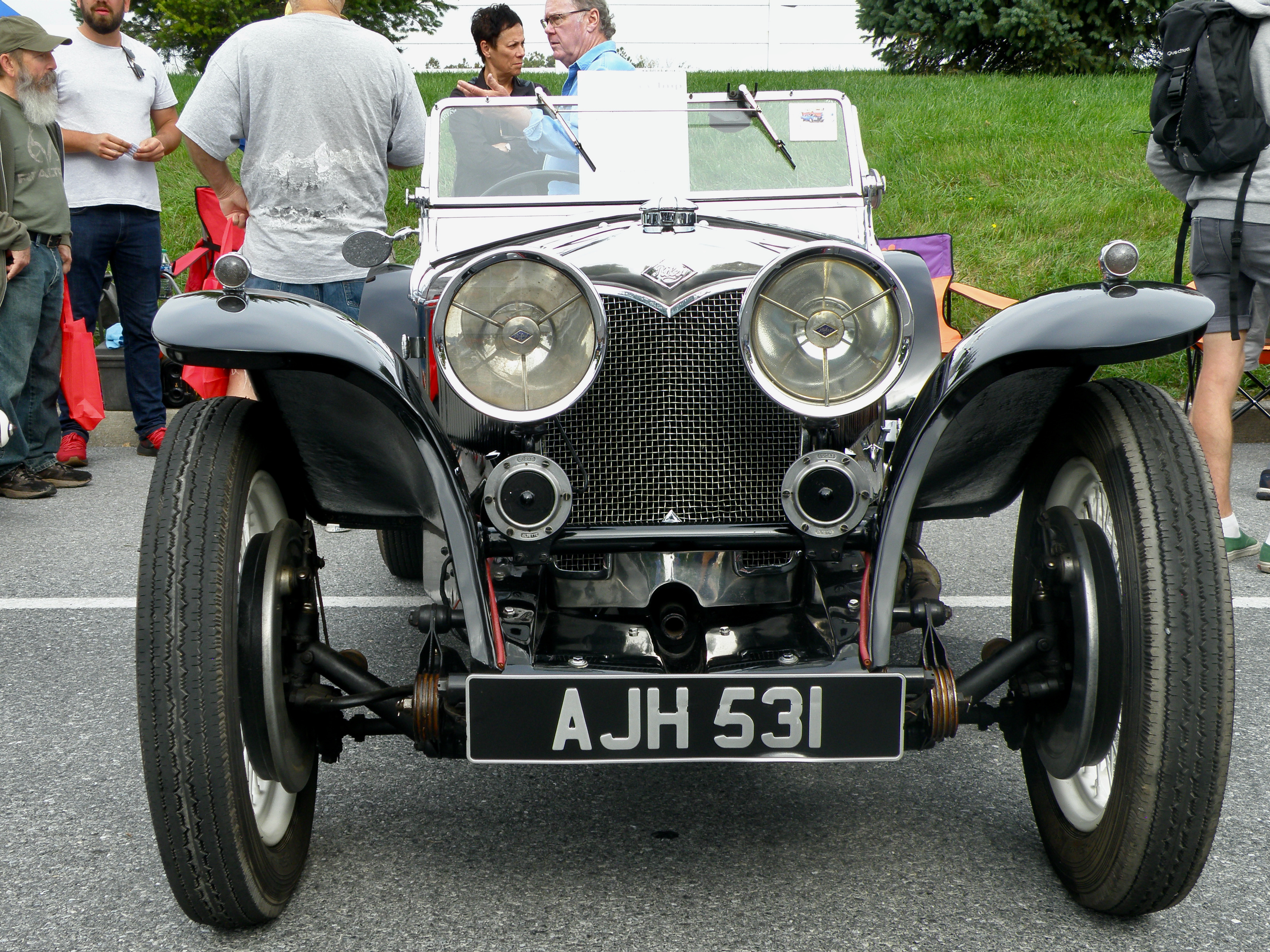
IMAGES FROM HERSHEY, PART II: A 1935 RILEY, DASH SHOTS OF A DUAL GHIA AND 1955 MERCEDES 300S

YES, PAULA, ALL THESE CARS WERE FOR SALE!  YOU COULD NOW BE BEHIND THE WHEEL OF A 1955 MERCEDES 300S, OR DUAL GHIA, OR 1935 RILEY, ZIPPING THROUGH THE RURAL ROADS OF SOUTH FLORIDA. YOU ONLY LIVE ONCE!


Images from the AACA Eastern Fall Meet at Hershey, October, 2023 -- a 1921 Mercer, 1947 Fiat Topolino, and More

 Great time at the event.  Attached are a few photos of cars that were for sale at the Car Corral. Actually, the Mercer was on the Field. I wish I could spend the whole week scouring the areas around the Giant Center. 

The Mercer ran at Indianapolis in 1931. The Topolino is an iconic design and one of the important small cars designed in the 1930s. It marks the democratization  of the motor car in Europe beginning in the Fascist 1930s that extended the automobile to the middle and working classes after World War II. 


Wednesday, October 4, 2023

Preview: Qatar Grand Prix: 2023


  1. Fact File: Qatar Grand Prix

    • The F1 Sprint returns for the first time since the Belgian Grand Prix back in August.

    • This will be the fourth sprint event of the season, following Baku, Austria, and Spa.

    • There are still two more sprint events to come before the end of the season: the

      United States Grand Prix in Austin and the São Paulo Grand Prix at Interlagos.

    • Following F1's inaugural visit to the Lusail International Circuit back in 2021, the

      circuit has been completely resurfaced.

      • Understanding how this has impacted on grip and tyre degradation will be a key focus for the team during FP1.

      • That will be particularly crucial this weekend as we enter parc fermé conditions ahead of qualifying on Friday evening.

      • A completely new pit and paddock complex has been constructed at the track in time for this year's race.

      • This will include larger pit garages, new team buildings, and new access tunnels.

      • Temperatures during the day in Doha are forecast to reach close to 40°C this week.

      • Qualifying, the F1 Sprint, and the Grand Prix itself take place at night, and therefore

        temperatures are expected to average a more comfortable 27°C.

      • However, FP1 and the Sprint Shootout will take place before sunset and

        temperatures, and thus track conditions, could therefore vary quite dramatically.

      • The race in 2021 saw a number of punctures attributed to the flatter kerbs of the

        Lusail circuit. Unspecified work has been carried out on these ahead of this year's

        race so that will be a focus of understanding ahead of running on Friday.

      • The track has a fast and flowing nature as it is predominantly used for motorcycle

        racing.

      • There is only one corner, turn six, that sees the minimum speed drop below 100

        km/h.

      • There are therefore no heavy braking events for us to tackle, a unique occurrence on

        the 2023 calendar.

      • The braking energy requirement is therefore low; there are still six braking events

        that the cars encounter across the lap.

      • There are 16 corners in total: 10 to the right and six to the left. The track's main

        straight covers over 1km of the total lap distance and is the sole DRS zone on the

        circuit.

      • The pit lane in Qatar is the third longest of any circuit we visit on the calendar, behind

        only Imola and Silverstone.

      • It clocks in at 450 metres and the expected pit lane time is over 20 seconds.


Tuesday, September 12, 2023

Singapore Grand Prix Preview 2023


Fact File: Singapore Grand Prix

  • This year's Singapore Grand Prix will feature a new layout as redevelopment works take place in the vicinity of the track.
  • The circuit between what was Turns 16 to 19 will now become one long 397.9m straight, reducing the number of corners from 23 down to 19.
  • The circuit length has therefore reduced from 5.063 km to 4.928 km and the number of laps of the Grand Prix increased from 61 to 62.
  • Lap times are expected to be reduced by roughly 10 seconds due to the changes.
  • The new layout will likely be beneficial for the tyres; previously, they would begin to overheat towards the end of the lap, but the removal of four 90-degree corners should help them stay closer to the optimum operating window.
  • Track evolution is incredibly high in Singapore, given that it is a street circuit. The surface can ramp up by as much as three seconds between FP1 on Friday and Qualifying on Saturday evening.
  • The Singapore Grand Prix is one of the most physically demanding races of the season. The intense humidity, warm temperatures, combined with the stop/start nature of the track, make it very challenging.
  • Due to these factors, drivers can lose around 3kg of weight during the race through sweating alone.
  • That stop/start nature, with a requirement for constant re-acceleration, ensures the circuit has the biggest fuel effect of the year. In simple terms, that means the amount of time you lose each lap is higher for every kilogram of extra fuel in the car.
  • Owing to the large amount of time spent in corners, just 50% of lap time is spent at full throttle.
  • That is one of the lowest percentages of the season, with only Monaco, the Hungaroring, and the Autódromo Hermanos Rodríguez in Mexico with lower amounts.
  • The Marina Bay Street Circuit has the largest number of heavy braking events of any circuit we visit at four.
  • The lack of long straights and short distance between turns also puts less air through the brakes. Cooling is therefore a big focus for the team.
  • The track is also very bumpy. That adds to the stress that the drivers and cars are put through - that is particularly true with these new generation cars that run lower to the ground.
  • The circuit also impacts the tyres as the surface temperatures can never properly cool down. The tarmac is also aggressive on the tyres, increasing wear and degradation.
  • With a speed limit of 60 km/h, and a layout that feeds in at turn two, the total pit lane time is the highest of the season at 25 seconds.
  • Owing to the layout changes, the number of gear changes per lap has dropped to 64. It was previously the circuit with the highest amount of gear changes but now ranks fourth overall.
  • Given the nature of a street track, it is perhaps no surprise that all 13 of the previous Singapore Grands Prix have featured at least one Safety Car deployment.
  • In the last five editions, we have seen 10 Safety Car deployments.

Stat Sheet: Singapore Grand Prix

2023 Singapore Grand Prix

Session

Local Time (SGT)

Brackley (BST)

Stuttgart (CEST)

Practice One - Friday

17:30 - 18:30

10:30 - 11:30

11:30 - 12:30

Practice Two - Friday

21:00 - 22:00

14:00 - 15:00

15:00 - 16:00

Practice Three - Saturday

17:30 - 18:30

10:30 - 11:30

11:30 - 12:30

Qualifying - Saturday

21:00 - 22:00

14:00 - 15:00

15:00 - 16:00

Grand Prix - Sunday

20:00

13:00

14:00