Popular Posts

Saturday, June 12, 2010

Suicide by Automobile: the Overlooked Connection between Suicides and Motor Vehicle Fatalities


A car sits smashed outside Marina Towers after an apparent suicide jumper landed on it. (Michael Tercha/Chicago Tribune)


Suicide by Automobile: the Overlooked Connection between Suicides and Motor Vehicle Fatalities


Hi folks, while suicide by carbon monoxide in a garage is a well known action, the use of automobile as a weapon upon self was not understood for quite a long time. Of course the news is filled with stories of suicide bombers, but this is a very different kind of act, not directed intentionally towards others. Here is the beginning of a study on the history of the subject.

Draft copyrighted 2010

John Heitmann

Department of History

University of Dayton

Dayton, Ohio 45469

While research on suicide has a long history, the motor vehicle’s complicity in suicides was not studied until the second half of the 20th century. It remained until the 1980s before this specific area was closely examined, theories proposed, and controversy followed.

During the late 19th century Emile Durkheim emerged as the first significant scholar in studying when, where, and why suicides took place and his work along with those who immediately followed pointed to some important “truths.” Contrary to conventional wisdom, it was found that more suicides happened in the spring than in winter, although more suicides did occur around the coming of the New Year and were more prevalent at the beginning of a month rather than the end. Yet, this body of work was totally divorced from any considerations about how the automobile might serve as a tool in a suicide attempt. It remained until the 1960s before researchers began to tie in automobile use or misuse with the self-termination of life. Until then fatal accidents were normally attributed to three main causes: speed, incompetence, or alcohol.

In 1960, Austin L. Porterfield published a seminal study "Traffic Fatalities, Suicide, and Homicide" in the American Sociological Review. Porterfield argued that there was a direct correlation between the rate of suicides and homicides in a given geographical area and motor vehicle deaths. Consequently, drivers living in a specific locus shared a mentality similar to those associated with suicidal and homicidal elements in the population. Porterfield concluded that "it may be predicted that drivers who have little regard for their own lives or the lives o others…will have higher rates of accidents than drivers who place a high value on human life." Basing his work on some sixty metropolitan areas within the U.S., Porterfield drew on previous studies on comparative mortality and uniform crime reports. Yet, self admittedly his work marked only a beginning, as he concluded that "further research…will need to incorporate case studies in accident prone drivers…class, educational, and vocational backgrounds." Put another way, the author ended by says that "if this comparison of suicide-homicide rates of death from traffic accidents stimulated further research, it will have served its purpose."

Austin L. Porterfield, "Traffic Fatalities, Suicide, and Homicide." American Sociological Review (1960): 897.

To be continued….

Tuesday, June 8, 2010

Photos of One of the Greats of Early Automobile Racing in the U.S., "Wild" Bob Burman.


Bob Burman, race car driver

[Race car driver Bob Burman and his "Blitzen Benz"]
Photo shows race car driver Bob Burman and his "Blitzen Benz."
Photo shows race car drivers Bob Burman, Louis Disbrow, Jack Tower, and Joe Grennon

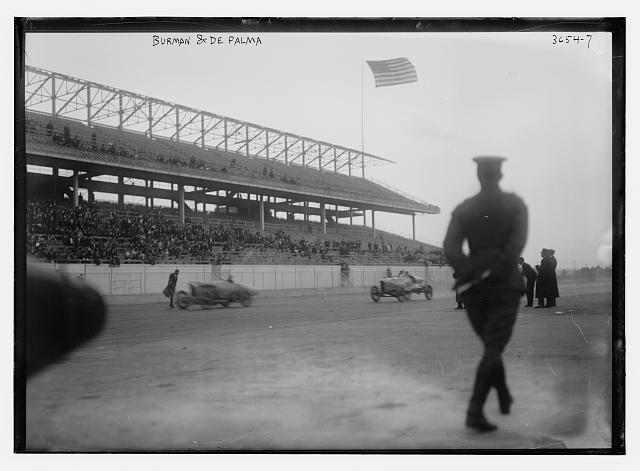
Burman & De Palma


Bob Burman's car after accident - Indianapolis


all photos from the Library of Congress

Bob Burman (23 April 1884 Imlay City, Michigan – 18 April 1916 Corona, California) was an active in the formative years of auto racing. He competed at the Indianapolis 500 in 1911, and was the winner of the first feature race at the track in 1909.

Burman was killed in a road race in Corona, California, when he rolled over in his open-cockpit Puegot. Three spectators were also killed, and five others were seriously injured. His death led Barney Oldfield and Harry Miller to design an construct a race car that incorporated a roll cage inside a streamlined driver's compartment that completely enclosed the driver (called the "Golden Submarine").

Monday, June 7, 2010

Additional Bibliographical Material on the Early History of Automobile Racing in America, Pre-WWII

Poster, 1909


Additional Bibliographic Material on Auto Racing Pre-WWII

Illustrated Speedway News, May 1938-

National Auto Racing News, November, 1934-

Quattlebaum, Julian. The Great Savannah Races. 1957. Rpr. Athens, GA: University of Georgia Press, 1983.

Radbruch, Don. Dirt Track Auto Racing, 1919-1941. Jefferson, NC: McFarland, 2004.

Rose, Buz. "Show Biz" Auto Racing: A Pictorial and Written History of IMCA Big Car Racing, 1915-1977. Glendale, AZ: Rose Racing Publications, 2001.

Russell, Jim and Ed Watson. Safe at Any Speed. Marshall, IN: Witness Productions, 1992.

Seymour, Miranda. The Bugatti Queen: In Search of a Motor-racing Legend. London: Simon and Schuster, 2004.

Simone, Daniel John. "Drivers, Dust and Dirt: The History of Auto Racing in Fargo, North Dakota (1903-1969)." MA Thesis, North Dakota State University, 2002.

Taylor, Sec. "Gus Schrader: Auto Racing Champion." Annals of Iowa, 3rd series, 38 (Spring, 1966), 304-8.

Wagner, Fred. The Saga of the Roaring Road. 2nd ed. Boston: Meador, 1938.

White, Gordon Elliot. Kurtis-Kraft: Masterworks of Speed and Style. St. Paul, MN: MBI Publishing, 2001.

________________. Lost Race Tracks: Treasures of Automobile Racing. Hudson, WI: Iconographix, 2002.

________________. Offenhauser: The Legendary Racing Engine and the Men Who Built it. Osceola, WI: MBI, 1996.

Wilkinson, Sylvia. Dirt Tracks to Glory: The Early Days of Stock Car Racing as Told by the Participants. Chapel Hill, NC: Algonquin Books, 1983.

Saturday, June 5, 2010

Some Photographic Images of the Vanderbilt Cup Races


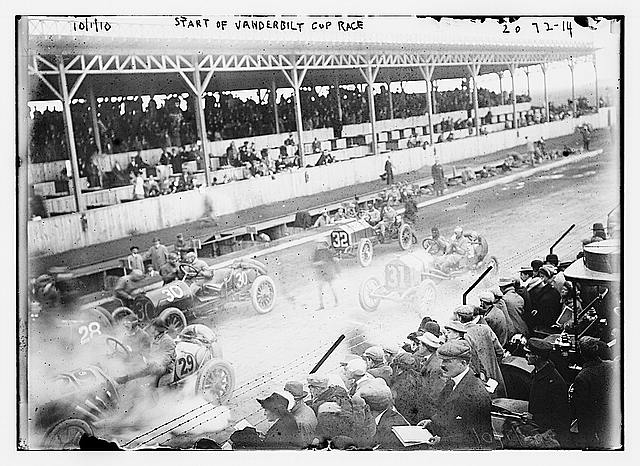
Start of Vanderbilt Race, October 1, 1910


Start of Vanderbilt Cup Race, n.d.


Tracey finishing in the Vanderbilt cup race, for racing cars sponsored by W.K. Vanderbilt, Jr.


Scoreboard at the Vanderbilt cup race, for racing cars sponsored by W.K. Vanderbilt, Jr.

Auto Racing and Women -- some fast and not so fast early women automobile racers

Duchess of Marlborough (Balsan, Consuelo Vanderbilt) leaving Vanderbilt Cup races in auto, amid crowd. Westbury, L.I. Oct. 14, 1905

Woman drives at world's record speed of 109 miles an hour. Mrs. Gwenda Stewart, ... at wheel of her ... bantam car ... in which she seat a world's small-car speed record ... at Montlhery Track, near Paris


Katherine Drexel Dahlgren in her racing auto


[Woman putting water in radiator of Stutz Weightman Special no 26. on Benning race track, Washington, D.C., area]

Wednesday, June 2, 2010

Bibliography of recent articles on the history of automobile racing in the U.S.


Ahlgren, Carol and Anthone, David. “Bad Roads and Big hearts: Nebraska and the Great Race of 1908.” Nebraska History, 73 (March, 1992), 12-17.

Casey, Robert. “The Vanderbilt Cup.” Technology and Culture, 40 (April, 1999), 358-363.

Chisum, Emmett D. “Crossing Wyoming by Car in 190-8: New York to Paris Automobile Race.” Annals of Wyoming: the Wyoming History Journal, 52 (January, 1980), 34-9.

Clark, George Stephens. “Gasoline and Sand: the Birth of Automobile Speed Racing.” Mankind: the Magazine of Popular History, 3 no. 4 (1971), 14-24.

Cole, Terrence M. “Ocean to Ocean by Model T: Henry Ford and the 1909 Transcontinental Auto Contest.” Journal of Sport History, 18 (Summer, 1991), 224-240.

Dill, Mark. “Barney Oldfield and the Quest of the Louisiana Purchase Trophy.” Gateway, 25 (Summer, 2004), 50-55.

Duncan, John D. “The Great Savannah Races.” Georgia Historical Quarterly, 68 (Summer, 1984), 305-6.

Dunkelberger, Steve. “Ten years on the Auto Racing Circuit.” Columbia: the Magazine of Northwest History, 22 (Summer, 2008), 6-8.

Earl, Phillip I. “New York to Paris via Nevada: the Great Auto Race of ’08.” Nevada Historical Quarterly, 19 (June, 1976), 104-7.

Featherstone, Ray. “The King of Speed: Erwin G. “Cannon Ball” Baker.” Traces of Indiana and Midwestern History, 15 (January, 2003), 30-39.

Fenseter, J.M. “Indy,” American Heritage, 43 (May/June, 1992), 66-79.

Giamturco, Michael. “The Infinite Straightaway.” American Heritage of Invention and Technology, 8 (1992), 34-41.

Gerber, Timothy. “Built for Speed: the Checkered Career of Race Car Designer Harry A. Miller.” Wisconsin Magazine of History, 85 (March, 2002), 32-41.

Hall Randal L. “Beach Racers: Daytona before NASCAR.” Florida Historical Quarterly, 87 (Summer, 2008), 128-130.

__________. “Before NASCAR: The Corporate and Civic promotion of Automobile Racing in the American South, 1903-1927.” Journal of Southern History, 68 (August 2002), 629-669.

__________. “Carnival of Speed: the Auto Racing Business in the Emerging South, 1930-1950.” North Carolina Historical Review, 84 (July, 2007), 245-275.

__________. “Silent Speedways of the Carolinas: The Grand National Histories of 29 Former Tracks.” North Carolina Historical Review, 84 (July, 2007), 329-330. Review of book by Perry Wood.

Herbst, Keith S. “Engineering for Speed: A Man for All Seasons.” Western New York Heritage, 11 (Fall, 2008), 54-65.

Holan, Mark. “On the Road Again: the Great Auto Endurance Race.” History Magazine, 11 (December, 2009), 20-1.

Kimes, Beverly Rae. “The Dawn of Speed.” American Heritage, 38(November, 1987), 92-99.

Leavengood, Betty. “The Legendary Pennsboro Speedway: Fast Times in Ritchie County.” Goldenseal, 33 (September, 2007), 46-51.

Lewis, W. David. “Divergent Cultures: The American Response to European Dominance in Automobile Racing, 1895-1917.” Icon: Journal of the International Committee for the History of Technology, 7 (2001), 1-34.

_____________. “Eddie Rickenbacker: Racetrack Entrepreneur.” Essays in Economic & Business History, 18 (2000), 85-100.

McLaughlin, Jack. “Seattle or Bust.” American History, 38(June, 2003), 18-25.

Messer-Kruse, Timothy. “You Know Me.” Timeline, 19 (May/June, 2002), 2-19.

Nolan, William F. “First to the phoenix Line.” Westways, 71, no. 6 (1979), 51-4.

Nott, Rick. “The Jack Johnson v. Barney Oldfield match Race3 of 1910: What it Says about Race in America.” Afro-Americans in New York Life and History (29 (January, 2005), 39-53.

Manchester, Alan V. “The Great Auto Race: Buffalo and the New York to Paris 1908 Automobile Race.” Western New York Heritage, 10 (2008), 26-40.

Peterson, Walter F. “Barney Oldfied Turns a Plowhorse into a Race Horse.” Northwest Ohio Quarterly, 35 no. 3 (1963), 122-8.

Pierce, Dan. “For Gold and Glory.” Journal of Sport History, 31 (Spring, 2004), 111-113.

Rossano, Geoffrey L. “Long Island Goes to the auto Races: the Great Vanderbilt Cup controversy of 1904.” Long Island Historical Journal, 3 (March, 1991), 231-244.

Scott, Cord. “The Race of the Century – 1895 Chicago.” Journal of the Illinois State Historical Society, 96 (March, 2003), 37-48.

Scott, Roy V. “the Great Savannah Races.” Journal of Mississippi History, 46(September, 1984), 260-262.

Seward, Bill. “103 Miles an hour in 1915.” Annals of Iowa, 36 (Winter, 1962), 215-217.

Simone, Daniel J. “Horsepower and Horse Tracks: The Fargo Auto Races of 1915.” North Dakota History, 74 (2007), 36-43.

Waters, Alvin W. “The Twin City Motor Speedway.” Minnesota History, 60 (December, 2007), 304-311.

Yanik, Anthony J. “Detroit’s First Automobile Extravaganza: the Glidden Tour of 1909.” Chronicle: the Bi-Monthly Magazine of the Historical Society of Michigan, 23 (1987), 14-15.