This blog will expand on themes and topics first mentioned in my book, "The Automobile and American Life." I hope to comment on recent developments in the automobile industry, reviews of my readings on the history of the automobile, drafts of my new work, contributions from friends, descriptions of the museums and car shows I attend and anything else relevant. Copyright 2009-2026, by the author.
Popular Posts
-
My 1971 Porsche 911T Targa Written for younger readers: Sports car is an automobile designed more for performance than for carrying passeng...
-
Raising an Alarm The wave of auto thefts in the early 1970s and the failure of manufacturers to make prod...
-
Hi folks -- I was visiting with Ed Garten on Friday morning at a local Panera in Beavercreek, Ohio when Ed noticed that a Mary Kay Cadillac ...
-
Hi folks -- when I was a kid I always noticed the OK used car signs at the dealers' lots. But where did the OK logo come from? I recent...
-
So what is a rat rod? These are becoming increasingly popular, as witenssed by the several at the Friday night cruise in and today at the C...
Monday, September 9, 2013
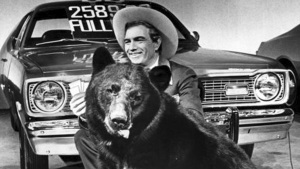
Only in America: Cal Worthington, TV ads, and Making Milllions selling cars
Cal Worthington, the one-of-a-kind car Dealer with dealerships in 5 western states, died at age 92 yesterday while watching a football game. He was larger than life -- a poor boy from Oklahoma, later a WWII bomber pilot who was awarded the Distinguished Flying Cross, a Hudson Dealer beginning in 1949, and finally he became oneof the most successful car dealers in America. Known for his outrageous TV ads featuring various animals ranging from apes to tigers, Worthington knew how to break the ice with his TV audience, while at the same time taking a dig at his competition. An American original, his sales techniques reflected an era when Americans loved their cars, and even some sales people and dealers. For a time at mid-century, being a car dealer was one way to become rich in America!
The Last GP European Drivers Champion before World War II -- Rudolf Caracciola
![]() |
| Italian Grand Prix in Monza, 11 September 1938.Manfred von Brauchitsch shortly before the start |
Following on from his successes in 1935 and 1937, Rudolf Caracciola became European Champion of the Association Internationale des Automobile Clubs Reconnus (AIACR) for the third time in 1938. One victory and two 2nd places in three meetings brought the title within reach for Mercedes-Benz’s chief driver of the time. In the Italian Grand Prix at Monza, 3rd place behind Tazio Nuvolari (Auto Union) and Giuseppe Farina (Alfa Romeo) was enough for Caracciola to take the championship in his Mercedes-Benz Silver Arrow W 154.
In the spring of 1939, Caracciola was awarded the German Sports Badge in gold after the 29th International Motor Show in Berlin in recognition of his success. “I won the European championship for the fifth time,“ Caracciola noted contentedly in his memoirs. Prior to the three Grand Prix championships which he won with the Mercedes-Benz Silver Arrow models W 25 (1935), W 125 (1937) and W 154 (1938), he had claimed the European Hillclimbing Championship in the supercharged Mercedes-Benz SSK and SSKL sports cars back in 1930 and 1931.
A hard-won victory
In contrast to the present-day Formula 1 ranking system, under which the winner of a race is allocated the most points and the highest total score decides the championship at the end of the season, the opposite points system applied in the European Grand Prix Championship in 1938: the winner received one point and the other drivers from 2 to 7 points, according to their placings. 8 points were allocated for a no-show.
Following his victory in the third meeting, the Swiss Grand Prix on 21 August 1938, Caracciola held a clear five-point lead in the European Championship table. While his rivals from Auto Union and the other makes no longer posed a threat, his team colleagues still represented a challenge. Caracciola fought his way through the Grand Prix, although the faulty exhaust of his W 154 heated up the pedals dangerously, leaving him with painful memories of the race: “Despite asbestos insoles in my shoes, the gas pedal burnt a hole through the leather sole, the asbestos insole and the sole of my foot.”
Manfred von Brauchitsch, who had dropped out of the race, took over from Caracciola’s W 154 for several laps. The rules permitted such changes of driver, with the points going to the driver who started the race in the car concerned. Caracciola then returned to the fray and continued the race with due caution: “I climbed back on board, pressing the glowing hot gas pedal only with the very edge of my sole,” he recalled in his biography.
Rudolf Caracciola finished in 3rd place. With only 8 points, he was now well ahead of his team colleagues Manfred von Brauchitsch (15), Hermann Lang (17), and Richard Seaman (18). The Auto Union drivers shared 5th place with 20 points each. This triumph made Caracciola the last European Grand Prix Champion before the outbreak of the Second World War.
Sunday, September 8, 2013
Cars and Parts Swap Meet and Car Show, Springfield, OH September 7
Some hurried photos here -- I discovered that my batteries were almost dead and thus I missed many excellent photo opportunities while at the Springfield event. Certainly pick up trucks are hot right now as collectibles and they were everywhere on the Clark County Fairgrounds. It was a hot afternoon, and since my left knee was bothering me, I couldn't quite enjoy the swap meet the way I usually do. Very littie foreign stuff on the tables, as always the case. And this time no great treasures found!
Saturday, September 7, 2013
The Mercedes Benz 180, 1953
![]() |
| Classic modern: "Ponton Mercedes" (120/121 series, 1953 to 1962), 190 Db model |
![]() |
| Safety first: frame-floor system of the Mercedes-Benz W 120 series of 1952. Further development led to Béla Barényi's patented safety cell. |
The première of the Model 180 (W 120) in 1953, today lovingly referred to as the “Pontoon Mercedes” (or the “Roundie”), was a technical and aesthetic milestone in the history of the passenger cars from Mercedes-Benz. The intermediate saloon was the first car from the Stuttgart-based brand to feature a unibody and at the same time the first whose bodywork was designed in the form of a pontoon. The W 120 was a trendsetting predecessor of the E-Class, but it also put its mark on the styling and technical design of the new luxury class (model series 180/105/128, from 1954).
Already the external appearance of the Model 180 presented by Mercedes-Benz in 1953 excited industry professionals and the general public. The so-called “three-box design” with a rectangular footprint, fully integrated wings and clearly separate sections for engine, passenger compartment and boot, set benchmarks for modern design. The bodywork of the W 120 stood out sharply from the passenger cars Mercedes-Benz presented right after the Second World War. Their design idiom and technical features were still based to a large extent on the traditions of the 1930s. In contrast, the pontoon design developed in North America in the late 1940s and reinterpreted by Mercedes-Benz for the intermediate saloons appeared fresh and clean. This design lowered the aerodynamic drag of the Mercedes-Benz 180 compared with earlier models, reduced wind noise and offered a more spacious passenger compartment.
The unibody pioneer at Mercedes-Benz
The bodywork of the Model 180 also set new technical standards. For the first time a Mercedes-Benz passenger car featured a unibody which was firmly welded to the frame-floor system to create a static structural unit. Compared with conventional frame construction with mounted body, this design increased torsional rigidity while simultaneously lowering the weight.
Another innovation was the double wishbone suspension of the front wheels which was bolted to a front axle carrier instead of directly to the frame. The U-shaped axle carrier also accommodated the engine, transmission and steering. It was mounted to the front section of the frame with silent blocks for low noise levels. The rear wheels on the tried and proven swing axle were now additionally controlled by widely spaced trailing arms. All in all this resulted in handling qualities that were outstanding for the time. In his road test report published in “auto motor und sport” magazine in 1953, Werner Oswald commended that the driver in the Model 180 “can unhesitatingly push the envelope set by the engine and suspension right from the start”.
The aforementioned engine was a side-valved four-cylinder in-line engine with a displacement of 1767 cc that produced 52 hp (38 kW). The Model 180 reached a top speed of 126 km/h and took 31 seconds to accelerate from rest to 100 km/h.
Successful differentiation
The Mercedes-Benz 180 presented 60 years ago quickly evolved into an entire model family. The arguably most famous variant of the “Pontoon Mercedes” was the Mercedes-Benz 190 SL sports car, which was presented in New York in 1954 and went into production in 1955 This roadster of the 121 model series was based on the shortened frame-floor system of the Model 180 and was powered by a four-cylinder engine producing 105 hp (77 kW) from a displacement of 1897 cc.
The diesel engine variant 180 D debuted in 1954 in the pontoon body of the 120 model series, followed by the petrol engine version Mercedes-Benz 190 of the 121 model series in 1956. It featured a four-cylinder engine producing 75 hp (55 kW) from a displacement of 1897 cc. The new top-of-the-line intermediate model set itself apart from the 180 models, among other things, with more chrome trim and larger tail lights. Referred to in-house as the 180 a, the Model 180 was revised in 1957 and now also had an engine with a displacement of 1897 cc that in this case produced 65 hp (48 kW). In 1958 the Model 190 D rounded out the family of pontoon saloons as the second diesel model in the 120/121 series. Its 50-hp (37 kW) engine originated from the engine of the Model 190.
Benchmarks for the luxury class
In 1953 the Model 180 also set benchmarks for the new luxury class vehicles from Mercedes-Benz that came on the market in 1954. On the outside the 220 and 220 S (W 180) as well as the 220 SE (W 128) saloons with in-line six-cylinder engines differed from the W 120 only by a longer wheelbase (2.82 metres instead of 2.65 metres), a larger passenger compartment and a longer engine compartment. The Model 219 (W 105) with six-cylinder engine, which was available from 1956, had the smaller body, however.
The Mercedes-Benz 180 put its stamp on the automotive world even before its market launch because the W 120 was the first car ever to appear in a spy photo. “auto motor und sport” magazine published a first photo of the future Model 180 in 1952, and accompanied it with a parody of Goethe’s Erlkönig (Alder King) poem, in which the new intermediate saloon is portrayed as “Daimler’s youngest child”. This is how the German term ‘Erlkönig’ (development mule) was coined to describe a prototype or a pre-production vehicle prior to its official presentation, a term that is still in use today.
Thursday, September 5, 2013
The Most Amazing Porsche Restoration Ever!
See link below. This Porsche guy is dedicated beyond belief. If you have the time, money, and love for the car nothing is impossible.
http://forums.pelicanparts.com/porsche-911-technical-forum/642031-1968-912-junker-reincarnation.html?utm_source=Porsche+2012+Cust&utm_campaign=203fcf3b88-Porsche_2012_Cust_9_59_5_2013&utm_medium=email&utm_term=0_cf8a68fc80-203fcf3b88-67548649
Monday, September 2, 2013
Sitdown, the Coming of the United Auto Workers, and the Battle of the Overpass
The Depression exacerbated labor
woes. James Flink wrote, “Labor unrest in the automobile industry spread with
massive unemployment and the deterioration of working conditions as the
Depression deepened.”24 The crisis was compounded by technological
stagnation, and since workers were more flexible than machines, human labor was
pushed to increase productivity.25 Work on the assembly line was
characterized by the “speed-up” and “stretch out” of the workforce. “Too many
men competed for too few jobs and automobile manufacturers took advantage of the
glut in the labor market.”26 Autoworkers of the 1930s had manifold
complaints, but the foremost grievance was the speed-up. Workers argued
bitterly that the speed of the line was
unbearable; that annual earnings were inadequate; methods of payment were too
complicated; the seasonal unemployment created by the industry’s insistence
upon an annual model change; the practice of shutting down during the model
changes (at Ford) and of hiring workers, regardless of skill, at the starting
rate; management ignored and refused to recognize seniority; workers over 40
found it difficult to remain employed; female labor was being substituted to
replace male labor; the continued “speed-up” of the assembly line; and the
espionage networks and the Bennett regime of Ford.27 Mounting
complaints would give impetus to a fledgling union movement.
Under the auspices of the New Deal,
Congress passed the Wagner Act and created the National Labor Relations Board
(NLRB). The original agreement was admittedly weak; it only stipulated
requirements for worker representation, and automobile companies continued to
resist unionization. The promises of the Wagner Act eventually came to
fruition. “In only ten years,” noted historian Richard Oestriecher, “the Wagner
Act led directly to an increase in union representation from approximately one
worker in ten in 1934 . . . to more than three out of 10 by
1945, and strong unions forced corporations to raise wages at roughly the same
rate that the economy expanded.”28 Concurrent with the Wagner Act,
the American Federation of Labor (AFL) chartered the United Automobile Workers
of America (UAW).
Even under the aegis of the Great
Depression and the New Deal political climate, the “Big Three” were able to
thwart worker’s attempts to organize. Unionization of the automobile industry
was not concluded when the ink of the Wagner Act dried. Ford used a police
regime to prevent violence; General Motors, Chrysler, and other firms embarked
on campaigns of espionage. It was said at the time that one out of ten workers
was a company informant. To unionize the auto industry, American politics had
to be moved to the left. In Management
and Managed Steven Jeffreys argued that the external political environment
was crucial in shaping the limits of unionization. He observed that the
Roosevelt labor coalition had left the “business community exposed.”29
Jeffreys’ thesis is also important because it recognized that “different
patterns of managerial authority developed in different plants.”30
Labor unrest is a microcosm of larger political effects on the American social
fabric. The historical experience of unionization was complex, and thus
different in every company, and then every plant within that company. A high
number of automobile strikes followed FDR’s 1932 election.
Companies battled to maintain
Detroit’s reputation as an open shop city. Historians have noted several
reasons for the auto industry’s ability to resist industrialization. First,
both the AFL and communist organizations bungled opportunities to organize
autoworkers. A proper political mechanism was not realized until a group within
the AFL created the Congress of Industrial Organizations (CIO), which intended
to jettison the AFL’s craft principle to organize workers in the mass
production industries. Second, the racial and ethnic composition of the
workforce made organization difficult. Third, management pursued deliberate
strategies to make unionization difficult. Ford’s initial benevolence was a
subtle attempt to assuage unionization, and his regime of violence under thug
Harry Bennett was an overt strategy to stop unions. General Motors had a spy
racket. In addition, politics within the unions were brutal and divisive. Even
with mounting complaints and the automobile industry’s speed-up, racial and
ethnic differences proved difficult to overcome.
Collective bargaining was made a
reality by historical actors who were catalyzed by the Great Depression and
energized as a part of the New Deal political coalition. Franklin Roosevelt’s
charisma forged a new political bloc that embraced class-based politics and
sided tentatively with labor. Workers also began to overcome their differences,
and as Ronald Edsforth and Robert Asher pointed out, “no matter what their
race, ethnicity, or gender, automobile workers found themselves confronting
similar problems . . . between
1935 and 1941 deeply felt resentments about what these workers called “the
speedup” or “the stretch out” brought diverse groups of auto workers together
in the successful organizing drives of the United Automobile Workers Union.”31
Leaders such as Homer Martin, Walter and Victor Ruether, Richard “Dick”
Frankensteen, George Addes, and others organized a motley gang of laborers into
the United Autoworkers (UAW). In a pivotal moment at the 1935 South Bend
Convention, Dick Frankensteen’s Automotive Industrial Workers Association
(AIWA) joined the UAW.32 Arnold Bernstein noted, “In the summer of
1936 the now more or less “United” Automobile Workers confronted the major task
of organization, which, given the extreme oligopolistic structure of the more
industry, necessitated a frontal attack upon one of the big three.”33
The opportunity for a “frontal
assault” came in 1936 with the sit down strike at General Motors plants around
the country. Arnold Bernstein noted that the youth of the autoworkers made the
sit down strike “democracy run wild.”34 The autoworkers used the
innovative sit-down strike tactic to prevent the removal of dies and to
obstruct the importation of strike breakers.35 After a 44-day period
of intense negotiations, the UAW gained the right to bargain with General
Motors. The moment was unique in American history; both Michigan Governor Frank
Murphy and President Franklin Roosevelt did not forcibly remove strikers. The
UAW’s conquest of General Motors quickly exacted contracts from Hudson,
Packard, and Studebaker, along with numerous parts producers. In the wake of
the strike, the union had “256 locals, 400 collective bargaining agreements,
and 220,000 dues-paying members.”36
The union won several victories and
had growing numbers, and in the summer of 1937 began to take on the Ford Motor
Company. The assault on Ford was concomitant with vicious union factionalism.
Dick Frankensteen led a progressive caucus while Walter Reuther headed up a
Unity caucus. Perhaps the most dramatic moment of UAW-CIO’s campaign to
unionize the automobile industry was the “Battle of the Overpass,” a brawl
between Harry Bennett’s thug regime and UAW leaflet distributors led by Walter
Reuther and Richard Frankensteen. Detroit
News photographer Scotty Kilpatrick captured the beat-down, and it
generated iconic images of the fight to unionize the auto industry. Arnold
Bernstein described the attack:
The
UAW people were attacked unmercifully. Reuther was beaten, knocked down, lifted
to his feet, and beaten again. Four or five men worked over Frankensteen. They
skinned his coat up his back and over his face and two men locked his arms
while others slugged him. Then they knocked him to the concrete floor . . . A
separate individual grabbed him by each foot and by each hand and his legs were
spread apart and his body was toward the east . . . and ten
other men proceeded to kick him in the crotch and in the groin, and around the
head and also to gore him with their heels in the abdomen.37
That
attack, and the public revulsion that followed, ultimately forced Henry Ford to
give in to union demands to organize, which occurred on the eve of World War
II. After several organizers and workers were fired in the spring of 1941, a
walkout occurred in the foundry, which spread to the entire plant. Unionization
was called to a vote, and a majority approved of the UAW-CIO. Much to the
dismay of a senile Ford, the “UAW received over 70% of the vote, won
recognition in all Ford plants, and obtained a favorable collective bargaining
contract.”38 The contract set limits on the arbitrary authority of
management, established grievance procedures, and stopped the use of steward
systems to mitigate disputes.
Subscribe to:
Posts (Atom)


.jpeg)