Some reflections after reading several years of the Los Angeles Tribune, an African-American Newspaper. First, the color of the Cadillac was almost always mentioned in the articles and entries. It could be as simple as white(which is mentioned more than any other color by far!), or as colorful as robin-egg blue, pink, or lavender. Often it was mentioned in news about performers,whether it be Sam Cooke, Sammy Davis, Jr,. Eartha Kit, or Duke Ellington. Other owners included ministers, funeral home directors, bookies, pimps, drug dealers, lawyers, or those with underworld connections. Several times, notorious black traffic offenders or those wanted for other crimes were in the company of white women.
In the breezy social columns prominent African-Americans were sometimes listed as traveling in their Cadillacs, or enjoying their new Cadillac.
No other car is given such media attention in the Tribune, although The Ford Thunderbird and Lincoln Continental is mentioned in passing.
This blog will expand on themes and topics first mentioned in my book, "The Automobile and American Life." I hope to comment on recent developments in the automobile industry, reviews of my readings on the history of the automobile, drafts of my new work, contributions from friends, descriptions of the museums and car shows I attend and anything else relevant. Copyright 2009-2026, by the author.
Popular Posts
-
My 1971 Porsche 911T Targa Written for younger readers: Sports car is an automobile designed more for performance than for carrying passeng...
-
Raising an Alarm The wave of auto thefts in the early 1970s and the failure of manufacturers to make prod...
-
Hi folks -- I was visiting with Ed Garten on Friday morning at a local Panera in Beavercreek, Ohio when Ed noticed that a Mary Kay Cadillac ...
-
Hi folks -- when I was a kid I always noticed the OK used car signs at the dealers' lots. But where did the OK logo come from? I recent...
-
So what is a rat rod? These are becoming increasingly popular, as witenssed by the several at the Friday night cruise in and today at the C...
Tuesday, October 8, 2013
Cadillacs and African-Americans
Hi folks -- the content for this post was taken directly from the link below, a blog on politcs and other matters.
http://blackdaffodill.wordpress.com/2010/02/05/nicholas-dreystadt-and-gm-cadillacs-and-african-americans/
I am currently advising an African - American student in an independent study and am casting around for a topic. After reading former stduent Peter Cajka's article that was published in the Automotive History Review in 2009 I thought of the possibilities of a paper on African Americans and Cadillacs. I started looking through a number of African American newspapers and then found this remarkable post on the Internet. I knew of Dreystadt and included him in my The Automobile and American Life, but did not use this remarkable story.
http://blackdaffodill.wordpress.com/2010/02/05/nicholas-dreystadt-and-gm-cadillacs-and-african-americans/
I am currently advising an African - American student in an independent study and am casting around for a topic. After reading former stduent Peter Cajka's article that was published in the Automotive History Review in 2009 I thought of the possibilities of a paper on African Americans and Cadillacs. I started looking through a number of African American newspapers and then found this remarkable post on the Internet. I knew of Dreystadt and included him in my The Automobile and American Life, but did not use this remarkable story.
Nick Dreystadt
Nicholas Dreystadt and
GM, Cadillacs and African-Americans
So. I have always vaguely
wondered about the rather unique love-affair between African-Americans and the
Cadillac. I stumbled across this story in a book called The Chrome Colossus by Ed Cray, while doing
some research for my dissertation…
It is 1932, and GM is actually at the point of abandoning the
Cadillac forever…what was on the cutting board? This beauty of an automobile:
Nicholas Dreystadt, head of the Cadillac division, breaks into
the meeting
As Cadillac service manager, Dreystadt had
earlier discovered that the car was very popular with the small black
bourgeoisie of successful entertainers, doctors and ghetto businessmen. A
surprising number brought Cadillacs in for service–surprising because corporate
policy was not to sell Cadillacs to blacks at all; the Cadillac was reserved
for the white prestige market. “But the wealthy Negro,” business critic Peter
F. Drucker recalled, “wanted a Cadillac so badly that he paid a substantial
premium to a white man to front for him in buying one. Dreystadt had
investigated this unexpected phenomenon and found that a Cadillac was the only
success symbol the affluent black could buy; he had no access to good housing,
to luxury resorts, or to any other of the outward signs of worldly success.”
Overwhelmed by Dreystadt’s audacity and bemused by his proposal,
the committee gave him eighteen months in which to develop the Negro market. By
the end of 1934, Derystadt had the Cadillac division breaking even, and by 1940
had multplied sales tenfold… (Cray 279)
It is one side of the story to be sure, a comfortable retelling
of an atrocious racism prevalent in this most American of institutions. And all
of America. There must be so much more to it of course, but what a fascinating
glimpse from a very corporate angle. Turned around, in spite of the fury it
inspires, it seems to say that African-Americans saved the Cadillac from
extinction. What did they save again?
God damn. I know it’s conspicuous consumption, but I continue
utterly smitten with the craftsmanship and beauty of something such as this.
But there is more. I continue reading and 50 pages later I find
this story from the WWII years:
Dreystadt had accepted a contract to produce
delicate aircraft gyroscopes. despite mutterings on the fourteenth floor that
the job was a killer and needed skilled hands unavailable. The dissent turned
to outrage when Dreystadt and his personnel manager, Jim Roche, hired 2,000
overage black prostitutes from Paradise Valley–uneducated, untrained, but
willing workers. Dreystadt hired the madams too, blithely explaining, “They
know how to manage the women.”
Dreystadt himself machined a dozen gyroscopes,
then produced a training film detailing the step-by-step assembly process.
Within weeks the women were surpassing quotas, and the outrage turned to
chagrin on West Grand Boulevard. Jokes about Cadillac’s “red-light district”
angered Dreystadt. “These women are my fellow workers, and yours,” he insisted.
“They do a good job and respect their work. Whatever their past, they are
entitled to the same respect as any one of our associates.”
Dreystadt knew he would have to replace these
women at war’s end–returning veterans had job preference, and the United Auto
Workers, heavily white male with a southern-states orientation, wanted the
women out of the plant. “Nigger-lover” and “whore-monger” Dreystadt fought to
keep some, pleading, “For the first time in their lives, these poor wretches
are paid decently, work in decent conditions, and have some rights. And for the
first time they have some dignity and self-respect. It’s our duty to save them
from being again rejected and despised.” The union stood adamant.
When the women were laid off, a number committed suicide
rather than return to the streets. Nick Dreystadt grieved, “God forgive me. I
have failed these poor souls.” (Cray 318-319)
Again, only one side and a highly problematic retelling of what
is truly a remarkable story by any measure. And again, racism in bucketfuls.
But who was this Nick Dreystadt really? And where are the other sides of this
story to be found? I shall be looking, no fear…
Sunday, October 6, 2013
Barney Oldfield Photos
![]() |
| Image of Barney Oldfield, automobile racer, driving a racing car along a racetrack in or near Chicago, Illinois. 1905. |
![]() |
| Half-length portrait of Barney Oldfield, motorist, sitting in a car parked next to a garage in Chicago, Illinois. 1905. |
![]() |
| Half-length portrait of Barney Oldfield, motorist, facing camera, sitting in a room in Chicago, Illinois. 1905. |
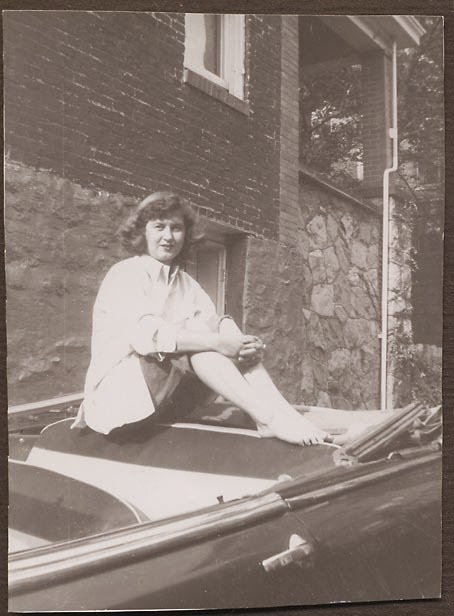
Girls in Convertibles: Images from the Past
Girls and convertibles -- they go together. The convertible is the ultimate expression of freedom and romance. Unlike a closed car with its constraints -- reflective of life itself -- the convertible opens one up to the world and its possibilities. The wind,weather, light, sounds -- all make one feel more alive.
The Transition to all Steel Automobile Bodies During the 1920s: Budd Coachwork
Cars as Homes
Since the
1920s, the home and the automobile have been inexorably linked.39
Perhaps a word should be said at the outset about psychological meaning of
these two things. The word home – and clearly very different than house – has a
meaning that is distinctive in American culture and in the English language.
For example, home is not exactly translatable in the Italian, French, or
Hungarian languages. It is a sacred place to many, a sphere in which
inhabitants shape a material environment that is essentially reflective of
self. For many individuals, the home is a place of relaxation, comfort, and
intimacy with others. The walls and ceiling of a home provide safety from the
elements and hostile others. The home is also a place of special objects. In
some cultures, the Middle East for example, the car dashboard contains numerous
trinkets. A generation ago, St. Christopher medals were attached to many
American dashboards. Not only did my parents always have a St. Christopher
medal in the car, they also had other non-essential gadgets from time to time.
For example, my cousin had a 1950 Oldsmobile with a vacuum-assisted pop-up bird
on the dash that responded to increases and decreases in acceleration. It was
like having a bird in a cage in the living room.
In any
case, typically for men, that special object attached to the home is often the
automobile, a possession that conveys status; for women, the things that mean
the most in a home are usually connected with loved ones or special people.
According to Mihaly Csikszentmihalyi and Eurgen Rochenberg-Halton, the home
“brings to mind one’s childhood, the roots of one’s being.”40 I can
certainly attest to this with regards to the car as an extension of the home,
as some of my first memories center on the dashboard, radio, ashtrays, lighter
and upholstery of my father’s 1948 Chevrolet.
For the car
to be an extension of the home, it had to be closed rather than open, unlike
the pre-WWI roadster or touring car. Thus, the first and undoubtedly most
important step in creating personal space in the automobile was the closed
steel body. Historian James J. Flink has called this development “the single
most significant automotive innovation.”41 Almost immediately after
World War I, public demand increased dramatically for a closed car that would
no longer be a seasonal pleasure vehicle, but rather all-weather
transportation. The few closed body cars built before WWI were extremely
expensive and the work of custom coach builders. This rise in demand during the
1920s, coupled with a remarkable number of concurrent technical innovations in
plate glass and steel manufacture, resulted in a revolution in production
methods, productivity and economies of scale. William J. Abernathy has
carefully characterized the transformation that took place on the shop floor
and assembly line, the first fruits of which occurred when in 1921 Hudson first
mass-produced a closed car. The transition away from rag tops (the word
convertible was first used in 1927 and officially added to the Society of
Automotive Engineers lexicon in 1928) was rapid and contributed to a venerable
prodigy of production by the end of the 1920s, as depicted in Table 4.
Table 4. Transition from Open to Closed Cars
|
Year
|
Open
Cars (%)
|
Closed
Cars (%)
|
|
1919
|
90
|
10
|
|
1920
|
84
|
16
|
|
1921
|
78
|
22
|
|
1922
|
70
|
30
|
|
1923
|
66
|
34
|
|
1924
|
57
|
43
|
|
1925
|
44
|
56
|
|
1926
|
36
|
74
|
|
1927
|
15
|
85
|
Source: John Gunnell, Convertibles: The Complete
Story (Blue Ridge Summit, PA: 1984), 129.
Significant
improvements in the quality of sheet steel were certainly part of this story,
but so too were developments in welding technology, the development of sound
deadening materials, and construction of the single unit body. All of these
innovations and far more were pioneered by the Budd Manufacturing Company.
Typical of the Budd All-Steel ads of the mid-1920s was one that appeared in the
Saturday Evening Post in 1926, with
the headline “Put the Protection of All-Steel Between You and the Risks of the
Road.”42 Like the safety inherent in a home, the steel body
protected its occupants, especially women and children. The ad continued, “Self
preservation is the first law on Nature. Today, with 19,000,000 cars crowding
the highways . . . With the need for safer motoring more
urgent than ever before . . . America is turning to the
All-Steel Body. It is the greatest protection ever devised to prevent injury in
the case of accident. See that your next car is so equipped!” A second 1926 Budd ad, like the first
mentioned, depicted a closed car traveling down a busy city street but in its
own clear lane, separated on both sides by huge sheets of steel that prevented
the masses of cars on each side from touching the car and harming its
occupants. The headline for this ad read in part, “The protection which it [the
all-steel body] brings to you and to your families is priceless – yet the cars
which have it cost no more than those which do not.”43 Clearly, the
message was that Budd-engineered closed body cars were worth the money spent.
The
rationale Budd used in ads published during the 1920s continued during the
1930s in the General Motors ads featuring the “Turret-Top” design that
contained such sentences as, “The instant feeling of security you
get . . . is beyond price.”44 Surprisingly
perhaps, the pitch toward safety was far more prevalent in ads of the 1930s
than one might think, although ironically during the early 1930s convertibles
were the center of many ads, even when closed cars were pictorially featured!45
On the eve of WWII, however, the theme of the home and the car was clearly
brought together, as reflected in a Hudson advertisement featuring a beautifully
attired woman sitting in a plushy upholstered rear seat. The ad touts the
availability of “a wide selection of interior color combinations that harmonize
with the exterior colors . . . at no extra cost!” This ad
has clear-cut similarities in terms of an emphasis on color and comfort to
paint ads of the same period, as exemplified by the Sherwin-Williams Paint and
Color Style Guide of 1941.46
In
automobiles, up to now, one upholstery color has usually done duty with every
body color. Carpets, floor mats, steering wheels, and trim have introduced
still other assorted colors and tones.
Now
Hudson’s Symphonic Styling gives you, in your 1941 car, the kind of color that
permit a wide variation in the details and equipment of each individual car,
without interfering with orderly, efficient mass production. Symphonic Styling
is the climax of this long-time development.47
With the
widespread adoption of the closed body car by the late 1920s, automotive
engineers next turned their attention to the suspension system.48 To
the uninitiated, suspension system engineering involves very complex mechanics
and geometry.49 One area of concern focused on shock absorbers or
dampeners. In addition to mechanical and hydraulic improvements, air springs,
or the insertion of an inflatable inner tube inside a coil spring, was one
strategy developed during the 1920s and 1930s to improve ride. A second
involved driver control of the shock absorber system, and in 1932 Packard
pioneered a Delco-Remy unit in which a cable mounted on the dash vastly
enhanced ride quality and handling.50 The most important innovation,
however, was the introduction of independent front suspension.51
First used by Mercedes in 1932, independent front suspension was installed in
Cadillac, Buick, Oldsmobile and Chrysler vehicles in 1934, with Ford only
adopting this technology after WWII. Pre-war Pontiacs and Chevrolets employed a
not nearly as effective Dubonnot design. The potential advantages of
independent front suspension, however, were never fully realized, however.
The closed
body style was designed for all-weather driving, as previously mentioned, but
it took several decades before climate control within the personal space of the
automobile became efficient and widely introduced. Beginning around 1925,
aftermarket manufacturers began to sell hot water type heaters for American
automobiles.52 The problem of heating the car was more difficult
than what one might initially think: proper controls and the mixing of heated
air coming from a heat exchanger with ventilated fresh air did not take place
until 1937, when Nash introduced its WeatherEye system. Variants of the Nash
system were introduced by Buick in 1941 and Ford in 1947 (Magic Air).
Subscribe to:
Posts (Atom)