Popular Posts

Sunday, January 13, 2019

The "Little Giant:" Richard Grant and Sales at General Motors, 1925-1941

Kettering brought more to GM than just technical expertise:  he brought talent that made crucial contributions to GM’s efforts to surpass the Ford Motor Company during the Interwar years. One of his closest associates at Delco was Richard H. Grant, and it was Grant who drew on his experiences at National Cash Register and the sales philosophy of John Patterson to teach GM to sell – first Chevrolets and then the entire product line. Known as “Dynamic Dick” and the “Little Giant,” Grant was one of America’s great salesmen. Born in Massachusetts and educated at Harvard, Grant learned to sell at NCR, became its general sales manager in 1913, later moved to Delco and Frigidaire, and in 1923 joined Chevrolet as sales manager. In 1929, Grant became a GM vice-president and was one of the top four or five executives of the firm during the 1930s, with memberships on six policy groups.


Currently this structure is a part of Normandy Methodist Church. As an aside, my home is on land that was part of a Normandy Farms orchard.

            The “Little Giant” played major role in reorganizing the distribution system at GM, eliminating distributors who previously held large territories and had control over local dealers. He was an orator and showman, but beneath the surface Grant was a careful, systematic thinker who implemented market research, accounting, and training procedures throughout the corporation. Grant had learned seven fundamentals of sales from NCR’s John Patterson that were subsequently instilled into GM personnel:
1. Have the right product.
2. Know the potential of each market area.
3. Constantly educate your salesmen on the product, making them listen to canned demonstrations and learn sales talks by heart.
4. Constantly stimulate your sales force, and foster competition. among them with contests and comparisons.
5. Cherish simplicity in all presentations.
6. Use all kinds of advertising.
7. Constantly check up on your salesmen, but be reasonable with them and make no promises you can’t keep.15

1929 Chevrolet International Coupe
1929 Chevrolet Art

Grant further refined Alfred Sloan’s notion of using R. L. Polk Company’s monthly state registration data to closely monitor subtle shifts in consumer demand. By the late 1920s, this information would be relayed to William Knudsen’s production group, thus ensuring that the automobiles made would be the kind that customers would quickly buy off dealer’s lots. After the Depression hit, Grant responded in 1932 with an aggressive strategy of reorganization and renewed energy centered on the formation of the Buick-Olds-Pontiac Sales Company. An interview in Barron’sin 1932 outlined his plans:
“The new organization is planned to intensify and improve the operating efficiency of our distributing outlets for these three lines of cars…. The present field organizations for the three brands will be combed for the best talent available and their united efforts under one directing organization will, we feel, form the strongest and most efficient sales force ever assembled in the automobile industry. The three cars will continue to be merchandised through the present dealer and distributorship organizations and the management expects to increase materially their sales through the new organization…. All talk of a discontinuance of any line as a result of this move is utter nonsense. The nation is junking more cars than it is buying. Auto buying has been at a low level for two years and something must turn soon to bring the public back in the market for new cars. People who have had automobiles and who can afford them will never deprive themselves of this modern luxury.”16


            Closely related to Grant’s efforts were those of the customer research group, led by Buck Weaver.17Weaver and his associates formulated a set of questionnaires aimed at asking the broad question of “What do customers want?” A large number of potential questions were mailed memorandum books in which every aspect of design and engineering was queried. Among the questions asked were what should be the shape of the radiator; what designs are too conservative and too extreme; should there be running boards on cars; and most significantly, how should a car be sold. For buyers of the early 1930s, the results of the surveys pointed to their priorities for cars that were dependable and economical. For the average American, speed and the power of the engine seemed to be the least of their concerns.18


Wednesday, January 9, 2019

Another look at Charles Franklin Kettering, his Ignition System, and the Development of Self-Starter


Below is my account of C.F. Kettering's ignition and self-starter inventions that were done before WWI. The past few days I have been revisiting this topic, and a bit of the material was dealt with in a previous post involving the work of J. Clyde Coleman and his early self-starter patent. What I have discovered is that the entire ignition/self-starter episode is about as complex as it can be.  And for me, my lack of full understanding of the principles of electric city and magnetism is a real hindrance to unpacking the story. In addition to the fine work of Stewart Leslie, I draw on  two previous Kettering biographies, T.A. Boyd, Professional Amateur: The Biography of Charles Franklin Kettering (E.P. Dutton, 1957) and Rosamond McPherson Young, Boss Ket: A Life of Charles F. Kettering (Longmans, Green and Co., 1961). Of course all of this work centers on the life of Kettering -- they are biographies that do not place in context Kettering's work in any kind of full context.  What can be said of the work of many others that took place at the same time that Kettering developed the Delco ignition system and then the self starter? In order to simplify a complicated history, we first need to separate ignition from starting functions, although the two will ultimately be combined into an integrated system. That synthesis is the most singular achievement of Kettering as a technological system builder.
The ignition system story points to a number of issues that demand further work. What seems so striking in the Young biography is the rivalry between Kettering and the "Magneto Boys."

In 1909 Moon employed a magneto starter in some of their vehicles


Also Young points a picture of a naive, focussed inventor who was at home in the shop and did not realize the commercial significance of what he was working on related to the rapidly expand automobile industry. I sincerely doubt that. Rather, it is more reasonable to see Kettering as driven and ambitious.

Kettering preferred to depend on storage batteries. (In initial versions of the Delco ignition system dry cells are also employed, as in a magneto system -- see diagram below). Dayton area inventor Vincent G. Apple preferred magnetos, and his Dayton-based Aplco was a major player in 1913. Was their a connection between Kettering and Apple?  To be followed up on by some archival work in the very near future!

Edward Deeds' efforts were also critical to Kettering's success. At critical junctures Deeds negotiated the assignment of patents both related to ignition (magnetic clutch) and starting. Deeds collaboration and business acumen proven critical to the success of the Delco venture.

Note that there were a good number of spring and compressed air starter motors both before and after Kettering's self starter installations on Henry Leland's 1912 Cadillacs. In fact , a very large electric motor was used to start an internal cousin engine as early as 1896.

Undoubtedly Kettering understood the limitation of springs from his work at National Cash Register. Most notably compressed air starters were standard on Winton sixes beginning in 1906. So Kettering did not invent the self starter. What he did was invent a reliable and small combination dynamo/motor that eventually dominated the marketplace.
Delco System in a 1913 Cole Motor Car. Note the important role of both the magnetic clutch and relay in the circuits.


From my book:
Biographer Stewart W. Leslie has said this about Kettering and his technological style:  “He made corporate bureaucracy work for him. Within the largest private organization of his time he fashioned a managerial role that proved technological entrepreneurship could flourish, and one man could still make a difference.”8Kettering had remarkable personal qualities that distinguished him as one of the leading industrial scientists of his and any other era in American history. He was sharply inquisitive, and this trait led to an intimate knowledge associated with the problem at hand, the result of close observation and direct experience. Kettering was equally comfortable in both theory and practice, and he usually focused his attention on a commercial bottleneck where improvement seemed possible rather than striking out into completely unexplored areas. Yet he had little use for high-powered scientific theories and abstruse terminology that usually had little applicability in an industrial setting. He once said that “Thermodynamics is a big word for covering up our inability to understand temperature.”9
Born in Loudonville, Ohio, Kettering attended The Ohio State University, majoring in electrical engineering.10Perhaps it was due to the strain of studies, but whatever the cause he temporarily lost his eyesight, only to regain it before he began work as a telephone line repairman. In 1903 he took a job at the National Cash Register Company (NCR), working in Invention Department No. 4 and was charged with the development of an electrical motor that would possess enough torque to operate a mechanical cash register. Dissatisfied with boss John Patterson, Kettering, along with Edward Deeds (then a vice-president at NCR), Bill Chryst and others, began work on an integrated automotive electrical system, a technology that would ultimately greatly improve the automobile as a form of transportation.
            In 1908, on the eve of Kettering’s involvement in the development of an efficient automobile ignition system, it was well recognized that ignition or providing the spark to ignite the fuel was a weak link. As Stewart Leslie has recounted:
A proper ignition for such a variable, high-speed engine had frustrated inventors for decades. Continental engineers, led by Robert Bosch, had eventually worked out an acceptable magneto around the turn of the century. Americans still preferred dry cell battery ignitions, which were cheaper though less reliable. However, battery ignition had its own shortcomings. To provide a spark of adequate intensity from a relatively small bank of batteries, the dry cells were connected to an induction coil in such a way that the primary circuit was repeatedly interrupted by a master vibrator that created a shower of sparks, which then depleted the non-rechargeable batteries after a few hundred miles of driving.11
            Kettering responded to this problem by drawing on his experience gained at NCR. Unlike invention that was born out of accident, inspiration, or a flash of genius, Kettering worked with deliberate purpose. He drew on his own experience and on the previous work of Clyde Coleman, who had filed patents for both air and spring starters in 1903 and 1904.12Taking a magnetic relay that he had used for a cash register design, Kettering used it to serve as a holding coil that would release the ignition contact only at the proper moment in the cycle and send one intense spark instead of a shower. He subsequently sold this ignition coil design to Henry Leland at Cadillac. His success would not only form the basis of the Dayton Engineering Laboratories Company (Delco), but also further work leading to an integrated electrical system. That technology involved a self starter, generator, voltage regulator and lighting units, which Kettering also first sold to Cadillac before marketing it to other companies.13

wasEdar tassignmentof two patents


What is so striking about the Kettering self-starter patent is his precise language and careful attention to detail. While there had been many other self-starter mechanisms in the recent past -- spring, air, and electric -- this one was fully integrated and reliable. It took a special mind to construct such a device, 


By early 1913, Delco occupied three floors of a rented factory building in East Dayton, Ohio, employed 1,500 workers, and had sold a total of 35,000 starting, lighting, and ignition systems. Despite the catastrophic Dayton Flood of 1913, Delco continued to grow, and thus by the end of that year the firm tripled its annual output, to more than 45,000 units. Profitable and innovative, it would be purchased by Durant in 1916.


            Self-starters were rapidly adopted throughout the industry. In 1912 only Cadillac used the device, but in 1913 the number increased to 48 companies, and by 1914, 92 percent of all vehicles offered the convenience. Even Ford adopted the technology before too long. The danger of a hand crank “kick back” upon backfire, resulting in what was known as a chauffeur’s fracture or fractured wrist, was now largely a thing of the past.

Tuesday, January 8, 2019

Old Engine Basics - Hot Tube Ignition


Along with make and break ignition systems the other early technology used to ignite gas/air mixtures in explosion engines was the so-called hot tube ignition. This video illustrates how it worked, and educates us on the primitive but foundational technologies that became a thing of the distant past.

Billy Durant and General Motors, 1908-1920

Although General Motors experienced a remarkable decline in market share and stock value during 2008-9, it still is one of the most powerful corporations in the world.1Hampered by health care costs and prior union agreements, government assistance and new management has opened a new chapter in the firm’s history. The maxim remains true, however, that “what is good for General Motors is good for America,” although increasingly GM is a global organization with its future tied to business in Asia. Indeed, GM’s financial resources are greater than all but a handful of countries. And while in many respects it has been characterized as a faceless corporation where decisions are made by committee and individualism is frowned upon, it is ironic that the firm was forged by a few strong individuals, among them William C. “Billy” Durant, Alfred P. Sloan, Charles Franklin Kettering, William S. Knudsen, Richard H. Grant, and Harley Earl. Perhaps its future will again be fashioned more by individuals than the organization itself, at least if current GM CEO Mary Barra has a say.2

Mary Barra at a shareholders meeting


“Billy” Durant and “Silent” Sloan 
Despite General Motors’ obvious global historical significance, a definitive account of the firm’s history remains to be written. Indeed, given GM’s reluctance to share archival materials, it is safe to say that such a history will not be forthcoming in the near future. Chapters from Alfred Chandler’s classic Strategy and Structure remain perhaps the most concise recounting of General Motors early history.3
 General Motors’ beginnings are intimately tied to the career and fortunes of stock manipulator and “dealmaker,” Billy Durant.4In 1885 Durant, a twenty-four year old insurance salesman living in Flint, Michigan, purchased a patent for $50 to make two-wheeled carts. Durant’s partner in this venture was J. Dallas Dort, a young hardware salesman.
William Crapo Durant (1861-1947)

The two began marketing their product nationwide, and as their efforts were successful, they first erected a manufacturing plant in Flint, and set up specialized plants to make bodies, wheels, upholstery, paint, varnish, axles, and springs.

Flint Road-Cart Company road-cart at the Sloan Museum

Durant’s efforts to develop a high volume, integrated business made him a millionaire before he was 40, yet he was never interested in the operational details of the business. Accordingly, he moved his personal headquarters to New York, where in imitation of business titans J. P. Morgan and others, he began to look for new industrial empires to conquer.
By 1900 the automobile was clearly emerging as an entrepreneurial opportunity for many, and Durant recognized that it posed a threat to his existing carriage business. In 1904 one of the smaller firms in the America automobile industry was that of the Buick Motor Company, located in Flint, Michigan, and headed by Scotsman David Buick. Then in bankruptcy, the Buick firm was taken over by Durant, and it became the foundation for an auto empire. Durant redesigned the car, built large assembly plants, and set up a nationwide distribution network and dealer organization.

David Dunbar Buick
1904 Model B Buick

            As sales volume increased, Durant encouraged the production of parts and accessories in Flint or purchased suppliers and moved them to Flint. Thus, he bought the Weston-Mott Axle and Wheel Company and moved it from Utica, New York, to Flint in 1905; in 1908, he bought Alfred Champion’s spark plug company and moved it to Flint from Boston. Durant was following a strategy of backwards integration and in doing so he was eliminating uncertainties associated with outside parts suppliers. 
1904 Surety Spark Plug


            As a result of Durant’s leadership, Buick’s output rose from only 16 cars in 1903 to nearly 8,500 units in 1908. This initial success with Buick convinced Durant that the automobile had a huge potential market in the U.S. Rather than expanding Buick internally and adding to capacity, Durant began to think of merging a number of existing companies into a conglomerate. To that end, on September 8, 1908, Durant formed the General Motors Company, which by the end of the year owned stock in Buick, Oldsmobile, and the W. F. Stewart Co., coach builders located in Flint. Durant then followed a strategy of exchanging stocks to control Cadillac, Oakland, six other car companies, three truck companies, and ten parts and accessory companies. Some acquisitions, including Oldsmobile and Cadillac, proved to be winners, while others, like Cartercar and Elmore were not. He thought that by “buying every car in sight, [he was] playing safe all along the line.”

Billy Durant, 1908 Glidden Tour

            While following an expansion strategy using both vertical and horizontal combination, Durant never prepared for a temporary decline in demand in the form of a business recession. He never considered building up cash reserves to weather an economic downturn. Ever-expanding through acquisitions, Durant made no attempt to collect information about output and demand in order to make adjustments in production that might compensate for temporary fluctuations in the economy. Further, Durant was not interested in management principles related to organization; he never focused on maximizing the economies of scale in purchasing or production that were possible due to his empire building.
            In 1910 a slight recession took place, and Durant lacked the money to pay his employees and suppliers. Financially rescued by bankers who took control of his company, Durant was forced into a position where he had little to say about company matters. James J. Storrow, a leader of the group of bankers involved in saving General Motors, desired more organization and more control over what had been autonomous company operations.

James J. Storrow (hemmings.com)

To that end, centralization took place at General Motors, and as a first step in that process headquarters were moved from New York City to Detroit. Three permanent offices were set up at the main office, with the idea that the firm would be administered more effectively. A new purchasing office was established so that economies would be achieved in volume buying for the various subsidiaries. An accounting office was also created, and accounting procedures were standardized throughout the company. Accurate information on costs, profits, and losses were now tallied. Finally, a new production office was put in place. With Charles Nash as president and Walter Chrysler in charge of production at Buick, GM’s sales rose from $85 million in 1912 to $157 million in 1915.5
Charles William Nash (1864-1948)


Walter Chrysler's first car, 1924 (Chrysler Museum Boyhood Home and Museum)

            Storrow’s measures were all steps in the right direction, but in 1915, when he left General Motors, company operations were far from efficient. Storrow left because Durant, ever the stock manipulator, returned through a complex financial arrangement. In that transition, the DuPont family was now in an important financial position at General Motors. With the support of the DuPont family, Durant encountered little restraint in expanding the firm in the years immediately after 1915. Increased volume was the focus of Durant’s maneuvers, and he paid no attention to the different needs or the changing demands of the market. Concurrently, he paid little attention to organization and strategies and policies where control and coordination would be exerted. Durant’s expansion was exhibited in a number of different ways. First, he acquired several leading parts and accessory companies, including Hyatt Roller Bearing Co., Remy Electrical Co., Delco, and Pullman Rim Co. New products, including tractors and refrigerators, were also introduced. After World War I, this drive to expand accelerated, as Durant bought the Fisher Body Company; gear manufacturer T. W. Warner Company; and Buffalo Metal Goods, a producer of braking systems. Stock investments were also made in Alcoa, Goodyear, and General Leather, all major automobile suppliers. 
            The DuPont family – flush with money due to the profits made during World War I but conservative in their business strategies – was troubled by Durant’s aggressive behavior and speculation in the stock market, but little was done until the economic downturn of 1920. By October, the automobile market had collapsed and General Motors stock took a nosedive. As a result, Pierre DuPont became president of General Motors and he acted decisively.  Among the first things to go was Billy Durant.

Wednesday, January 2, 2019

The “Carnival of Speed” and the Indianapolis 500

Industrial America: The “Carnival of Speed” and the Indianapolis 500
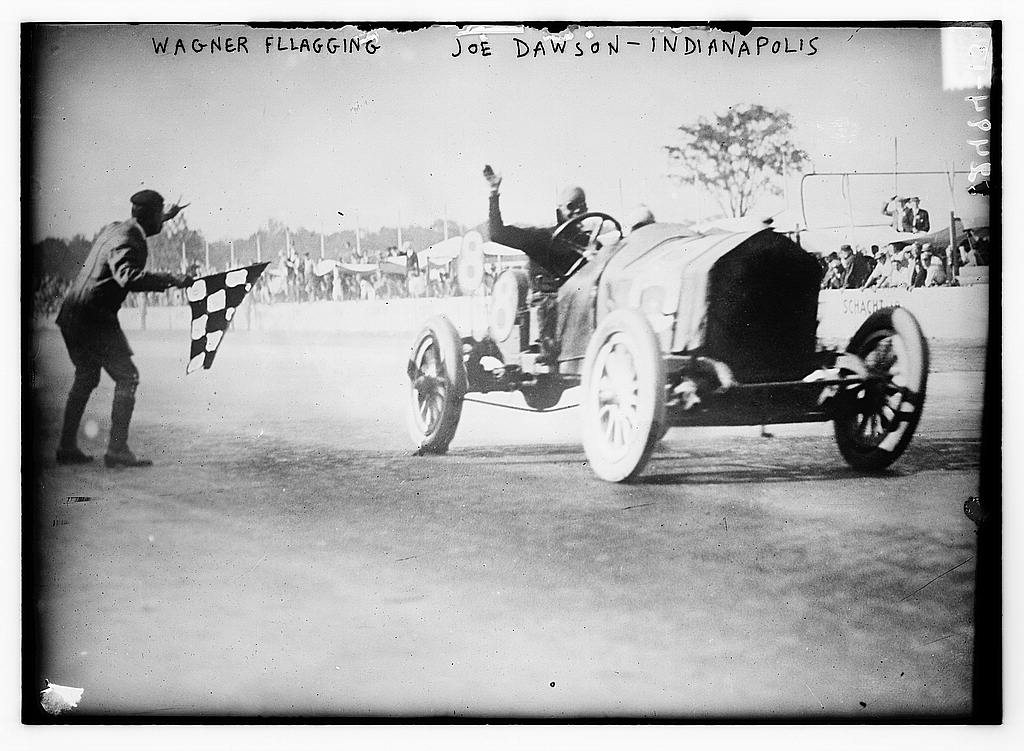
Photo shows Joe Dawson, winner of the 1912 Indianapolis 500 automobile race. (Source: Flickr Commons project, 2008 (LC)
While many early 20thcentury Americans held frugality and financial stewardship dear, they saw no inconsistency in their having an obsession with speed. Industrial America shaped auto racing and capitalist America cast the sport into a “Carnival of Speed.” To alleviate the risk to spectators and to ensure a paying audience, automobile racing transitioned from open road courses to closed tracks. This new phase was inaugurated in 1909, when the American Automobile Association took on organizational responsibility for the sport. At the same time, entrepreneur Carl Graham Fischer and partner James A. Allison had a 2.5-mile oval constructed 4 miles from downtown Indianapolis using crushed stone as a surface. Racing began at Indy in 1909, but the problem of thrown rocks and injured drivers and mechanics resulted in later paving the track with bricks.84In 1911 the first 500 mile race took place on Decoration (later Memorial) day, with driver Ray Harroun winning the inaugural race without a riding mechanic and using a rear view mirror.  

Drivers speed into the first turn on the Brickyard during the first Indianapolis 500 on May 30, 1911. The drivers, from left, are Will Jones (9) driving a Case; Joe Jagersberger (8) in a Case; and Louis Disbrow (5) in a Pope-Hartford.


 Photo shows driver Ralph DePalma and his riding mechanic, Rupert Jeffkins, pushing their car towards the finish line at the 1912 Indianapolis 500 automobile race. (Source: Flickr Commons project, 2008 (LC)

1912 --Photo shows Joe Dawson crossing the finish line as the winner of the Indianapolis 500 automobile race. (Source: Flickr Commons project, 2008) (LC)


1913 Indianapolis 500 (LC)


Photograph shows French race car driver Jules Goux (1885-1965) winning the Indianapolis 500 on May 30, 1913. (Source: Flickr Commons project, 2013) (LC)
Photo shows Georges Louis Frederic Boillot (1884-1916), a French Grand Prix motor racing driver sitting in a Peugot EX3, possibly ca. June 1914 when he set a new speed record at the Indianapolis 500. (Source: Flickr Commons project, 2011) (LC)

At the time critics were calling for an end to racing due to the high death toll. Even driver Barney Oldfield got into the debate, stating  “I was never famous until I went through the fence at St. Louis and killed two spectators. Promoters fell over one another to sign me up.” In addition to the major races sanctioned by the AAA, there were hundreds of other events held at state fairs and by “circus” barnstormers. Randall L. Hall characterized the early sport as one linked to manufacturers with the vague promise that the mayhem was somehow connected to technical progress, while in fact in reality it was a commercial spectacle.

Year            Winner                       Car                                Average Speed
1911             Ray Harroun             Marmon                           74.602
1912              Joe Dawson               National                          78.719
1913              Jules Goux                 Peugeot                           75.933
1914              Rene Thomas             Delage                            82.47
1915              Ralph DePalma         Mercedes                       89.84
1916               Dario Resta               Peugeot                          84.001
By 1913 with the entrance of three French Peugeots in the Indianapolis 500 field, the race became a battle of nations.85The French reigned supreme at Indianapolis between 1913 and 1916. But with World War I and the coming of the Duesenberg brothers and Harry Miller, the winds of racing supremacy between Europe and America soon shifted. In 1916 Miller rebuilt a Peugeot engine for driver Bob Burman, and in the process began designing and building power plants superior to the pre-war Peugeot twin cam, 4 valve per cylinder engines. Such was the transition that in 1921, driver Jimmy Murphy, piloting a Miller-powered Duesenberg, was the first American to win the French Grand Prix. Thus, at the opening of the Roaring Twenties, Americans not only made fast cars that were more than competitive on the world stage, they also made inexpensive cars for the masses, thanks to Henry Ford.

Photograph shows Belgian engineer, racecar driver and aviator Josef Christiaens (1879-1919) who competed at the Indianapolis 500 in 1914. (Source: Flickr Commons project, 2011) (LC)

         
Photograph shows French racecar driver and aviator René Thomas (1886-1975) who won the Indianapolis 500 in 1914 driving a Delage automobile. (Source: Flickr Commons project, 2011) (LC)


Photograph shows racecar driver Berna Eli "Barney" Oldfield (1878-1946), probably at the 1914 Indianapolis 500. (Source: Flickr Commons project, 2011 (LC)
Photograph shows Dario Resta (1882-1924), an Italian-British racecar driver who came in a close second at the 1915 Indianapolis 500. (Source: Flickr Commons project, 2013) (LC)
  • Photograph shows Ralph DePalma (1882-1956) who won the 1915 Indianapolis 500. (Source: Flickr Commons project, 2013) (LC)

The complexities of the Ford story reflect the inherent inconsistencies of American life itself. At times, history turned on the elusive factor of personality, and clearly strong personalities – including Henry Ford – made a difference. Yet, the success of the Model T was also the consequence of American social values, social structure, and geography. The Model T is ultimately integral to the twentieth century story of the common man, but the Model T is also about technology. The emergence of mass production at the Ford Motor Company represented the accumulation of techniques rooted in the nineteenth century, refined and focused with unprecedented power. When all these strands came together, however, what resulted was more than just wealth creation; the Machine Age transformed the habits and everyday lives of virtually every American. Whatever America was prior to 1908, it now was on a different pace, and with a different sense of space. 

Tuesday, January 1, 2019

AUTOMOBILE MAKE AND BREAK IGNITION -- Videos of how it worked!

Since I am now studying the history of early auto electrical systems, I wanted to understand what make and break ignition was all about. I found these videos on Youtube and they are excellent. The second in particular really demonstrates the workings. How clever these early inventors were! How can I say that I am an historian of the automobile without getting into this technology?

Anyway, look at these two and you will have significantly increased your knowledge concerning the early history of the automobile.


Start by going to this you tube video and then watch below.
https://youtu.be/egbCVxAKvX0